
Showing posts with label Christmas tree trends. Show all posts

Thursday, December 22, 2022

Reusing Christmas Trees for Any Skill Level

A woman in a blue puffy coat holding a spindly Christmas tree.

Whether you are a person that takes down their Christmas tree before New Year’s Eve or someone who waits until way into January, you still have to decide what to do with it once it’s stripped bare. If your tree is artificial you most likely just stuff it in the box, but real trees have to be disposed of somehow. There are a lot of ways to do this; some are easy, but others require tools and motivation. Here are some ideas based on just how much work you want to do.

- The Simplest Ways –

A sign saying Christmas Tree Recycling.
Recycle It - Most communities in the U.S. have some sort of tree recycling program and it’s usually available to both apartment dwellers and single-family homes. They usually offer curb-side pickup or some equally convenient way to get your tree to them. You really can’t get much easier than hauling your tree to the curb when you are taking out the mountain of packaging and other garbage that Christmas creates.

A man dragging a Christmas tree through the snow.

Leave It Outside
– If you live where you can pull it off, just leave your tree in your yard or nearby fields or woods. Natural Christmas trees are 100% biodegradable, and the soil will appreciate the donation of organic matter. Shelter can be hard to come by in winter, so all types of animals and will appreciate the added protection the tree offers. Additionally, both insects and animals will feed on the tree. You should only dispose of a tree this way if it is chemical-free and everything artificial has been removed, down to the last bit of tinsel. If you are leaving it anywhere but your own property, be sure there are no regulations prohibiting it and that you are not trespassing on someone else’s property. 

Four young people gathered around an outdoor fire pit.
Add It To A Firepit – Some people may argue that this is not the best choice since burning them adds CO2  to their air. However, if you have regular fires at this time of year, one single tree will not increase your emissions in any significant manner. Never burn a tree in an indoor fireplace; they are an extreme fire hazard in many ways (more details here).

Chickens in the snow looking at a pine tree.
Give It To Your Chickens – Giving your Christmas tree to your chickens offers multiple benefits to them. Not only do they like the taste of pine, but it is a nutrient-rich snack. Additionally, having the tree in their run will provide hours of stimulation as they root around in it, which will also spread the refreshing smell of pine around. Goats also love pine, and it’s been shown to reduce intestinal worms and support overall digestive health for them (more here). So, when you go out to feed your animals,
drag your tree out with you. 

- A Little Work Is Needed –

Brown pine trees on a sand dune in the Outer Banks, North Carolina.
Use It’s Ashes - Wood ash is nutrient-rich, so after your tree is burned you can dig it out of the firepit and add its ashes to your garden. They can also be composted. 

Find A Place That Wants It – There are municipalities that use donated trees for projects like landscaping and erosion control. For instance, many seaside communities are using them to strengthen their sand dunes. There are also some zoos that take trees to give to their animals to eat or play with (see lions living it up with their trees, here) Do a little research to find what’s around you and who might want your tree.

A fark-haired woman wearing a Santa suit underwater decorating a Christmas tree.

Sink It In A Lake – Just as land animals would appreciate the shelter of the tree, overwintering fish will also. While this is as simple as tossing the tree in water, unless you have a pond on your land you will need to find a location that will allow this, and you will need to transport the tree to that site. As mentioned before, your tree will need to be chemical-free and completely bare before you dispose of it in water. 

Pine boughs in a wooden raised bed planter.
Put It On Your Beds – Break off some boughs and lay them over your  perennial beds. This will provide some insulation as well as a barrier protection from snow. It will also help reduce frost heaving. You don’t have to limit yourself to bedding areas, put them anywhere you feel could benefit from that extra layer.

Use It As Plant Stakes – Break off small branches, strip the bark and use them to support your plants. Since this is a super-adaptable process, this will work for everything from bushy small indoor plants to leggy seedlings. Look around and you may find another way that this break-and-support thing would work for you. 

           - You’ll Need Tools For These-

Several shiny ornaments with some pine branches on wood chips.
Chip It Up – Rent or borrow a woodchipper and feed your tree to it. You can use the resultant chips as mulch right away or save them until spring. Pine mulch will suppress weeds and add nutrients to the soil as it decomposes. The acidic nature of pine mulch makes it an excellent additive for acid-loving plants like blueberries, hydrangeas and potatoes.

Gnomes with white beards and red hats painted on sticks.
Make It Into Twig Gnomes – This is an exceptional tree disposal solution if you have small children. You’ll probably not be able to get rid of a whole tree by making twig gnomes, but you’ll have plenty to play with. And they couldn’t be easier to make : Cut off some branches, sand them down a little and add hats, beards and faces. The hats can be painted on or made with felt, fabric and cotton balls. Here’s how one lady makes them . 

Edge Things With It – If you strip off the branches and cut the trunk into disks (2” is a good size), you can set them in the soil as a border. This would be especially effective along flower beds, walkways and driveways.

Make It Feet – In much the same way as you’d make the edging, you can make pot feet for your outdoor container plants. Lifting outdoor plants off the ground helps reduce insect problems, improves drainage and air circulation around the pot and lessens the chance of staining your wood or concrete surfaces. Make them any size you want and make extra to hold onto and use when the originals deteriorate.
- Master Level Crafts –

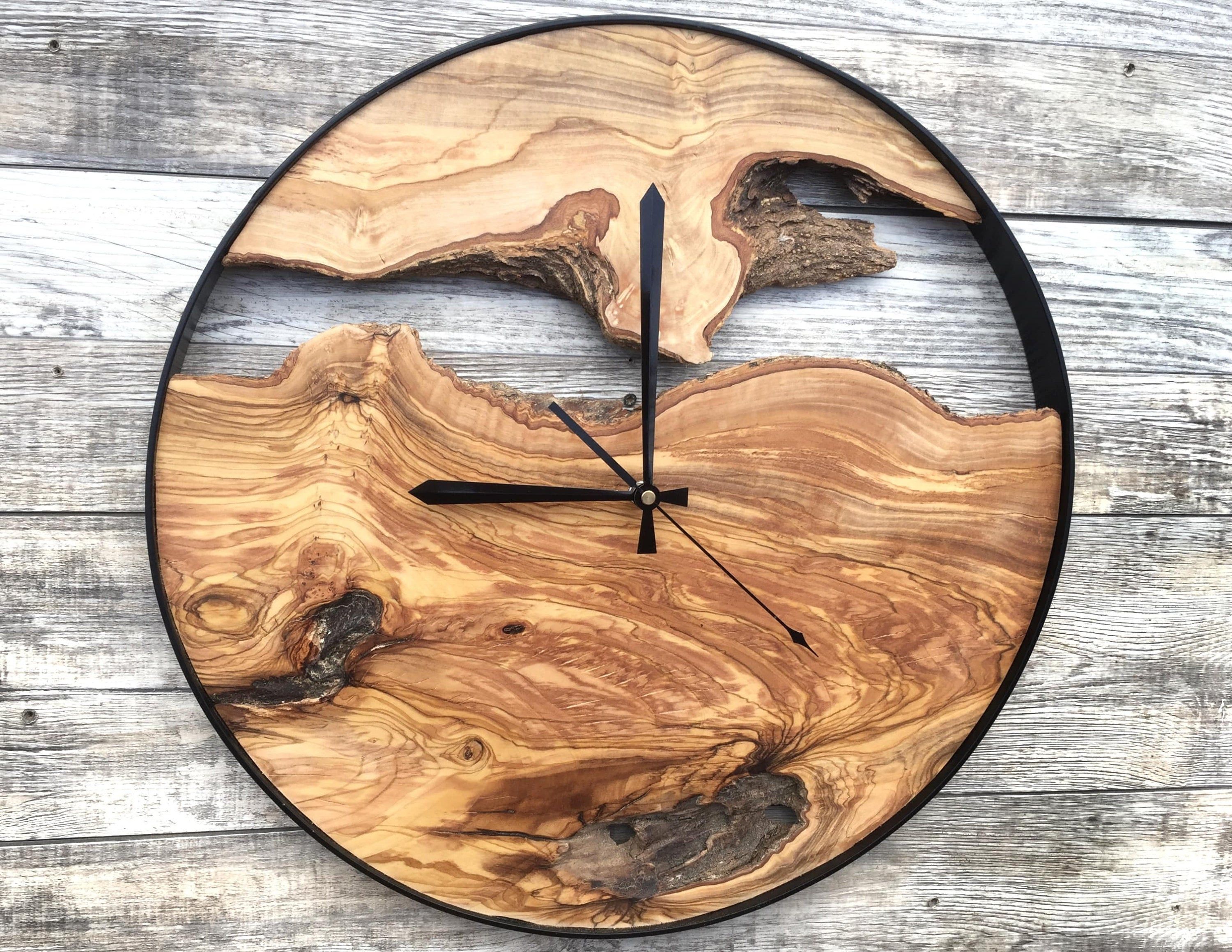
A modern woodern clock.
There are innumerable ways you can use your tree in crafts. At the end of the day, Christmas trees are wood, and one can make nearly anything from wood. These types of crafts can be pretty easy, like the ones I’ve talked about, but others require more tools, time and finesse than most of us have (i.e., clocks, musical instruments). This article has a lot of ideas and even gives instructions on how to prepare a tree to reuse.

No matter how you recycle your tree, remember to first enjoy it thoroughly in all its sparkly, shiny decorated beauty. Christmas with loved ones around the tree can be magical, and we all need a little magic in our lives.

A lion rolling around with a Christmas tree with snowlfake ornaments.

Happy Holidays!

Submitted by Pam


Friday, December 18, 2020

The Art of the Christmas Tree

Gold abstract drawings of Christmas trees on a black background.

To most people, Christmas decorations are a wonder to behold – the lights, color, and sparkle are simply enchanting. But, is it Art? I believe most people consider theirs to be a work of Art, but Christmas tree images are almost non-existent in the fine art world. Nevertheless, artistically-minded Christmas tree lovers have found ways to be creative and, at times controversial, in their tree creations. And their visions have made their way into the public sphere for all to enjoy or abhor. 

An illustration of an 1848 engraving showing the British royal family around their tree.
There is a very good reason why there aren’t depictions of Christmas trees that date many centuries in the past– the trees as we know them simply haven’t been around that long. The rise of the modern Christmas tree has been credited to Prince Albert, husband of Queen Victoria. He was German, and there they had been decorating evergreen trees since the 16th century. He introduced the tradition to England and, in 1848, an engraving of the royal family around their tree was widely published. Spurred on by the popularity of the Queen and the vastness of her empire at the time, the use of Christmas trees quickly spread worldwide. So, it was a piece of engraved art that was the catalyst for our current beloved trees.

An Art Deco style drawing of a woman in a coat with a large white fur collar standing by a Christmas tree.
Art Deco tree
Even though Christmas trees became increasingly fashionable, artwork depicting them remained mostly limited to kitschy greeting cards and advertisements for many decades. And then came the design explosion that was Art Deco in the 1920s. This was a radical shift from conventional ways of looking at fashion, housewares, architecture, and more. Sleekly modern stylized images were all the rage during this prosperous era. Glamorous people standing by abstract trees became a popular Christmas look. The glitz of Art Deco, however, soon wore off under the hardships of the Great Depression and World War II. Glam gave way to homespun images and all-out Americana as people longed for better times and optimism in the future waned. No one could portray these “All-American” values better than Norman Rockwell. In his lifetime (which spanned much of the 20th century), he painted thousands of images full of homespun humor and affection for the average citizen. They appeared on magazine covers, advertisements, and calendars – they were ubiquitous in pop culture. The world he portrayed might not have been familiar to many Americans, but it was at least aspirational. His Christmas-themed works are full of conventional trees and families, but he includes witty twists that can bring a smile.
Painting by Norman Rockwell showing a man sitting on a step ladder by a tree. He is entangled in Christmas lights.

Traditional tree images seemed to rule the day throughout the 1950s. Until 1959, is. That year, Hallmark cards (in a fit of high-brow optimism) commissioned the famous surrealist painter, Salvador Dali, to make some Christmas cards. When they came out in 1960, there was an audible outcry. It seems the public was not quite ready for his vision of a butterfly Christmas tree. Or comic camels. Or headless lute players. I, personally, like the butterfly tree. 

At the same time that Hallmark was managing its Dali situation, the aluminum tree came into the mainstream. I wrote about this tree’s brief heyday in my blog last week. I haven’t been able to find any artwork depicting this tree, aside from basic advertising renditions. It’s my belief that the best illustrations of these trees are in family photo albums.

A painting by Salvador Dali that shows a Christmas tree made of butterflies.
Dali butterfly tree
I'm going to fast-forward to the 1980s because this is when begin to take an interesting turn. For decades leading up to this time, Christmas decorations were all over private and public spaces. Whole neighborhoods lit up. Stores had elaborate displays inside and in their store windows on city promenades. Hotels were ablaze with lights and shiny decorations. Towns and cities, both urban and rural, had their community Christmas tree, and families came to ooh and ah as they were lit. But these were all usually very conventional decorations – heavy on the Christmas ornaments, snow (real or fake), maybe some reindeer or Santa (or even a Grinch or two), and lights, lights, lights. But, by the 80s, people began to take some risks in pursuit of something new for their Christmas installations. Instead of a standard tree, many places welcomed more conceptual Christmas decorations. 

A Christmas tree hanging in a green room. It has a beam of blue light projecting from its base.
In 1988, the world-renowned Tate Britain museum in arts-rich London decided to turn over their annual  Christmas tree display to a series of contemporary artists. In recent years, the artwork seems to have migrated outdoors, but for 23 uninterrupted years, Londoners were regaled with some mighty interesting trees. Or, more correctly, most of  those years there was some sort of tree – a couple of years the artists’ visions were of no tree at all. Here are pictures of every year. My choice for worst-dressed is 2006; Fairy genitals just don’t say “Christmas” to me. 

Whether the Tate Britain was an innovator or acting in response to a growing movement in the art community, I don’t know. But, since then alternative Christmas tree displays have spread around the world with spectacular results. Interestingly, hotels seem to have taken on the job of showcasing certain artists (like this one in London), while municipalities have embraced Christmas trees made of alternative materials and/or carrying specific messages. This, then, is where modern Christmas tree Art can be found. And, just like Hallmark’s Dali debacle, not all the efforts are appreciated. Back in 2014, artist Paul McCarthy unveiled his bright green, inflatable abstract Christmas tree in posh Plaza Vendome, Paris. Unfortunately (and, purposefully), it bore a striking resemblance to a very particular type of sex toy. The display only lasted two days. I’m not positive, but I’m pretty sure some Parisians are still upset about it. See it for yourself here.

An inflatable iridescent Christmas tree standing by some windows. There are lots of silver baubles hanging from the ceiling.Jack Irving tree 2019.
Jack Irving Christmas tree at the W London hotel

There are so many amazing examples of these Christmas tree installations that I cannot choose just a couple to direct you to, so I’m just going to provide a series of links for you to browse through at your leisure:

Now that we are firmly in the 21st century, it should come as no surprise that many of the modern tree designs are high tech art. Check out some here and here (this one includes a flying Christmas tree).

This article talks about a show in Boston last year by the modern artist Hyman Bloom. It combined Christmas tree paintings with those of corpses (not sure I follow that line of connectivity).

Here are some 2014 Christmas tree installations from around the world.

Santa dancing across a picture of a Christmas tree.
Here are some of the best from 2016.

And this is what they look like for 2020.

No matter where your artistic preferences lie, you can find something to like during the holiday season. And, at this time, when we are all ready to get this horrible year behind us, we need all the beauty (or whimsy) we can get. 

Happy Holidays and here’s to a better New Year.

Submitted by Pam


Tuesday, December 11, 2018

Turn Christmas On Its Head


A rustic, lodge-type room with a fire and candles burning and a hanging, upside-down Christmas tree
My blog from last week on colored Christmas trees got me going on unusual things that can be done with yuletide designs, trees in particular. Which led
me immediately to the
A blue-decorated upside-down Christmas tree in the lobby of an elegant hotel with black and white flooring
Claridge's, London 2017
Upside-down Christmas tree decorated in white and shades of blueupside-down tree. This trend has reared its controversial head in our country in recent years, but it has been around for a while in Europe. It dates back to sometime in the Middle Ages, although exact dates are up for debate. At that time, its shape was seen as a way to represent Christ’s cross or the Holy Trinity. Interestingly enough, many people today believe that the pointy end of the tree points to Heaven, thus making this the proper placement for religious significance.

The upside-down display became popular in retail settings in the 19th century. It was seen as a great way to present ornaments at eye level and to free up floor space. Upside down trees are especially popular in hotels and retail spaces today for these same reasons.
An upside-down Christmas tree hanging in the stairwell of a home

Besides commercial properties, who is this for?
- Fans of Stranger Things on Netflix who are already comfortable with the Upside Down
 - Someone who is simply bored with the traditional
 - Apartment and other small-space dwellers
An upside-down Christmas tree on a red, pink and green stand with elf legs sticking out of the top - Parents with small children who want to keep those little hands off  the tree (you could even place a platform above the tree to put presents on)
A small Christmas tree decoration hung upside-down on a wall
Wall tree
 - Someone who needs plenty of room to put lots and lots of presents under the tree

 - People with mischeivious and/or naughty little pets
 - Someone who wants to get their friends and family talking
A Christmas decoration of a small white upside-down Christmas tree on a red background complimented by white candlesNot quite ready to commit to a full-on upside-down tree? Here are some options:
A tree design made from bare branches and glass balls- Hang a small artificial tree over a table for a centerpiece that leaves plenty of room for the food on the table.
- Cut a small tree in half, hang the pointy end and create a Christmas chandelier. Use the remaining branches as garland around the room.
 - Cut the very tip off a tree (or fashion one with wire and branches ) and hang it on a wall.
 - Create an abstract tree from whatever strikes your fancy.

Beautifully decorated upside-down Christmas tree standing between a white chair and a fireplace in a white paneled room

Upside down trees can be bought complete with a stand, so you can just place them on the floor, or you can hang them yourself (here are some pointers on that). Naturally, it will be easiest if you have an existing ceiling feature that can handle the
Upside-down presents!
weight. There is speculation that the reason the upside-down tree fell out of favor in the past is that plastered ceilings replaced rafters in most homes.

Unless you are working with an upside-down tree that sits on the floor, when decorating your tree the weight of your decorations should be carefully considered. Think ribbons, twinkly fairy lights, lightweight plastic and lots of tinsel.

Go big, go small, hang them from the ceiling, hang them on a wall – you are only limited by your creativity when it comes to upside-down Christmas trees.

Submitted by Pam

Featured Post

IT'S EARTH DAY 2026!

Happy Earth Day from ARBICO Organics! This year we'd like to introduce you to our newest local non-profit partner - Mission Garden. Loca...