Showing posts with label insect mating rituals. Show all posts

Wednesday, September 8, 2021

What’s This Bug? The Jerusalem Cricket.

A fine example of a Jerusalem Cricket
This intimidating-looking insect is the Jerusalem Cricket (Stenopelmatus spp), and it is in no way as fearsome as it looks. They are native to North and Central America and it is estimated that there are more than 100 species, with 60-80 just in California. They are often found in sandbars and under rocks and logs, but with such a widespread distribution throughout so many different ecosystems, they can be hiding most anywhere. As common as the Jerusalem Cricket is, it’s still unfamiliar to a lot of people. This is mainly because they live most of their lives out of sight underground and are solitary creatures who do not live in large communities. If you run into one, it will most likely be at night, when they venture out looking for food, a mate, or a new place to bed down. If you see one during the day, it has most likely gotten trapped somehow and has been unable to return to its out-of-sight lair. 
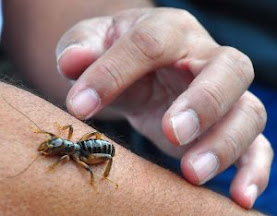
A hand reaching for a Jerusalem Cricket on someone's arm.
Jerusalem Crickets are in no way a threat to people, they’re non-venomous and usually docile. Those big, scary-looking mandibles protruding in front of them are for chewing through dirt and roots, not for biting people. However, if they feel threatened they can emit a foul smell and are capable of doling out a nice little bite. Such a bite is usually a response to being carelessly or overly handled. They are much more likely to play dead than bite when caught.

If you are still not too sure about these guys, consider the fact that they’re beneficial insects. They are omnivorous and feed on decaying organic matter in the soil, other insects and some tubers and roots. Since they are slow moving and cannot fly, Jerusalem Crickets are not out there aggressively hunting other insects as a predator would, they are instead scavenging dead or injured insects that they come across as they hop-walk around. This keeps the area they’re in above the surface tidy. And as they munch and move around underground, it keeps the soil healthy and aerated. All in all, they are beneficial to the environment and should be viewed as helpers, not as something to be stomped out – no matter how frightening they look. 

A closeup of a Jerusalem Cricket face. Does it look like a baby's face to you?
This creature wins my award for the insect with most names. Just some of the names are Potato Bug, Child of the Earth (Niño de la Tierra”), Devil’s Baby, Earth Baby, Qalatötö (“Shiny Bug” in Hopi), Ćićin lici (“Red Skull” in Navajo), Skull Insect, Sand Cricket and Stone Cricket. A great many people seem to think their heads look like human babies or old men and some of the names have evolved from that, but I personally can’t see that and think it’s a little creepy. Additionally, how it came to be commonly known as the Jerusalem Cricket has spawned as many theories as there are names for this insect. This article gives one short version. 

A Jerusalem Cricket in the dirt.
Jerusalem Crickets don’t make the familiar chirping sound that we all know; but they do make noise with their hind legs. When disturbed they will rub them together and emit a sound that is more of a hiss than a chirp. A far more impressive noise that they create is the drumming sounds they use as mating calls. These sounds are quite loud and are the result of them drumming their abdomens against the ground. This drumming can not only audibly draw in a mate, can also be felt as vibrations in the ground. Unlike many other creatures, where the male tries to impress the female, both genders of Jerusalem Crickets send out these signals.  As they each zero in on the other’s signal, the male and female begin a duet that allows them to find each other in their usually solitary and dark world. Each species of Jerusalem Cricket has a distinct drum sound that it uses, which assures that they find the proper mate. Jerusalem Cricket species are hard to distinguish by simple visual assessments, so scientists have been using these unique drumming sounds to differentiate between species and identify new ones. With this technique, the number of species identified  has been growing steadily. Check out this video to see and hear their drumming. 
A Jerusalem Cricket head morphing into a baby.

If you run across one of these interesting insects, be gentle with it and send it on its way peacefully.

Take Care.                                                        

Submitted by Pam


Tuesday, August 3, 2021

What’s This Bug? The Scorpionfly.

Male Scorpionfly
Male Scorpionfly
Insects are masters of illusion and the Scorpionfly (Order: Mecoptera) is an excellent example of this. This bug may look like a devilish mashup of a scorpion and a wasp that could seriously hurt you, but it’s so not that.  It’s none of those things and, in fact, is completely harmless. Scorpionflies cannot sting and do not bite. And that large stinger-looking thing? It’s actually the oversized genitalia of the male.  Now you’re looking at this insect completely differently, aren’t you?

Female Scorpionfly
Female Scorpionfly

Scorpionflies are not actually flies, but they are nearly as common with more than 500 species in five families worldwide. Of those, 68 species are in North America. One or another of this large family can be found in all kinds of habitats – there are even Snow Scorpionflies. Despite being nearly everywhere, scorpionflies are not familiar to most people. This may be due to their small size (½” to 1” in length), or to their lowkey lifestyle. Scorpionflies are generally scavengers and feed on dead or dying insects (although they take a sip of nectar on occasion); but, there some species that prey on easy pickings, like wounded or slow-moving insects. Scorpionflies are also said to steal bugs from spider webs, but this behavior is probably as brazen as these little guys get. For the most part, they hang around (literally, they hang) on leaves and branches until they have an opportunity to feed.  

An artist's vision of the Permian Period with various plants and animals.
The Permian Period
Scorpionflies claimed their place on our planet a very long time ago and have carried on ever since. They developed during the Permian Period 250-300 million years ago. This was a time of great climate change and mass extinctions due to intense volcanic activity. These insects persisted, however, and changed very little between ancient and modern times. They are believed to be the ancestors of flies, butterflies and dragonflies. This time period also saw the rise of the cockroach, an insect that most people probably wish had not survived the volcanoes. 

So, what about that big “tail”? Like other male creatures with flashy parts, it’s used in courtship display. They wave it around while emitting pheromones to get the attention of females. But he has to have more than a big tail to win the female over; he needs to offer her a nuptial gift. These gifts are either dead insects or a saliva ball that, if she accepts him, she’ll feed on while copulating. Just in case she changes her mind, he has claspers on his huge appendage that keep ahold of her. And if she goes through her food gift too fast, he will hack up another saliva ball for her to eat. These methods to subdue and placate her are necessary as the females have been known to eat their suitors. 

A male scorpionfly feeding off a spider's web.
A Spiderweb Buffet
Another probable reason for such an ostentatious tail-end is Batesian mimicry. This is when a defenseless animal takes on the characteristics of more threatening creatures. In the case of the scorpionfly, their black, yellow and orange coloring is similar to a wasp. When you add the stinger-like appendage, you have a harmless animal that looks like a dangerous scorpion-wasp hybrid. This is an excellent strategy to keep predators (and some humans) away. But is also causes witless humans to kill something peaceful for looking like something else. 

Real footage of a volcano in Iceland.
Scorpionflies active and doing their part to clean up organic matter from May through September, so keep an eye out for these little guys. Be gentle with them, though; they’re survivors but also very delicate.

Submitted by Pam


Featured Post

IT'S EARTH DAY 2026!

Happy Earth Day from ARBICO Organics! This year we'd like to introduce you to our newest local non-profit partner - Mission Garden. Loca...