Showing posts with label white plants. Show all posts

Wednesday, October 19, 2022

5 Ghostly Plants

Since plants are corporeal beings, there is nothing inherently ghostly about them in reality. These plants gain the ghostly title by virtue of their spectral foliage and/or reclusive growing habits.

- Ghost Orchid-
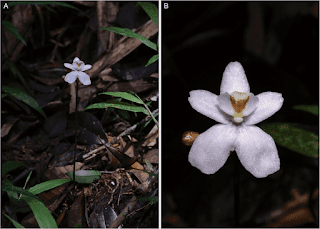
On the left, a Ghost Orchid in its habitat and on the right is a close-up of the same flower. Photos by John Hermans.

(Didymoplexis stella-silva)  

In 2021, scientists named 205 new plant and fungal species around the world. Correct scientific naming is essential to protecting environments and endangered species. Providing a name begins the process of research, extinction risk assessment, and protections. In Madagascar, scientists from the Kew Madagascar Conservation Center named 16 species of orchids, including the Ghost Orchid (Didymoplexis stella-silva). Its name means “star of the forest” as this little flower grows in the near-complete darkness of the jungle floor and has star-like flowers. The fact that they even found this orchid is amazing. It is just a small flower and stem. It is leafless (so it has no chlorophyll for photosynthesis) and lives entirely via a symbiotic relationship with underground fungi. The flower only shows it itself for a brief 24 hours after a rain during which it is believed the orchid is pollinated by ants. In order for us to have this knowledge, those dedicated scientists from Kews would have had to put many, many hours in patient observation in that inhospitable jungle. Kudos to them.

- Philodendron Florida Ghost –

(Philodendron pedatum cv ‘Florida Ghost’) aka White Ghost 

A Florida Ghost showing the different colors its leaves can be.
Philodendrons have long been a favorite for houseplants as they are relatively vigorous growers and are easy to care for. This gorgeous plant is a philodendron hybrid created by combining Philodendron pedatum with Philodendron squamiferum. There are naturally many similarities between the parent plants and the Florida Ghost, but there are also some desirous differences. For instance, the Florida Ghost is more compact with tight leaf clusters and will grow well vertically on a supporting structure just until it reaches about eight feet (this article contains more comparisons). The Florida Ghost requires ample sun to retain the white hue to its leaves; without sufficient light the leaves will be a normal green. If you aren't sure if you have ample light, the same effect can be achieved with a grow light. If you have four-legged pets this might not be the one for you as it is toxic to cats and dogs. 

- Ghost Plant (succulent version) -

A Ghost Plant succulent growing amongst masonry and cascading down from it.
(Graptopetalum paraguayense) aka Mother of Pearl

This cold-hardy succulent makes an eye-catching addition to any home or landscape. It grows up to 1 foot tall and about 2-3 feet wide. In full sun the foliage turns a pinkish-yellow, but in partial shade it will acquire the blue-grey hue that gives it its name. In time, the stems will begin to cascade or spread along the ground and it will display little star-shaped yellow flowers. This succulent was first introduced to the U.S. in 1904 and at that time it was thought that it came from Paraguay in South America (this is how the paraguayense became part of its name). Over time, scientists have grown to understand that it is most likely from a place 5,000 miles away from Paraguay - Chihuahua, Mexico. I state that it is “most likely” from Mexico because there is still a surprising lack of clarity as to its origins and what is known has been extrapolated from what is known of the plant itself. This article has more on this interesting botanical mystery. 

- Ghostly Manzanita -

A bee on the white flowers of the Ghostly Manzanita.
(Arctostaphylos silvicola ) aka Bonny Doon Manzanita, Santa Cruz Manzanita, Silverleaf Manzanita

This rare shrub is a native of California, where it lives in ancient sand dunes in the Santa Cruz mountains. This plant is quite beautiful with its silver-grey leaves, deep red bark and bell-shaped flowers that look like the Lily of the Valley. These sweet flowers can bloom in both winter and spring and are beloved by pollinators. In the right circumstances, the Ghostly Manzanita can grow up to 8-20 feet tall and spread out just as wide,  but it is struggling in its native environment. Due to the very limited geographic locations where it grows, and threats from sand mining, this Californian treasure is considered threatened and/or endangered. Any loss of naturally-growing plant life is tragic, but this plant should survive in the long-run as it has become a popular landscape choice.

- Ghost Plant (perennial version) –

Ghosts plants rising from a verdant forest floor nest to a moss-covered log.

(Monotropa uniflora) aka Indian Pipe, Corpse Plant, Death Flower, Ghost Flower

This is arguably the best-known of the five plants on this list. It is similar to the Ghost Orchid in that it lives deep in dark forests, has no chlorophyll and survives off the mycorrhizal fungi in the soil. However, it differs from the wisp that is the orchid by its much-longer and more complex life cycle (learn more on that here). Although this smallish plant (4-10 inches) is found in most of its native North America, it is largely unseen due to reclusive growing practices. But if you look down in a dark forest by an old log, you may stumble across one. Beginning in early summer and until early autumn, it produces hanging ghostly white, translucent blooms, each on a single stem. As it matures the white will fade into a non-descript brown, but it will retain its upright posture. There is something about this plant that has lent itself to folklore and artistic contemplation. Native Americans used it medicinally and the famous American poet Emily Dickinson (1830-1886) wrote lovingly about it. 

A gif of the four original Ghostbusters.
Plants are spectacular in general, but I love a plant that is unique. If it has a bit of mystery, even better. These five provide some of all that.

Happy Halloween, everyone!

Submitted by Pam 


Friday, August 21, 2020

The Black and White of Indoor Plants

Black and white translucent flower heads. Photo by Matthew Schwartz on Unsplash.
Some of us are very color-conscious and need to have the colors in our home match, or at least reside harmoniously together. So, why not incorporate your plants into your color scheme? The fun will be in the challenge to find and nurture the beauties that will be the perfect enhancement to your space. If you are a green-lover, congratulations – you have all the choices in the world. Reds, purples and other colors are also well represented. But for those that want something less run-of-the-mill, I’d like to offer some ideas and suggestions on the most basic of neutrals - black and white.

BLACK: Plants in this hue are highly in demand for trendy Goth Gardens. These outdoor gardens amp up the spooky factor with black plants or plants with ominous names or histories. They often contain decorative pieces that continue the dark theme (here is one celebrity’s cool Goth Garden). You may not want to go all Goth, but decorating with black plants can be an elegant way to add a time-honored neutral to your décor. When choosing a black plant, you should be aware that not all of them start or stay black and that many need specific conditions to maintain their color. Just do your research and pick carefully and you will be rewarded with beguiling black beauties.

A Zamioculcas Zamifolia Raven plant in an orange pot with a ceramic rabbit sitting next to it.
ZAMIOCULCAS ZAMIIFOLIA “RAVEN” - aka Raven ZZ. This plant is so easy to grow that some people claim it’s virtually impossible to kill. Be that as it may, this African native is definitely undemanding. It can survive quite well in very low light, really thrives when placed near direct sunlight, and is okay with irregular watering. Lighting does not affect the colors of this plant, the darkness of its glossy leaves increases over time from bright green to deep violet-black. Learn more here and watch a video here.
SINOCRASSULA YUNNANENIS aka Chinese Jade in a beige pot.
SINOCRASSULA YUNNANENIS – aka Chinese Jade.  This perennial rosette succulent originated in the Yunnan province of China. It grows up to 4” in diameter and has densely packed, very dark green (close to black) leaves. If possible, put this beauty in full sun - it likes the warmth and the light helps it keep its darkest shade. For more on how to get the most from your Chinese Jade, read this and watch this short video.

A close up of the dark leaves of a BLACK PATENT LEATHER COLEUS – aka Shiny Shoes BLACK PATENT LEATHER COLEUS – aka Shiny Shoes – Most people are familiar with the coleus as a houseplant, but this variety has a special look. A native of Southeast Asia, this upright plant grows to about 18” x 18” and does little to no flowering –it’s all about the leaves. They have a shiny, bubbly texture and ruffled edges and are all-together delightful. Unlike some black plants, this one holds its color in the shade. There are several varieties of black coleus, some of which are hard to come by; so, if the one you want is not available, give another one a try. They are all beautiful. Here is a helpful article on growing coleus indoors.
A OPHIOPOGON PLANISCAPUS “NIGRESCENS” – aka Black Mondo Grass plant in a beige pot. There are berries on it.

 OPHIOPOGON PLANISCAPUS “NIGRESCENS” – aka Black Mondo Grass, Black Lilyturf, Black Dragon, Ebony Night, and more. If you’d like a change from run-of-the-mill houseplants, this flashy perennial from Japan really brings the drama. Black Mondo Grass sports dense, slender and long (8”-12”) leaves that arch gracefully out in all directions. This plant has traditionally been used as a groundcover in landscaping, but there’s no reason it can’t move indoors (here’s more on that). You can enjoy its foliage year-round, its small pale-pink flowers in the summer, and its glossy berries in the fall.

A COLOCASIA ESCULENTA “BLACK MAGIC” – aka Black Elephant Ear in a black pot on a green surface.
COLOCASIA ESCULENTA “BLACK MAGIC” – aka Black Elephant Ear, Taro, Taro Black Magic, Elephant Ears Black Magic. This beast of a plant can grow 3-6’ tall and produce leaves as long as 2’. Plants in both the Alocasia and Colocasia families are known as Elephant Ears; one difference is that the leaves of the Alocasia point up and the leaves of the Colocasia hang down. Elephant Ears are popular houseplants for their dramatic look and this variety will not disappoint - it will produce abundant, gorgeous deep purple/black leaves. Keep in mind that this plant grows from a bulb and may go dormant in winter. For more on growing this plant indoors, check out this article and for some more quick info, watch this video.

WHITE: 
Attempting an all-white houseplant theme may be surprisingly challenging. The reason is pretty simple - most plants have green stems and/or foliage (at least at some stage). So, when searching for white plants, you will soon find yourself looking mostly at plants with white flowers. Of course, there are some exceptions (with Nature there always is); check out the White-stemmed Bramble (which looks more grey to me) and the Ghost Plant. With such a paucity of truly white plants, I’ve expanded my white selections below to include a couple of silver (again, some may call them grey) choices. As far as white-flowered plants go, I’ll leave it to you to sort through the many thousands to find the ones that suit you, should you go that route.

A close-up of the furry leaves of the SRACHYS BYZANTINA – aka Lamb’s Ear plant.
SRACHYS BYZANTINA – aka Lamb’s Ear – This pretty perennial has silvery leaves that are as soft and fuzzy as a lamb’s ear, and somewhat the same shape. These captivating leaves are what most people like about this plant, but in the summertime, it produces a tall flower spike with little purple blossoms that is equally interesting. Lamb’s Ear is usually used as a ground cover because it likes to spread, but it can be grown indoors if it’s given the proper conditions. Read more about how to grow this here.

A WHITE CALADIUM plant in a stand next to a blue chair.CALADIUMS– aka White Queen Caladium, Moonlight Caladium, Caladium Florida Moonlight, Angel Wings Caladium, and many more. These tropical perennials, with their elaborately mottled and almost translucent leaves, are real show-stoppers and with their nearly-endless varieties, there is something for every taste. Despite their huge popularity, these plants are not easy to keep healthy and are seasonal, so you will only get the foliage from spring to autumn. They grow from a tuber, however, so when winter approaches you can store the tubers and begin again the following spring. Here’s an article on how to grow them indoors and here's a video you may find interesting.
A HELICHRYSUM PETIOLARE – aka Licorice Plant in a black pot.
HELICHRYSUM PETIOLARE – aka Licorice Plant, Trailing Dusty Miller, Silver Bush. This is a small (9”-12”) perennial that prefers to grow out rather than up. The small, roundish leaves are plentiful and covered with soft grey hairs that shine with an iridescent glow. This plant is not the edible type of licorice, but it has a delicious fragrance nonetheless. There are several varieties of licorice with varying degrees of silver-shine; take your time and pick the one that is right for you. Here’s more on how to grow this in containers.


WHITE PAMPAS GRASS in a black pot with 2 ceramic owls sitting next to it.MONEY PLANT aka Lunaria Silver Dollar dried seed pods in a white vase.A fun option to add white to any room without bringing in a plant itself is to bring in some dried accent pieces. You could go with White Pampas Grass - it is absolutely stunning. However, it can grow very tall (10’-13’), so it's not practical for most indoor settings. But, if you have a place to grow it on the patio or in the yard, you could harvest and dry the plumes for indoor decorations. According to this article, White Pampas Grass is the newest Instagram craze. (Here is more on how to grow them in containers.) Another fabulous option is the Money Plant (aka Lunaria Silver Dollar), these biennials have beautiful magenta flowers, but they are coveted for their silvery, translucent, coin-shaped dried seed pods. You can enjoy all stages of this outside plant and then bring the pods indoors to add glamour to your fall and winter décor.

Morticia Adams from the Addams Family show cutting off white rose heads.I hope this gets you thinking about some of the endless possibilities of using plants as a basis for interior design and that you will find your way to your own uniquely beautiful decor.

Submitted by Pam

Featured Post

IT'S EARTH DAY 2026!

Happy Earth Day from ARBICO Organics! This year we'd like to introduce you to our newest local non-profit partner - Mission Garden. Loca...