Showing posts with label Aluminum Christmas trees. Show all posts

Monday, December 20, 2021

Have Yourself A Nostalgic Little Christmas

A Santa dressed in blue holding a white kitten. He is in the foreground, out of focus yellow lights are in the background.
According to people who keep track of these sorts of things, a big trend this Christmas is nostalgia.
Decorating and celebrating in retro ways seems to offer the modern reveler some comfort in the storm of current events. What better way to escape the inflation, social upheaval and pandemic that has colored all our lives than by retreating into an imagined time of good old days? In this blog, I have put together a smattering of Christmas joy ideas from the 1950s and 60s. I’ve chosen those decades because, frankly, I think they’re the most fun to replicate. It may be late in the season to do all this, but maybe do it next year, or pick a few
elements to embrace. 

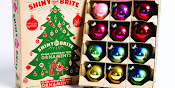
A box of Shiny Bright ornaments, the original glass ornaments.
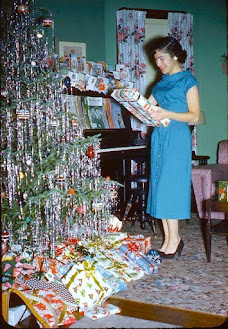
A photo from the 50s - it shows a woman in a blue dress and black heels in front of a heavily itself tree with lots of presents under it.
The Tree - You’ll need to get the tree right for a proper vintage Christmas. You’ll want  plenty of brightly colored glass ornaments (maybe even some bubble lights), and you’ll want to make some popcorn or paper chain garlands. If you can swing a toy train to put under the tree, that would be ideal. And of course, a must-have is tinsel – and gobs of it. Unfortunately, the modern tinsel made of mylar doesn’t drape as well as the old-school kind that was made of lead. They outlawed that stuff back in 1972. You could go for an aluminum tree; their heyday was from the very end of the 50’s until the mid-60s  (see my blog from last year for their story). If you go with the metal tree, you may as well commit to a color wheel as well (also super-fun).

Décor -  Artificial snow spray was patented in 1953, and it was a big hit immediately.  After you spray some of this all over your tree, give you windows a good coating.. A word of warning, though: That stuff can be hard to get off surfaces. 
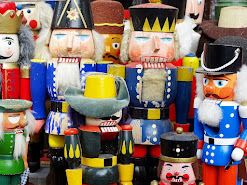
Many different types of nutcrackers.
Nutcrackers became a Christmas thing during the 50s. You could add one to your table or put it under the tree with the train, but really they can be as little or as big as you like and go almost anywhere. 

Although people don’t send out Christmas cards like they used to, you should prominently display any that you get. 

Rudolph the Red-Nosed Reindeer first aired in 1964, so that little reindeer was very much a part of pop culture at the time. Any decorations that he's a part of are good.
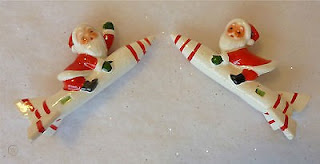
Santas on rockets vintage ornaments
Starting in the late 50s, the US and Soviet Union were in a Space Race that culminating with the moon landing in 1969. Anything that was outer space or astronaut themed was popular and this was when science fiction came into its own as an entertainment genre. So, add anything space-y to your theme to tap into the excitement that all the new science brought. Here’s an article on how to go full Space Age on Christmas.

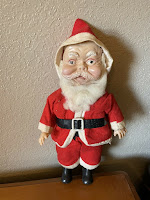
A Santa doll with a thousand-yard stare
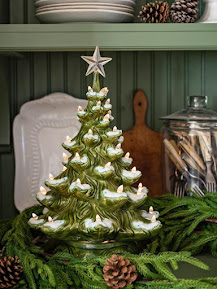
Santas, you need Santas. Santa ornaments, tabletop Santas, Santa door-hangings, Santa linens, Santa dolls – all kinds of Santas were popular throughout the 50s and 60s. And some of them were pretty creepy. For more Santa decor (some creepy, some not), check these out.A tabletop plug-in ceramic Christmas tree.

Kitsch is king in vintage decorations, so you have a great deal of leeway in choosing. Think rocking horses, Christmas villages, wreaths, tree toppers and wall hangings. All of these are available retro-style, extra-cheesy optional. Here’s some examples.

Food - If you choose to do an authentic mid-century Christmas, you should commit to mid-century tastes. So, out with the paleo or keto routine and in with relish trays, Christmas cookies,  elaborate cakes and even more elaborate appetizers, Jell-O molds and creamed onions. Or maybe not – here’s some menus to get inspired by. And don't forget the nut tray - it's the perfect accessory to your nutcracker because back in the day people would actually use them to crack nuts.
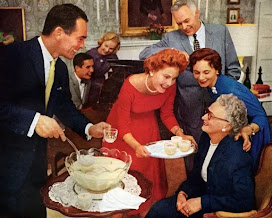
A Christmas gathering where they are offering eggnog from a punch bowl to the grandma.

Drink - I don’t want to portray everyone as drinkers in the 50s and 60s, but the culture of cocktails was strong. Cocktail parties and boozy poker nights were common, so a proper host or hostess had a well-stocked bar. But no IPAs or flavored vodkas – we’re talking scotch, vermouth and gin. And whatever it is they need to make a Pink Gin Fizz. And there was eggnog, of course. This was a special favorite of those that “only drank on Christmas”. Holiday punch (spiked or not) was also popular. Here are some excellent cocktail suggestions that would be right at home at any mid-century gathering. 

Dress Code -  After you’ve dolled up your tree and house, get yourself all fancy. In the 50s, one always dressed up for Christmas. So, gentlemen get the tie out and ladies, put your heels on (I think you can skip the girdle, though).
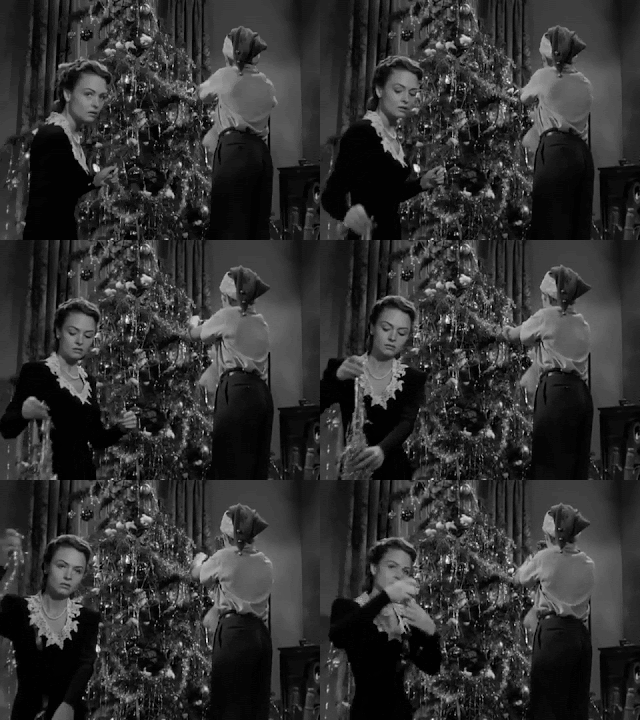
In a scene from It's A Wonderful Life, Donna Reed and one of the children are putting tinsel on a tree.

Music - Although it should go without saying, I'm saying it anyway - no retro Christmas would be complete without a soundtrack of  great mid-century Christmas crooners. Bing Crosby, Eartha Kitt, Perry Como and Dean Martin are some of my favorites but there is an abundance of goodness in Christmas music of the era.


Happy Holidays!

Submitted by Pam


Wednesday, December 9, 2020

The Tree Cut Down By a Cartoon

Closeup of red and gold ornaments on a silver aluminum tree.
If you think politics are polarizing, try asking a group of people how they feel about aluminum Christmas trees. Whether you like their kitsch factor or find them an abomination, there is no denying that their shimmering sheen is a sight to behold. Aesthetics aside, their place in American culture and their ultimate demise are as interesting as the reflective light patterns they create.

To explain the aluminum tree phenomenon, it is important to look back at where we were in the late 1950s and early 1960s. This was a time of prosperity for most Americans and a time when people were actively looking to the future with enthusiasm. The possibilities must have seemed endlessly golden for the adults at that time. These were people who had made it through the Great Depression, World War II, and the Korean War, and they were ready for something new to look forward to. Combine that attitude with the economic security of well-paying jobs and emerging technologies from the space program, and the market for gadgets and gimmicks was well set. The American people were excited about the prospect of space exploration and wanted to be a part of this new world in some small way. So, they bought Tang and Teflon pans and Christmas trees that looked like something the Jetsons would have. 

Reproduction of an ad for Evergleam trees from Aluminum Specialty Products.
Cultural shifts often have humble beginnings (Microsoft began in a garage, after all), and for the aluminum tree we all think of, the beginning was in the small city of Manitowoc, Wisconsin. For any number of reasons, Manitowoc had been a center of aluminum production since the late 1800s. The factories there provided good incomes for thousands of residents, and by mid-century, there were many new aluminum products on the market to keep them busy. Then, in late 1958, an employee of Aluminum Specialty Company in Manitowoc saw an aluminum tree that another company had created. But that tree was expensive and hard to assemble, so it wasn’t selling. Seeing an opportunity, the dedicated employee took the tree to the engineers at Aluminum Specialty. Within a few months, they had designed an affordable, portable tree that was easy to assemble. By Christmas 1959, the Evergleam model was rolling out and selling big. The innovative employee’s name has been lost to time, but hopefully, he was rewarded handsomely for his vision.

Young woman sitting by an aluminum tree with lots of presents and a color wheel under it.
Aluminum trees quickly caught the collective imagination and they catapulted into mainstream Christmas. But, a hiccup soon developed – it was downright dangerous to put lights on them. Aluminum is an excellent conductor of electricity, so all it takes is a faulty wire or bulb to charge the tree. Fires, shocks, and even electrocution can result. The solution was the now-iconic color wheel that projects color onto the tree; it was introduced in 1962. That same year, rotating stands were also unveiled (later models even played music). Different manufacturers and varieties in sizes, colors, and adornments appeared. The tree was a bonafide hit and in the early ‘60s every hip household had one – the future looked shiny for the aluminum tree.

An aluminum tree lying in the middle of a room. There is a television, folding tray tables and two very guilty-looking cats.
If one looks at the decade of the 1960s, the first half has a distinctly different flavor than the second half. What had been a time of optimism quickly became a time of dynamic cultural changes. The complacency of peacetime morphed into the horror of Vietnam. Fun fashions and music evolved into a counterculture that was fraught with drug use and social unrest. Environmental consciousness was awakened and put a shadow on the unrestrained consumerism of earlier years. All of this had an effect on aluminum tree sales, but it was Charlie Brown who dealt the final blow.

In 1965, A Charlie Brown Christmas was beamed into living rooms across the country. Charlie Brown (and other characters from Peanuts) had been loved by readers of Sunday comics since the late ’40s, but this was their first primetime special for the whole family. In the show, Lucy wants Charlie to buy a pink aluminum tree, but he chooses – and loves - his now-famous threadbare  but real tree. This was seen by many as an overt protest against crass consumerism and a rallying cry to embrace the real, and flawed, natural world. After the broadcast, aluminum tree sales quickly tapered off and then crashed significantly as Charlie Brown’s Christmas became an annual favorite. Aluminum Specialty Products had remained the leader in aluminum trees; but by 1969, they had ceased production of their glittering Evergleam trees. 

Charlie Brown and Linus are in a field of colorful trees and Linus is asking, "Gee - Do they still make wooden Christmas trees?".
Luckily, at the same time that aluminum trees were popular, cheap cameras and film were also available. This means that there is a delicious trove of photographs showing people by their trees. These images capture that short period of time in all its garish glory. Here, for instance, is a collection of every-one-is-better-than-the-next pictures. Some of these have a strangeness to them that is outright hilarious or definitely creepy. Or something else entirely that I cannot name. Enjoy.

A room with a real Christmas tree to the left rear next to fireplace and an aluminum tree in the right forefront"
As with everything deemed retro, aluminum trees are cool again. This has led to a batch of companies making new trees that look like the old kind, or new trees that are sort of like the old ones. And all the ornaments and accessories as well, of course. For people who aspire for the ambiance that only an aluminum tree provides, this is a great way to go. If, on the other hand, you are one who demands the real deal you had better be willing to pay a premium price. Vintage trees can cost hundreds and even thousands of dollars. If you are interested in either a true antique or reproduction, this blog has some useful buying tips and this one has some beautiful decorating ideas.

America may have had a short-lived infatuation with aluminum trees, but they have had a lasting effect on a lot of us. They elicit strong nostalgia in many people - they remember the sparkly trees they had or wished they had. Others associate them with a better time, or possibly of a not-better time that embraced the artificial. Some see them as a little of all that - like this man who retains vivid memories of his family tree. However you see them, they sure are an eyeful.
                                                                                                                
Take Care.
Submitted by Pam


Featured Post

5 Cool Things About Nematodes

It’s September, and here at ARBICO, it’s Beneficial Nematode season. Every year we put our Beneficial Nematodes on sale at this time to enc...