Showing posts with label Christmas in America. Show all posts

Wednesday, December 9, 2020

The Tree Cut Down By a Cartoon

Closeup of red and gold ornaments on a silver aluminum tree.
If you think politics are polarizing, try asking a group of people how they feel about aluminum Christmas trees. Whether you like their kitsch factor or find them an abomination, there is no denying that their shimmering sheen is a sight to behold. Aesthetics aside, their place in American culture and their ultimate demise are as interesting as the reflective light patterns they create.

To explain the aluminum tree phenomenon, it is important to look back at where we were in the late 1950s and early 1960s. This was a time of prosperity for most Americans and a time when people were actively looking to the future with enthusiasm. The possibilities must have seemed endlessly golden for the adults at that time. These were people who had made it through the Great Depression, World War II, and the Korean War, and they were ready for something new to look forward to. Combine that attitude with the economic security of well-paying jobs and emerging technologies from the space program, and the market for gadgets and gimmicks was well set. The American people were excited about the prospect of space exploration and wanted to be a part of this new world in some small way. So, they bought Tang and Teflon pans and Christmas trees that looked like something the Jetsons would have. 

Reproduction of an ad for Evergleam trees from Aluminum Specialty Products.
Cultural shifts often have humble beginnings (Microsoft began in a garage, after all), and for the aluminum tree we all think of, the beginning was in the small city of Manitowoc, Wisconsin. For any number of reasons, Manitowoc had been a center of aluminum production since the late 1800s. The factories there provided good incomes for thousands of residents, and by mid-century, there were many new aluminum products on the market to keep them busy. Then, in late 1958, an employee of Aluminum Specialty Company in Manitowoc saw an aluminum tree that another company had created. But that tree was expensive and hard to assemble, so it wasn’t selling. Seeing an opportunity, the dedicated employee took the tree to the engineers at Aluminum Specialty. Within a few months, they had designed an affordable, portable tree that was easy to assemble. By Christmas 1959, the Evergleam model was rolling out and selling big. The innovative employee’s name has been lost to time, but hopefully, he was rewarded handsomely for his vision.

Young woman sitting by an aluminum tree with lots of presents and a color wheel under it.
Aluminum trees quickly caught the collective imagination and they catapulted into mainstream Christmas. But, a hiccup soon developed – it was downright dangerous to put lights on them. Aluminum is an excellent conductor of electricity, so all it takes is a faulty wire or bulb to charge the tree. Fires, shocks, and even electrocution can result. The solution was the now-iconic color wheel that projects color onto the tree; it was introduced in 1962. That same year, rotating stands were also unveiled (later models even played music). Different manufacturers and varieties in sizes, colors, and adornments appeared. The tree was a bonafide hit and in the early ‘60s every hip household had one – the future looked shiny for the aluminum tree.

An aluminum tree lying in the middle of a room. There is a television, folding tray tables and two very guilty-looking cats.
If one looks at the decade of the 1960s, the first half has a distinctly different flavor than the second half. What had been a time of optimism quickly became a time of dynamic cultural changes. The complacency of peacetime morphed into the horror of Vietnam. Fun fashions and music evolved into a counterculture that was fraught with drug use and social unrest. Environmental consciousness was awakened and put a shadow on the unrestrained consumerism of earlier years. All of this had an effect on aluminum tree sales, but it was Charlie Brown who dealt the final blow.

In 1965, A Charlie Brown Christmas was beamed into living rooms across the country. Charlie Brown (and other characters from Peanuts) had been loved by readers of Sunday comics since the late ’40s, but this was their first primetime special for the whole family. In the show, Lucy wants Charlie to buy a pink aluminum tree, but he chooses – and loves - his now-famous threadbare  but real tree. This was seen by many as an overt protest against crass consumerism and a rallying cry to embrace the real, and flawed, natural world. After the broadcast, aluminum tree sales quickly tapered off and then crashed significantly as Charlie Brown’s Christmas became an annual favorite. Aluminum Specialty Products had remained the leader in aluminum trees; but by 1969, they had ceased production of their glittering Evergleam trees. 

Charlie Brown and Linus are in a field of colorful trees and Linus is asking, "Gee - Do they still make wooden Christmas trees?".
Luckily, at the same time that aluminum trees were popular, cheap cameras and film were also available. This means that there is a delicious trove of photographs showing people by their trees. These images capture that short period of time in all its garish glory. Here, for instance, is a collection of every-one-is-better-than-the-next pictures. Some of these have a strangeness to them that is outright hilarious or definitely creepy. Or something else entirely that I cannot name. Enjoy.

A room with a real Christmas tree to the left rear next to fireplace and an aluminum tree in the right forefront"
As with everything deemed retro, aluminum trees are cool again. This has led to a batch of companies making new trees that look like the old kind, or new trees that are sort of like the old ones. And all the ornaments and accessories as well, of course. For people who aspire for the ambiance that only an aluminum tree provides, this is a great way to go. If, on the other hand, you are one who demands the real deal you had better be willing to pay a premium price. Vintage trees can cost hundreds and even thousands of dollars. If you are interested in either a true antique or reproduction, this blog has some useful buying tips and this one has some beautiful decorating ideas.

America may have had a short-lived infatuation with aluminum trees, but they have had a lasting effect on a lot of us. They elicit strong nostalgia in many people - they remember the sparkly trees they had or wished they had. Others associate them with a better time, or possibly of a not-better time that embraced the artificial. Some see them as a little of all that - like this man who retains vivid memories of his family tree. However you see them, they sure are an eyeful.
                                                                                                                
Take Care.
Submitted by Pam


Friday, December 20, 2019

Merry Christmas, America!

Five clear ornaments filled with red, green and gold doodads.
Last year at this time, I wrote a blog about Christmas events around the world, so this time around  figured I’d explore closer to home and see what goes on in our country. What I found was, that when you remove the faith-based aspects of the season and other cultural celebrations (shout out to Kwanzaa), Christmas looks remarkably similar across the US. Everybody seems to like ornaments, Santa, Christmas trees and the general sparkle of the season. Where the differences lie are in the ethnic histories of communities, which makes sense in an immigrant country as diverse and multicultural as ours.

A green and white neon decoration, reflected in water, of Santa in a boat being pulled by gators.
In parts of Louisiana it’s not just Christmas, it’s Cajun Christmas. Cajuns are descendants of French Canadian Catholics who arrived in the area in the late 1700’s. The story of these people, known as Acadians, is (like many other settlers) one of religious and cultural persecution and exile (here is a short history). They settled in the bayous of Louisiana where they could live their own way and their ancestors continue that attitude to this day. Cajuns have their own very unique language, culture and traditions that pull from the ancestral French but are spiced up Cajun-style. And Christmas is no exception - in Cajun Country Santa is called Pere Noel and his reindeer and sleigh transform into alligators and a boat when they reach the bayous (and the alligators have names).  Along the levees, bonfires are set on Christmas Eve to help guide him along. These fires also light the way to Midnight Mass. Over the years, people have gotten creative with the size and shapes of these fires – here is a giant alligator being constructed for this year’s Christmas Eve.

Santa on a white and blue surfboard surfing a blue-green wave.
In our newest state, Hawaii, Christmas traditions are truly a cultural melting pot. For native Hawaiians, Christmas just happens to fall in the time period of their traditional observance of
Makahiki. This celebratory period between mid-November and late January-early February is meant to be a time to gather and pay tribute to leaders, harvest, rest and recreate. Christmas fits right into that. Many Americans became tuned into Hawaiian Christmas when Bing Crosby first sang Mele Kalikimaka(the phonetic version of “Merry Christmas” in native Hawaiian). Modern Hawaii has incorporated cultures from around the Pacific and their Christmas foods show it; sushi is as likely to be on the menu as poi. But, all in all, Christmas in Hawaii looks much like Christmas elsewhere – except that Santa is surfing, or wearing shorts, snowmen are sandmen and poinsettias are what’s blooming on those big trees in the backyard.
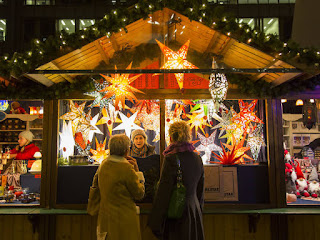
A brightly lit up stall in a market. Two women, with their backs to the camera, are talking to a woman in a booth. Christkindlmarket in Chicago, photo by Jaclyn Rivas
Christkindlmarket , Chicago, IL
Considering the huge number of Americans with German ancestry, it should come as no surprise that Christmas markets can be found across the US. Many, such as the Christkindlmarket in Chicago, reflect the large German populations within those areas; others are more fabricated and kitschy (but still fun). Having had the privilege of experiencing “real” Christmas markets in Germany, I highly recommend them in any form. Especially if they have mulled wine (Glühwein)! Here are of the best to be found.
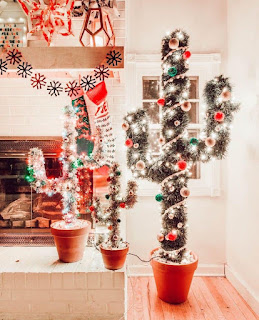
Three cacti in red pots lit up in white lights and colorful ornaments.Here in southern Arizona (and everywhere else there is a large Latino community), Christmas is tamale time. Sure, people decorate their cactus and put out luminarias, but Christmas in Tucson is about the tamales. It’s just in the air. In the last couple weeks, I’ve had numerous random tamale conversations. And people take their tamales seriously. There are unlimited variations to the basic recipe that are endlessly debated, validated, criticized and discussed. In the end, people fall back on what their families have always done. Because those are the best tamales, with that special nostalgic taste that Christmas demands.
A drawing of a large family gathered in a blue and yellow kitchen. Everyone is doing there part in making tamales.
Una tamalada

Why tamales at Christmas? Good question. There are many anecdotal theories (this article has some of those), but there’s no one definitive answer. Tamales have been eaten in the Americas for a very long time and sometimes such ancient sources of traditions can get blurred. What is not in question is that tamales are a family affair. Because they are labor-intensive, the more hands to help, the better. When people gather for the holidays that labor comes right into the kitchen. Tamale making then becomes a bonding experience and a way to honor traditions that is priceless. Here is an excellent article that relates one family’s tamalada. If you don’t have tamale helpers nearby, just like working solo or have never tried making them before, here is an article with illustrated step-by-step instructions. While its title indicates that tamale making is a family event, the clear cut steps will work well for a solo tamale adventure.

A man dressed as George Washington face to face with a camel over a wooden corral fence.And now I’d like to pivot from specific traditions to straight-up Americana and talk about George Washington.  It’s never the wrong time of year to acknowledge the accomplished general and statesman who was our first president, but he also has some interesting connections to Christmas. His famous crossing of the Delaware, for instance. That took place, in the midst of a brutal winter storm, during the night of December 25-26, 1776. This historic moment is reenacted every Christmas in aptly named Washington Crossing, PA. Meanwhile, down at his home in Mount Vernon, Virginia, people come to see his Christmas Camel. Washington was an animal lover and was especially fascinated with creatures from foreign lands. According to historical documentation, he regularly paid to see exotic animals, including a lioness, a tiger, a sea leopard and an an elephant. In 1787, he paid 18 shillings (a considerable amount to pay, about half a laborer’s weekly salary) to have a camel brought to Mt. Vernon at Christmastime. It would have been an extremely rare sight for his family and guests. Modern Mt. Vernon pays tribute to that camel by having a Christmas Camel every year. The current star is named Aladdin and apparently he is happy to pose for selfies, although he has been known to eat the occasional hat.

There are so many fascinating Christmas celebrations that I simply don’t have the time or space to share them all. I encourage you to look around and find new, delicious, educational and plain old fun ways to enjoy the season in your area.
                                                                                                         
A Star Wars gif, with a young black man fighting a giant candy cane man with a candy cane light saber.
                                            May the force be with you this holiday season!
  Submitted by Pam


Featured Post

IT'S EARTH DAY 2026!

Happy Earth Day from ARBICO Organics! This year we'd like to introduce you to our newest local non-profit partner - Mission Garden. Loca...