Showing posts with label Australia. Show all posts

Monday, October 12, 2020

The Magnificence of Autumn Trees

A view looking up into a magnificent yellow-leafed tree.

 “Autumn is a second spring when every leaf is a flower” – Albert Camus

As I write this, in the northern parts of our globe Nature is putting on one of its most spectacular displays – colorful fall foliage. As a child in Virginia, this was a magical time for me. The crisp air, the smell of burning leaf piles and fireplaces lighting up, the beauty of the trees, the excitement of all the Fall holidays – it was all just so exhilarating. Now that I live in the Sonoran Desert, I am hopelessly nostalgic at this time of year.

A line-up of similar trees with different colors.As the season heads toward winter, spurred on by shorter days, trees in cooler climates begin releasing hormones that cut off the chlorophyll to their leaves as they prepare to overwinter. The gorgeous colors in the leaves, which had been hidden by the chlorophyll up to this point, are made delightfully visible again. The chemicals that cause specific colors in leaves do the same thing for other plants. The carotene that makes carrots orange is also responsible for making certain tree leaves go orange. Anthocyanins turn leaves red, but cause fruits like blueberries and grapes to turn purple-blue. Evergreens keep their green on in winter due to their uniquely shaped needles, which are compact and watertight. If they do drop leaves it will be in the spring, when older leaves can turn yellow and fall off.

A view looking down on a road winding through a forest of multi-colored trees.
In the United States, the image of fall (a uniquely American way of saying autumn) foliage is dominated by images of New England. Undeniably awe-inspiring, the colors of fall are much more than a thing of beauty in New England – they are an economic boon to the area. After the lake-dwellers, beach-goers, boaters, and hikers have left, and before those states are hit hard by winter, there is a rush of tourism to see the trees. “Leaf-peeping” (as they call it up there) can bring in as much as three billion dollars a season. Not an insignificant amount.

A snow-covered mountain with a grove of Aspen trees in the foreground. Off Last Dollar Road in southern Colorado.
It’s the variety of deciduous trees here in North America that makes our viewing especially colorful. We have vast hardwood forests, which produce vivid and diverse displays of color. The colors of New England show all of them. But, the western US has some incredible displays as well, although there may not be as many varieties of tree species. The spectacularly photogenic aspen trees in their large groves, for instance, rival any New England vista for sheer magnificence. If you are interested in what colors are peaking where and when, this article can help. NASA also keeps track of fall colors.

A house by a green field on a fjord with colorful forests all around it. There is a boat moving on the water.
Spectacular autumn foliage is not only occurring in North America right now, of course. All across
Europe, they are being treated to their own version of this Nature’s gift. In Scandinavian countries, you can even see the Northern Lights after a day of viewing autumn leaves –a Nature double-feature for sure. Russia, with its immense tracts of forests, has leaf-peeping for days – literally – a trip across the country (Moscow to Vladivostok) by train takes 7 days. If you are brave and hardy enough, it will take you a minimum of 11 days to drive. In St. Petersburg, they call it Golden Autumn (a term attributed to the beloved poet Pushkin) and it looks amazing – see more on St. Petersburg here and other Russian Fall destinations here.
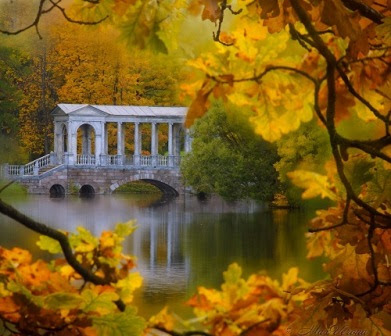
A white marble building by a lake in St. Petersburg, Russia
In the northern Far East Asian countries, the arrival of fall colors is holiday-time. China has many traditional and wildly popular Red Leaves Festivals that last the month of October. In the Sichuan province, the Red Leaves Festival at Guangwu Mountain is considered by many to be the most beautiful spot in China to see fall color (see a video here). Beijing also hosts visitors in the city itself and the surrounding countryside. The number of people who travel to see trees across China is staggering – tens of millions of visitors will come to just one site. According to Beijing Holiday, in one year 90 million people visited the Xiangshan Red Leaves Festival on the outskirts of Beijing.

Mist and red foliage around the Great Wall of China.

In Japan, the sublime pleasure of tree-watching is more than a seasonal pastime, it is a deeply-held cultural rite. In the spring, they gather to appreciate the spectacular flowering of cherry trees in an event called hanami (roughly “viewing the flowers”). In Autumn, it is koyo (the phenomenon of changing Autumn colors) and, more specifically, the glorious maple tree. References to and metaphors about this tree are deeply entrenched in the Japanese world. For instance, there are expressions like “Maple leaves and a deer”, which defines a good match (for more on all this, go here). The Japanese have also created a seasonal delicacy that dates back more than 1300 years - tempura-battered maple leaves (momiji tempura). They only use the yellow leaves, apparently the red just doesn’t work. Leaves are first pickled and then battered and deep-fried. I can honestly say this article makes them sound divine and I would definitely try one.

Deep-fried maple leaves with a white napkin underneath them in a grey bowl with chopsticks.While all this is going on in the northern half of the world, in the southern half it is spring going into summer. Autumn in those places goes from March into May. If you think of deserts and beaches when you think of Australia, you’re right. They have a lot of that. But they also have some majestic mountain ranges. The Dandenong Ranges, not far from Melbourne in the southern part of the country, are not the largest mountains in Australia, but they are appreciated for their display of colors. Their peak color season is March. Here is an article on that beautiful place and here is one on other places for leaf-peeping Aussie style. On another continent in the southern hemisphere, the Patagonia region of Argentina and Chile, draws foliage tourists from near and far. Their peak time is April. See some of that (including a video) here.

Leaves in all colors by Phil Barnett.

So, if you had the time, resources, and inclination, you could travel around the world enjoying autumnal foliage. You could go Down Under in March-April, visit southern South America in April-May, and then spend the summer months in the middle of the globe where the daylight stays mostly the same year-round and trees don’t change. Come September, you could head north and begin the leaf-peeping process in New England. It sounds like a wonderful way to live to me.A cartoon with 2 faces, one with sunglasses and one with a white beard. It says "Greetings from Red Leaf Forest. The hottest nature around".


Take Care.

Submitted by Pam                 


Friday, January 24, 2020

Some Good News Out Of Australia

Trees silhouetted by a fast approaching brush fire in Australia
Since they began back in the fall, the news of the fires in Australia has been ceaselessly appalling.The sheer volume of the devastation is nearly impossible to comprehend – a billion animals have been killed! The human death toll rose again today with the news that three American firefighters were killed when their air tanker went down. The emotional and societal effects have been enormous as well. On the ground, in people’s homes and in their communities, there has been much controversy over who or what’s to blame, as well as the level of governmental help that’s been laid out. Here’s a video that explains one side of the “how did this happen” question. The worry and stress is annihilating. One of my closest friends is from the Melbourne area and she has not been able to rest with the constantly changing fire situation on and around her family’s properties. Thankfully, while the fires are not over, weather and firefighters (or “firies” as the Aussie’s call them) may have turned the corner on some of the larger blazes.

Three Australia-shaped white cutouts hanging on a line with a small Australian flag. They spell out "Happy Australia Day"
With all the disastrous news swirling about, it may be hard for some people to think there is anything good happening Down Under. This Sunday, January 26, is Australia Day – a day that they celebrate all things Australian. In honor of their special day, I’ve decided to spread some good Aussie news in this blog.

A vibrant green Wollemi Pine tree against a bright blue sky.
Wollemi Pine

Dinosaur trees: In an undisclosed location in New South Wales, there is a grove of ancient Wollemi Pine trees. Known as Dinosaur trees since they flourished alongside those giants, these trees lived as far back as 200 million years ago and exist nowhere else on Earth. Scientists were aware of the fossil record, but thought they were extinct until a forest worker stumbled across a grove of them in 1994. The decision was made to keep the trees’ location secret to keep them safe from the diseases and damage that visitors could bring. As the recent fires approached the grove, the government surreptitiously sent out a specialized team of firefighters to implement safety measures. It was a Zero Dark Thirty moment in the conservation world and was a tremendous success. The fire retardant they’d sprayed and the irrigation system they’d installed did the job and the grove was saved. For all involved in this special-ops mission, it meant much more than saving a couple hundred trees. It was all about preserving something uniquely ancient Australian and a source of great national pride.
                                                                                                                         
An adorable white, brown and grey Koala-detecting dog named Smudge.
Smudge
Let’s talk dogs: Unsurprising (Man’s best friend and all) but still wonderful are the stories of heroic dogs that have come out of these fires. There is Patsy (#patsythecorryongwonderdog), a terrier-shepherd mix, who brought her entire herd of sheep to safety (through the darkness of night) ahead of the fire. She is one good dog and just adorable; check her story out here. Then there are the Koala Dogs. Australia has been using dogs to find koalas (and other native species) for some time and are rightfully proud of what they can do. Up to now, though, their training was mostly for research and conservation purposes. But their particular skills have proven excellent for finding injured koalas in burn areas. Humans simply cannot do what these working dogs can. Watch Koala Dog Smudge in action here. For an update on how some rescued koalas are doing, see this article.

A close-up of a greyish-brown wombat
Wombats: For a minute there, there were stories that went viral about the Australian native wombats herding other animals into their burrows for safety from the fires. But this is only partially true. Wombats dig massive underground warrens with interconnecting burrows that go on and on and have multiple entrances. They move around this underground world, sleeping and doing their wombat thing in various parts of the structure. They don’t seem to mind if some animals come and use the burrows while they are somewhere else (but, they don’t like to share with other wombats, foxes or dogs). So when the fires came, there were many small creatures that knew where to find shelter. Of course, no one knows exactly how it all went down down there. Perhaps they were like humans at a hurricane party – locked down and partying until the worst happened or it was all over. Here is an excellent article on all this, including a video of burrow visitors. All in all, wombat burrows have been good news for many critters.

The Sydney Opera House with its wings lit up with images of Australian firefighters (AKA "Firies")
Sidney Opera House Honoring The Firies
People have truly stepped up: All across Australia – and the world – people have been donating their time and money to help wildlife, firefighters and recovery efforts. Many A-list celebrities have been
digging into their deep pockets and giving substantial amounts. But, it is the everyday people that I find impressive. Australian comedian Celeste Barber began an online fundraiser that garnered $30 million in just one week (an amazing $10,000 a minute). Others are out there feeding firefighters or establishing food and watering stations for displaced animals. When the call went out for mittens for burnt paws the response was overwhelming and worldwide. In fact, they received so many that they had to put a hold on the handmade donations. And crafters sent money instead. In case you haven’t seen it already, check out this guy’s car; he apparently just picked up whatever koalas he could find and put them in his car. One does what one can. For more on some of the millions of people who have helped, read this heartwarming article.

A close-up of a tree sprouting new growth
A cartoon of a a koala before and after receiving mittens for its burnt pawsWhile there are already encouraging signs of regrowth in parts of Australia, this whole thing is far from over. It will never be over for those humans and animals who’ve lost their homes. People may be able to rebuild but help is always needed. Animals can’t rebuild on their own – they will need help to carry on. If you want to help, but don’t know which way is best, here is an article that can help you decide which charity to support. G’day.

Submitted by Pam

Featured Post

IT'S EARTH DAY 2026!

Happy Earth Day from ARBICO Organics! This year we'd like to introduce you to our newest local non-profit partner - Mission Garden. Loca...