Showing posts with label autumn. Show all posts

Tuesday, November 23, 2021

The World-Wide Obsession with November’s Flower

A blonde haired woman in a white shirt carrying a bunch of huge pink chrysanthemums over her shoulder.
Chrysanthemum is November’s birth flower and those lucky November-born couldn’t have a more
exquisite or meaningful bloom associated with their month. The chrysanthemum comes in hundreds of varieties and each one is competing with the others to be the most beautiful bloom (see some stunning pictures here and here.) Unlike most other flowers, mums bloom in the chilly weather of autumn. This late-season blooming habit makes them the most obvious and popular choice for holiday bouquets, but for many people it has also made mums a symbol of vitality and perseverance. Mums have inspired symbolism across time and place. In Victorian times, they were symbols of well-wishing and friendship, in Australia they are the flowers of Mother’s Day (because they’re called “mums”, get it?), and in many European countries they have come to be symbols of death (which comes from their being used so frequently in funerals and graveyards). The meanings of chrysanthemums seem to be as wide-ranging as their varieties.

The Emperor of China mum - a beautiful pink, white and red variety.
A 4 Gentleman type painting with yellow chrysanthemums on the far rightIn China the mum is venerated as a whole –their symbolism, their beauty, their medicinal qualities, their spiritual potential, and even their flavor. To underscore this devotion, look no further than this ancient Chinese saying: “If you would be happy for a lifetime, grow chrysanthemums”. As far back as 3,000 years ago Chinese people have been planting, painting and writing about the Chrysanthemum. It is one of the Four Gentlemen of traditional Chinese art. These four plants are the plum blossom, orchid, bamboo and chrysanthemum. They each represent a season (plum blossom-winter, orchid-spring, bamboo-summer and mums-autumn) and also embody the highest levels of integrity and moral character. Although these ideals/images became part of the culture in the time of Confucius (551-479 BCE), they have remained an element of Chinese thought even through communism. Chrysanthemums are now a part of Chinese identity, with towns being named after the flower (Chu Hsien=Chrysanthemum City) and weeks-long festivals held in its honor.

Emperor Akhito of Japan standing in front of his Chrysanthemum throne. You can see the flower emblem on the back of the chair.
A gorgeous yellow mum opening and closing.
The chrysanthemum came to Japan much later than China (5th century AD) and has since become deeply ingrained in Japanese culture. It had been widely admired and used in many facets of Japanese life for centuries before Emperor Go-Toba made it the official symbol of his reign (1183-1198). From that time to this day, the emperors of Japan have sat on the Chrysanthemum Throne. This concept encompasses not only the monarch, but the government that he rules. Thus, the image of this mum appears not just on the actual throne, but on official documents, stamps, coins and even Japanese passports.  An interesting side note: Even though the role is mostly symbolic these days, the Japanese emperor represents the world’s oldest continuing hereditary monarchy; the same family has ruled for 2,600 years
A beautiful peach, pale yellow and red spider type of mum from Japan.

Although their beauty is undeniable, mums have more to offer than just good looks. They are the source of the powerful botanical pesticide Pyrethrin. Like the ancient Chinese, the ancient Persians had mums, and they all were well aware of its insecticidal properties.  As early as 400 BC, Persians were rubbing pyrethrin ointments on their livestock to repel fleas and ticks. This article suggests that the mum, and it’s use as an insecticide, originated in Persia (modern-day Iran) and was brought to China along the Silk Road 2,000 years ago. Others claim it moved the opposite way. Wherever and however this use began, it remains an excellent alternative to synthetic pesticides. We carry a number of top-notch pyrethrin products – check them out here.

A Kenyan woman smiling while standing in a field of daisy-like flowers.
The introduction of pyrethrin was likely a game changer for those ancient Chinese and Persians, and the same can be said for people in Kenya when British colonizers brought it there in the late 1920s. Since pyrethrin has been around so long, it's unlikely that Kenyans had never heard of it, but the British presented it as a money-making crop and that was the game changing part. It seems Kenya has the perfect climate for the daisy-like Chrysanthemum cinerariifolium that pyrethrin is derived from. These flowers grow prolifically after the semi-annual rains and they can be harvested as frequently as every two weeks, providing a nearly year-round income for growers. By the 1940s, Kenya had replaced Japan as the world’s number on producer (a position it had held for hundreds of years. In addition to the financial benefits that this flower brought to local farmers, it turns
out that just growing the plant is enough to
Red and yellow Indian chrysanthemums (Chrysanthemum indicum
repel the sand flies that carry leishmaniasis. This infection, which can cause painful skin lesions and attack internal organs, has maimed or killed untold numbers of people in Africa. The benefits that the chrysanthemum brought to the Kenyan people got lost for a while as they struggled with their new-found independence in the 1960s, but it was still cherished enough to be a part of the new Kenyan Coat of Arms. Nowadays, the mum is back to being widely produced by farmers in Kenya and studies are being done to determine how it can be used to control the locust hordes that regularly decimate crops in Africa.

A beautiful chrysanthemum with pale pink swirling petals
An amber colored glass mug with some clear liquid in it and with a lemon and a chrysanthemum floating in it.
It’s hard to think of any other flower that has such widespread devotion, with the possible exception of the rose. Chrysanthemums are undoubtedly gorgeous, in all their varieties, but they also make a healthful and delicious tea that is a natural de-stressor. If you want to take a moment to try some Chrysanthemum Tea, here’s a video from a tea expert.

Submitted by PamLucy Ball and Desi Arnaz. Lucy's hair is sticking up everywhere and she is saying, "I've always wanted to look like a chrysanthemum".

Monday, October 12, 2020

The Magnificence of Autumn Trees

A view looking up into a magnificent yellow-leafed tree.

 “Autumn is a second spring when every leaf is a flower” – Albert Camus

As I write this, in the northern parts of our globe Nature is putting on one of its most spectacular displays – colorful fall foliage. As a child in Virginia, this was a magical time for me. The crisp air, the smell of burning leaf piles and fireplaces lighting up, the beauty of the trees, the excitement of all the Fall holidays – it was all just so exhilarating. Now that I live in the Sonoran Desert, I am hopelessly nostalgic at this time of year.

A line-up of similar trees with different colors.As the season heads toward winter, spurred on by shorter days, trees in cooler climates begin releasing hormones that cut off the chlorophyll to their leaves as they prepare to overwinter. The gorgeous colors in the leaves, which had been hidden by the chlorophyll up to this point, are made delightfully visible again. The chemicals that cause specific colors in leaves do the same thing for other plants. The carotene that makes carrots orange is also responsible for making certain tree leaves go orange. Anthocyanins turn leaves red, but cause fruits like blueberries and grapes to turn purple-blue. Evergreens keep their green on in winter due to their uniquely shaped needles, which are compact and watertight. If they do drop leaves it will be in the spring, when older leaves can turn yellow and fall off.

A view looking down on a road winding through a forest of multi-colored trees.
In the United States, the image of fall (a uniquely American way of saying autumn) foliage is dominated by images of New England. Undeniably awe-inspiring, the colors of fall are much more than a thing of beauty in New England – they are an economic boon to the area. After the lake-dwellers, beach-goers, boaters, and hikers have left, and before those states are hit hard by winter, there is a rush of tourism to see the trees. “Leaf-peeping” (as they call it up there) can bring in as much as three billion dollars a season. Not an insignificant amount.

A snow-covered mountain with a grove of Aspen trees in the foreground. Off Last Dollar Road in southern Colorado.
It’s the variety of deciduous trees here in North America that makes our viewing especially colorful. We have vast hardwood forests, which produce vivid and diverse displays of color. The colors of New England show all of them. But, the western US has some incredible displays as well, although there may not be as many varieties of tree species. The spectacularly photogenic aspen trees in their large groves, for instance, rival any New England vista for sheer magnificence. If you are interested in what colors are peaking where and when, this article can help. NASA also keeps track of fall colors.

A house by a green field on a fjord with colorful forests all around it. There is a boat moving on the water.
Spectacular autumn foliage is not only occurring in North America right now, of course. All across
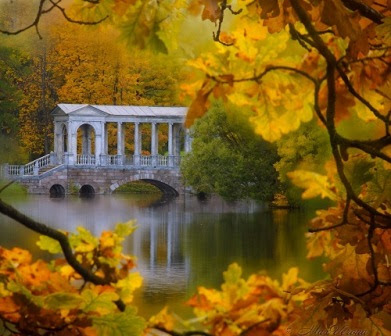
Europe, they are being treated to their own version of this Nature’s gift. In Scandinavian countries, you can even see the Northern Lights after a day of viewing autumn leaves –a Nature double-feature for sure. Russia, with its immense tracts of forests, has leaf-peeping for days – literally – a trip across the country (Moscow to Vladivostok) by train takes 7 days. If you are brave and hardy enough, it will take you a minimum of 11 days to drive. In St. Petersburg, they call it Golden Autumn (a term attributed to the beloved poet Pushkin) and it looks amazing – see more on St. Petersburg here and other Russian Fall destinations here.

A white marble building by a lake in St. Petersburg, Russia
In the northern Far East Asian countries, the arrival of fall colors is holiday-time. China has many traditional and wildly popular Red Leaves Festivals that last the month of October. In the Sichuan province, the Red Leaves Festival at Guangwu Mountain is considered by many to be the most beautiful spot in China to see fall color (see a video here). Beijing also hosts visitors in the city itself and the surrounding countryside. The number of people who travel to see trees across China is staggering – tens of millions of visitors will come to just one site. According to Beijing Holiday, in one year 90 million people visited the Xiangshan Red Leaves Festival on the outskirts of Beijing.

Mist and red foliage around the Great Wall of China.

In Japan, the sublime pleasure of tree-watching is more than a seasonal pastime, it is a deeply-held cultural rite. In the spring, they gather to appreciate the spectacular flowering of cherry trees in an event called hanami (roughly “viewing the flowers”). In Autumn, it is koyo (the phenomenon of changing Autumn colors) and, more specifically, the glorious maple tree. References to and metaphors about this tree are deeply entrenched in the Japanese world. For instance, there are expressions like “Maple leaves and a deer”, which defines a good match (for more on all this, go here). The Japanese have also created a seasonal delicacy that dates back more than 1300 years - tempura-battered maple leaves (momiji tempura). They only use the yellow leaves, apparently the red just doesn’t work. Leaves are first pickled and then battered and deep-fried. I can honestly say this article makes them sound divine and I would definitely try one.

Deep-fried maple leaves with a white napkin underneath them in a grey bowl with chopsticks.While all this is going on in the northern half of the world, in the southern half it is spring going into summer. Autumn in those places goes from March into May. If you think of deserts and beaches when you think of Australia, you’re right. They have a lot of that. But they also have some majestic mountain ranges. The Dandenong Ranges, not far from Melbourne in the southern part of the country, are not the largest mountains in Australia, but they are appreciated for their display of colors. Their peak color season is March. Here is an article on that beautiful place and here is one on other places for leaf-peeping Aussie style. On another continent in the southern hemisphere, the Patagonia region of Argentina and Chile, draws foliage tourists from near and far. Their peak time is April. See some of that (including a video) here.

Leaves in all colors by Phil Barnett.

So, if you had the time, resources, and inclination, you could travel around the world enjoying autumnal foliage. You could go Down Under in March-April, visit southern South America in April-May, and then spend the summer months in the middle of the globe where the daylight stays mostly the same year-round and trees don’t change. Come September, you could head north and begin the leaf-peeping process in New England. It sounds like a wonderful way to live to me.A cartoon with 2 faces, one with sunglasses and one with a white beard. It says "Greetings from Red Leaf Forest. The hottest nature around".


Take Care.

Submitted by Pam                 


Friday, September 6, 2019

A Busy September in the Garden

Yellow and red roses on a two-toned wooden table with a white envelope that says "September". Photo by Brigitte Tohm on Unsplash
Now that Labor Day is in the rearview mirror and all the kids are back in school, people everywhere are amping up for the busy fall season. This is especially true for gardeners. This time of year is chock-full of gardening and taking-care-of-outside chores. As most serious gardeners know, September is not the end of the season. In reality, it is the beginning. What you do between September and late November will help determine how heavy your workload is for next spring.

An assortment of leafy greens in a silver colanderMany gardeners are well on their way to having a fall garden by now. Depending on where they live, the planning and prep has been done and they have already planted or are ready to move on to planting. Those winter greens and vegetables will be very welcome as fall turns to winter. Here is a delicious-sounding salad that features Brussels sprouts, pumpkin seeds – and a surprise touch.

But what if you are not doing a fall garden this year? If you want to plant in the spring or just want a healthy backyard environment for your warm weather enjoyment, there is a lot that can be done now to make that happen. Putting in a little time now can save you time, money and worry as you come out of winter next year.

A skeletal black tree on a green and misty hillside.  Photo by Adarsh Kummur on Unsplash.
Plant a tree: If you are not up to going the whole fall garden route but still want to get your hands in some soil, consider planting a tree. Every day is a great day for a tree, but September through November is the ideal time for planting one. This will give their roots time to establish before hard freezes and allows them to concentrate their energy on growing roots before they put out leaves in the spring. The key to success with this schedule is to encourage strong and healthy root growth and to water deeply. We recommend Root Build 240 for the roots. For more information, check out our tree planting blog here.

Multicolored plants in clay pots stacked against a brick building.Apply Beneficial Nematodes: We strongly encourage fall applications of these microscopic organisms to control pests that overwinter in the soil. We have beneficial nematodes that can control a myriad of pests, including various beetles, ticks, fungus gnats and caterpillars. Apply some now and apply again in the spring to knockdown any pests that got away. These fascinating creatures do amazing unseen work in the ground. We have a ton of information on them here. And they are on sale through September!

Move your garden to containers: If you have some plants that you’d like to keep going or some favorites that you like to have around, put them in containers. It will be easier to protect them (and yourself) from the elements. Put them close to the house or on a porch for easy access and raise them off the ground; this will keep them from becoming waterlogged in the wetness of fall and winter. Here is a video with some tips on fall container planting. 

Colorful fall leaves on a lush green lawn.Lawns: Your lawn will enjoy some dethatching, fertilization and aeration at this time of year. And, while you’re at it, you may as well go after those stubborn perennial weeds. Weeds draw up nutrients in the fall to prepare for winter; if you apply herbicide now it will be drawn up as well. Corn Gluten Meal may work well for you; it will fertilize as well as kill weeds. Check out our blog on this versatile corn by-product. We also have many other excellent weed control options here.

Clean out sheds, greenhouses and cold frames: Now that the weather is cooling off (except here in Southern Arizona), get out and clear up the clutter that it was just too darn hot to deal with over the summer. If you are planting again, you will want this clean slate. If you are not, cleaning now will give you a chance to move items that shouldn’t be out in the cold and free you from spending your spring days going through debris from the year before. Be sure to empty and clean out all the compost and decaying plant matter from old pots and containers to keep overwintering pests from finding a home there.

Teardrop shaped small pumpkin on dark soil and surrounded by green leafy vines.Photo by Steffi Pereira on UnsplashTrim things up: Help your plants by maximizing light sources as we move into the darker months. Remove thick or overhanging vegetation around your garden, greenhouse or patio. To encourage pumpkins to ripen by Halloween, trim up any leaves and/or re-direct vines that may be shadowing them. If you have apple trees – lucky you – run the mower under them so you’ll be able to easily spot any windfalls.


Young blond haired boy in jeans and a blue shirt playing in a pile of brown leaves, Photo by Scott Webb on UnsplashCompost: Not composting? Start now to take advantage of falling leaves and dead plant material. If you are already composting, you probably know already that the bounty of leaves in the fall are an excellent addition to a compost pile. Check out our composting products here.

A closeup of a hand holding some daffodils and daisies. Photo by Sam Mgrdichian on Unsplash


Plan for beauty
: Now that you have a trimmed up and cleaner yard environment, and a plan for all the fallen leaves that someone will have to rake up, it's time to plant bulbs for next year’s enjoyment. Stick them in now and when they start popping out next spring you will be so glad you did.                                                                 
Above all, get out and enjoy this time of beautiful time of year. The sunny, cool days and crisp nights of autumn are something that this Virginia native gets homesick for every year at this time.

Submitted by Pam


Featured Post

Common Pests of Hemp and Cannabis Plants

The cannabis industry has steadily grown over the years, and with that expansion comes a remarkably diverse set of insects that want a piece...