Showing posts with label desert spiders. Show all posts

Monday, July 18, 2022

What’s This Bug? The Solufigid/Camel Spider.

 What we have here is a solufigid (Arachnida solifugae). They are found in arid regions around the world and have many, many names: solifuges, solpugids, wind scorpions, wind spiders, sun spiders, false spiders, jerrymanders, madres de alacran and camel spiders (probably the most widely-known name here in our country). Some names are specific to certain regions. For instance, in South Africa, they are called roman spiders, red roman spiders, rooi spiders, kalahari ferraris, haarskeerders (Afrikaans for “hair cutter) or baarskeerder (“beard cutter); the latter two so-named for the local belief that they cut people’s hair in their sleep to use it for nesting material (Solufigids like hair that’s been shed from humans and animals, but the harvesting part is myth). And that’s not all of the South African names, see more here.

When the US military went into Iran and other parts of the desert Middle East, our troops came across these unusual-to-them creatures and, of course, told everyone back home about them. They adopted the prominent name from the area, camel spiders (For clarity, I’m going to use this name for the remainder of this blog). This awareness of camel spiders to Americans, spawned many urban myths. It just so happens that the misconceptions highlight some of the most unique aspects of this creature. It’s been said:

Some of the many species of solufigids

 -  that camel spiders are spiders from Hell.

Clearly these creatures are not literally from the underworld. In fact, they are not true spiders, although they come from the Arachnid genus. There are over 1,000 species of camel spiders, and none have the correct anatomy to qualify as spiders. They do have the eight legs (the two front “legs” are called palps and function more as feelers or hands for grasping prey), but little else a spider has. They don’t have venom or spinnerets. Additionally, spiders have separate heads and thoraxes, while camel spiders have a large one-piece head/thorax combination (which takes up 1/3 of its body).

- that camel spiders charge at people.

These are animals that avoid the sun and/or daylight exposure. In fact, the Solifugae name is derived from Latin and means “fleeing from the sun”. If caught out in the sun, they will rush into whatever shade they find and sometimes that is the shade a human is making. They’ve also been known to use a walking person’s shadow as moving shade, which makes it seem they are chasing that person. At night, they will rush towards any light they see, including flashlights and campfires. Seeing them approaching rapidly from the darkness would give anyone a fright.

- that camel spiders can grow to the size of a dinner plate.

A camel spider sitting on a hand.
Two soldiers holding what appears to be gigantic camel spiders, but the photo is deceiving.A widely-shared picture from Iraq shows soldiers holding two locked-together gigantic camel spiders. While this made for titillating conversation, the photo is a classic case of false perspective. Camel spiders in the Middle East don’t grow to more than 2“, and most are around 1”. If you consider that dinner plates are 10½-12” in diameter, it’s clear just how much their size has been exaggerated. 

- that camel spiders can jump up to 6 feet and run up to 25 mph.

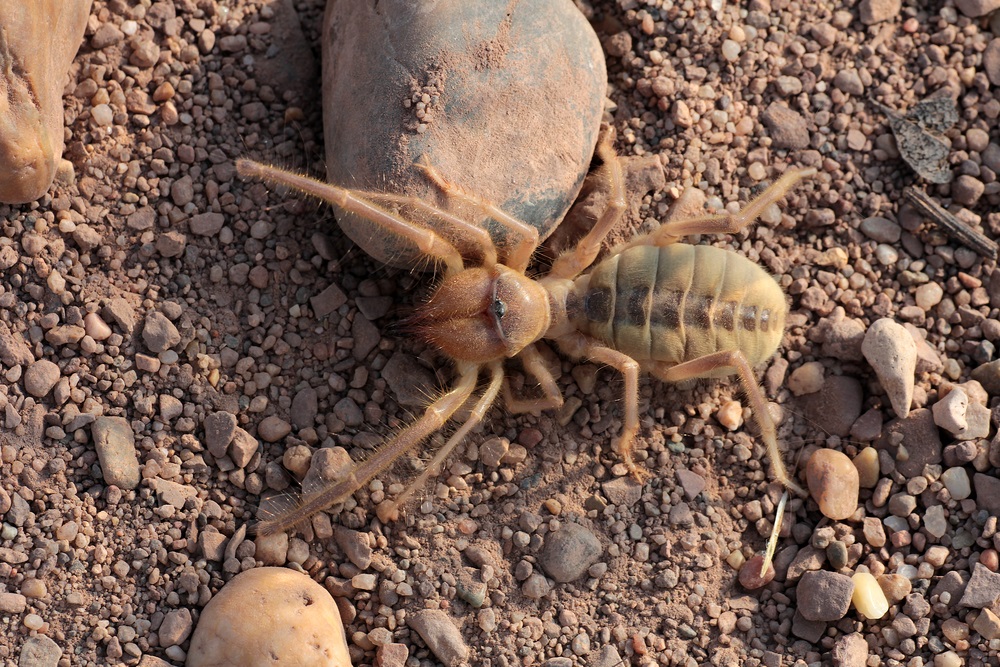
A camel spider amongst the rocks.In reality, camel spiders are not good jumpers. However, their chief hunting behavior is to run at breakneck speed towards their prey. I mean run – while they can’t go 25 mph, they can do 10 mph. And they can keep up this speed indefinitely; there is no “slow” switch. Once night falls, they barrel out of their hiding places and start running. According to this man, they have a preferred route that they transverse over and over. While this article tells of researchers who tried to keep up with these speed demons and had to give up after a non-stop two-hour dash. As it zooms around, a camel spider will attack and devour any prey that is unfortunate enough to cross it’s path. They will literally run into something, rear up, slap/grab it with their palps and then begin chewing on it immediately. In no time, the camel spider will have shredded, liquified and consumed It and be off looking for something else. As horrifying as this running-attacking seems to be, camel spiders should be considered beneficial due to some of their food choices. Their diet is varied and includes many creatures that are deemed undesirable by humans, like venomous insects, spiders, scorpions and centipedes. Here's a video showing an attack on a millipede that shows just how fast they work (it is not sped-up, it’s in real time).

A camel spider reared up with its impressive jaws wide open.

- that camel spiders will screech as they attack.

They do not scream (again, an anatomy thing), but their powerful jaws can cut through feathers, bones and shells and that could create an ugly sound. And some species do clack their jaws as they attack. Or perhaps the noise in question is that of onlookers screaming in horror.

The face of a camel spider. - that camel spiders lay their eggs in animal’s fur (particularly camels) and eat camel bellies.

Camel spiders are not parasitic, nor are they blood-eaters, so they have no reason to seek out an animal host to lay their eggs on. They lay them in out-of-sight and underground places like burrow and under rocks or logs. As far as eating camels goes, these arachnids are fierce and have a varied diet, but it does not include large mammals (although a small mammal may become a meal if it runs into it).

A camel spider covering itself with sand.
Camel spiders have so many interesting behaviors, but my favorite is their ant-slaughtering. It appears that they like to accost ants at the opening to their colony and cut them to pieces as they come out to defend their home. The camels spiders are not eating the ants, they are simply killing them. And in a way that seems almost gleeful. Scientists have theories (scientists always have theories), but there is no real explanation for these attacks. Be that as it may, this behavior is inexplicably mesmerizing to watch. Here’s a video and here’s another. 

Submitted by Pam


Wednesday, October 17, 2018

Spiders & Their Webs - Our Eerie Friends


‘Tis the season that Halloween decorations pop up around the country. A festive favorite for many homeowners is the faux spider cobwebbing strung about to create a creepy, spooky aesthetic. While the seasonal decorations are a staple of Halloween, the real things tend to be far more orderly than most of that webbing and often give insight into what kind of spider or insect you are dealing with. 


Orb Weaver Spiders Create Recognizable Webs
Orb Weaver Spider & Its Web (From Deb)
Spider webs range from the orderly and planned spoked wheel-looking orb weaver webs to the black widow’s web, which resembles what I would imagine a spider web would look like after a long weekend in Las Vegas – disorderly and half-baked. Regardless of their apparent utility or lack thereof, these two varieties use their webs for refuge and to trap prey. Imagine a house that hunts your dinner for you. 

Huntsman Spider on a wall indoors
Martina the Huntsman Spider
Then you get to some aptly named groupings of spiders, funnel web and triangle spiders. Guess what their webs look like? While the designs are simple, the beauty is in that simplicity. Triangle spiders lack venom and thus need to use their fuzzy (not sticky) webs to smother their next meal. Funnel spiders, the hobo spider being one of them, build a one way street for prospective prey trapping them on a path to consumption. Being the conniving architects they are, funnel spiders plan ahead and make sure to attach an emergency exit for themselves allowing for quick flight from the premises. 

While spider webs can take us by surprise and be a hassle to remove, at least they give us an idea of where our spider friends have been lurking. Hunting spiders – wolf spiders, jumping spiders, huntsman spiders – don’t give us that warning. They will appear when they like and often when least expected. These guys also tend to be larger than some of their web-building counterparts, hunting down bulkier prey in the vast unknown of nature. The good thing is, you can befriend them like one of my colleagues, Cara, has done. Meet Martina the huntsman spider. 

Spiderman in his natural habitat
The thing to remember about spiders and their webs is that they combine to kill a lot of the bugs we find to be nuisances. If they’re nearby, chances are good that the spiders are providing you a public service and free pest control. Remove them if you need to, but refrain from killing them on sight. Our eight-legged friends do quite a bit more good than bad in the grand scheme of things. 

Contributed by Sterling N.

Tuesday, September 25, 2018

Famous Faces of the Desert – Tarantulas


In the interest of full disclosure, I’d like to make it clear that I am not a fan of spiders. All those skittering legs, yucky webbing and fierce fangs just make my skin crawl. This attitude is the direct result of a horrifying incident with a giant spider and its web when I was a child in Panama. I can’t bear thinking about it to this day.
Large grey tarantula
Photo by Valerie, Customer Service

Having said all that, I do rather like tarantulas. After numerous encounters with these spiders, both in the wild and as someone’s pet, I see that they are gentle and delicate creatures. They are probably the most misunderstood of all the iconic desert creatures we have here in Arizona.

Unlike other desert creatures I have talked about in this series, I have not encountered tarantulas in or around our office. However, most of our crew has had them around their homes; so I asked for pictures from them. Mike, our Shipping Manager, contributed an image of a large black one found in his garage and Valerie, Customer Service, donated one of a lovely grayish specimen. These two pictures, taken just a few miles from each other, show the variety of tarantula species in our area.

Large black tarantula on a garage floor
Photo by Mike, Shipping Mgr
Despite their rather fearsome appearance and their unwarranted reputation as being dangerous, the truth is tarantulas are more shy and reclusive than anything else. They live solitary lives in holes, burrows or crevices and rarely venture far from them. Around here, if you find a hole about the size of a quarter, it may be a tarantula hole. If you see silk in or around the hole, it is actively occupied. The silk helps prevent cave-ins and makes the perfect nesting material. They often extend the silk lining outside the entrance. This outside webbing has two purposes: waterproofing and an early warning system. Tarantulas do not like water and their silk helps keep their burrows dry. If a burrow floods, the tarantula will flee. This is one reason that they are more
likely to be seen during monsoon season here. Outside webbing also serves to let the spider know that prey is nearby. They can sense vibrations and the slightest touch to the webbing will send the tarantula out to snag its dinner. When it is time to hibernate for the winter, the spider will mix the silk with a little dirt dirt and create a plug for the opening.

A tarantula lying on its silk in its nest
A tarantula resting on its silk
Females will always be in or very near their burrows, but males will head out looking for love during mating season (generally September-October). In some places, tarantula males head out in large numbers, making for an unsettling display of devotion to reproduction. Once a male finds a female’s burrow, he will “knock” on the silk around the door. The female will rush out and, in that split-second, make her decision to mate with him, eat him or both. After the long trek to get to her, it is the worst kind of blind date. With what he goes through for love, it should come as no surprise that females live twice as long as males.

Although their bite can be painful, a tarantula’s venom is not dangerous to humans. Because they feed on small prey like other insects, arthropods and the occasional small lizard or mouse, they have no need for venom strong enough to disable or kill a large being. Unless the person has a severe allergic reaction, a tarantula bite is no more serious than a bee sting.

The hairs on a tarantula can cause a person more trouble than their venom. They have hundreds of hairs on their upper abdomen called urticating hairs that are used as a defense mechanism. They will flick these barbed hairs at would-be tormentors. Once lodged in their target, these hairs are extremely irritating and difficult to remove. They can cause real damage if embedded in the eye or inhaled. Just give them their space and they will give you no trouble.

Tarantulas have very thin skin, especially in the abdominal area. This makes them very vulnerable to damage from falls. A height of less than a foot can kill a tarantula. This makes for another good reason not to handle them.

While they cannot handle falls, losing a leg is something most tarantulas can overcome. They will simply regenerate a new leg the next time they molt. Never one to turn down a meal, the tarantula may even eat its detached leg. Since males rarely molt once they reach sexual maturity, it will be the females or immature males re-growing legs. We used to have a very large (about 4½”) 7-legged fellow who hung out in the tree by our front door.

Tarantulas appear in many legends around the world  and in many myths of native peoples. Underscoring its importance as an essential part of our Southwestern world, the Navajo, Zuni, Apache and Pima all have traditional lore surrounding the tarantula.

When it comes to predator and prey, tarantulas are equal parts of each. They are valuable predators for pest insects such as cockroaches, but they are also preyed upon in all stages of their lives. Ants invade their burrows and feast on their eggs and large predators gobble them up when they are old enough to leave their burrows. The most terrifying and gruesome nemesis of a tarantula is the Tarantula Hawk (Pepsis spp).These insects prey on and parasitize the spider as part of their
Close-up of an individual tarantula hawk
Tarantula hawk
reproductive cycle. I will save the specifics of their predation for one of my October blogs on insect mummies and zombies. Suffice to say, it’s pretty gross.

Usually, at this point in the blog, I would direct you to ways to control the creature I’ve been discussing. With tarantulas, however, I have no control recommendations. These benign creatures mean you no harm and can easily be guided away from you, your yard and your pets.

Submitted by Pam


Featured Post

5 Cool Things About Nematodes

It’s September, and here at ARBICO, it’s Beneficial Nematode season. Every year we put our Beneficial Nematodes on sale at this time to enc...