Showing posts with label beneficial insects. Show all posts

Monday, December 6, 2021

What's This Bug? The Antlered Wasp.

Closeup of the Antlered Wasp on a green background
It’s Christmastime, and to mark the season I bring you the Antlered Wasp (Eucharitidae).  What these
guys lack in size (they’re less than an inch), they make up for with their large and dramatic antennae. These insects are known as Antlered Wasps, because with a little imagination, they could be itty bitty reindeer (although some people see their “antlers” as punkish mohawks). And while it’s entertaining to view them as tiny reindeer, you will not come across one of these wasps where reindeer reign, as they are tropical insects.

A tint Antlered Wasp on a person's fingertip
Antlered Wasps, like many other wasps, practice parasitism as a part of their life cycle. And they only parasitize ants, an insect that is often the aggressor in the insect world and not the victim. To put an even finer point on it, each specie (there are over 400 species) specializes in a particular species of ant. Here is a list of some of those pairings.

Child-rearing in nature is extremely variable, with some species providing long-term, hands-on care and other species leaving their offspring to fend for themselves. Antlered Wasps are firmly in the latter category. When the female is  ready to lay her eggs, she chooses a plant that is a favorite of ants, or one with an ant colony nearby. She lays her eggs and moves on; after a week to ten days the larvae will hatch. The larvae will then spend several days lolling about on the plant, getting their energy and nerve up, and (presumably) planning their strategy for the next step. The goal of the larvae is to infiltrate the ant colony, so the next step is to find an ant to take it into the nest. For this attachment to happen, most 
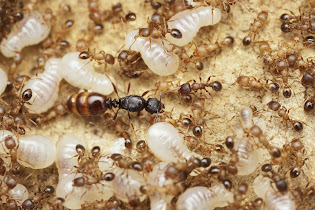
A ant queen on her nest with eggs and other offspring
Ant Queen and her offspring
Eucharitid wasp larvae depend on rubbing up against an ant and fastening themselves to it. If there are no available ants around, the wasp larvae will use an intermediary host that can get them up close enough to grab an ant. However, according to this article, the Kapala species in the Eucharitidae family has developed jumping abilities. Apparently, they will stand up on the leaf and jump down onto a passing ant. High diving larvae – nature is amazing.

Once a larva has found its Trojan Horse/ant host, it will ride it right into the ant colony. Ants are notoriously and intensely protective of their nests, so how do these larvae get away with this? It seems they have developed the ability to mimic the odor of the ant larvae. Scientists have observed that ants will avoid the adult wasps, a clear indicator that they view them as a threat. But, thanks to the aromatic camouflage, ants seem to not recognize the wasp larvae as different from theirs. 

Closeup of an ant tending to a newborn wasp.
Ant tending to a newborn wasp
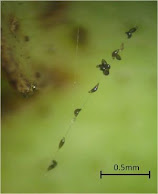
Small black larvae moving along a nearly invisible filament.
Wasp larvae on the move
The camouflaged wasp larva makes its way, with the unwitting help of the ants, deep into the ant colony’s inner sanctum – the brood chamber. This may be the easiest part of their mission, as the wasp simply has to find an ant larva to attach to. Since a queen ant can lay up to 300,000 eggs a day, there is an abundance of potential hosts for the little wasp. Once attached, the wasp larva will begin feeding on its ant counterpart, but it eats just enough to keep them both going until the ant pupates. Once this happens, the wasp will finish off its host. The wasp uses this last bit of ant fuel to finish growing into an adult and will then emerge from its host. At this point, still helpful and unwitting, ants will feed and groom the newborn as they do their own. Eventually, the wasp will fly out of the colony and mate, usually right above the ant nest. 

Closeup of an Antlered Wasp facing the camera

Cartoon ants shouting "Arghh!" fearfullyThe life cycle of the Antlered Wasp could be adapted into a Mission Impossible type action movie. And be as unbelievable. Except this is an incredible true story.

Take Care. 
Submitted by Pam

Tuesday, November 9, 2021

What’s This Bug? The Fiery Searcher Beetle.

Calosoma scrutator, the Fiery Searcher Beetle

This beautiful beetle is the Calosoma scrutator, commonly known as the Fiery Searcher or simply Caterpillar Hunter. As their name(s) suggests, these beetles are tireless and aggressive predators. Luckily for us humans, the foods they love best are some of the most crop-damaging pests around. They will prey upon a variety of insects in varying life stages, although their favorite is the caterpillar stage. Their dinner of choice depends on whether they are larvae or adults, as they hunt in both stages. Fiery Searcher larvae, since they are not as agile as the adults, prefer to target insects in their pupal stages while adults are way less picky (here’s more on their feeding preferences). According to this article, they favor the all-star list of crop pest which includes the larvae of imported cabbage worms and gypsy moths, the larvae, pupae and eggs of root maggots, as well as the Colorado potato beetle, diamondback moths, cutworms, cabbage loopers, aphids, asparagus beetles, slugs and flea beetles. Some species even eat snails. Fiery Searchers are exceptionally long-lived for an insect; they can live 2 years or more. And during their lives they can consume hundreds of insects. So, these are clearly helpers that you want to have in your yard and garden. 
Fiery Searcher larva (R) eating a Pipevine Swallowtail larva

These beetles live throughout North America, but their numbers are largest in eastern states. They are nocturnal, so even if you live in an area where they are prolific you may not see them. They spend their daylight hours in crevices, under leaf litter, logs and rocks and venture out in the dark. This night-life suits them well; it allows them to  stay hidden from those animals that like to prey on them and the insects that they like to eat are also hiding in daylight for the same reasons. As pests come out at night with a false sense of security and their eyes on your plants, the fiery searchers are ready to snatch them up. 

A Fiery Searcher beetle wrapped around the tip of a tree branch.

Fiery searchers are usually found in fields and gardens, although some live on forest floors. These beetles have wings, but rarely fly. Instead, they use their long legs to scamper up branches and tree trunks to grab a meal. They are especially fond of tent caterpillars and gypsy moth larvae, which they find up in the trees. Fiery searchers don’t just use their long legs to climb trees, their legs allow them to run very fast to chase down prey. Their burst of speed in pursuit of prey is similar to a cheetah’s, so much so that they have been called the cheetah of the insect world. 

A closeup of the head of the Fiery Searcher.
If you come across a fiery searcher, it is best to give it a wide berth. These are large insects (about 1-1½ inches) with big, sickle-shaped mandibles. They will not hesitate to give a nasty bite if you mess with them. And if that doesn’t do the trick, they can and will emit a foul odor when handled. Clearly they have some tools that help them remain the predator and not become prey.

Fiery searchers are around from May through November but are most active from May through June when trees have leafed out and caterpillar populations boom. In the fall, they will be scuttling around getting the last of the bug goodies before it gets too cold and it’s time to overwinter. They like to spend their winters under some bark or under a rock.

These beetles are glorious – not just in how pretty they are, but in their hunting game. They literally take no prisoners. Here’s a really informative video that shows them in action and this article contains three separate short illustrative videos . Enjoy the glory that is the fiery searcher on the hunt.

a little boy in a coonskin hat and glasses holding up 2 beetles on earring hooks and saying, "I made you some jewelry. Are your ears pierced?".

Take Care

Submitted by Pam


Thursday, November 4, 2021

Creatures To Be Thankful For

An image of Earth, showing different ecosystems like jungles and underwater.
At this time of year, we are all encouraged to find things to be thankful for and this year I'm encouraging you all to look beyond humans and to consider all the other living things that help us survive on our planet. Without the input of these creatures, the conditions that allow people to live comfortably would not exist (or perhaps humans wouldn’t exist at all). All of these deserve our gratitude. While we are familiar with many animals that are essential for the environment (hello, bees), there are many others you may not think of. I’d like to introduce you to some.

A black silhouette of a female praying mantis
BENEFICIAL INSECTS & NEMATODES- Here at ARBICO beneficial insects are a big part of our daily lives, so I can’t help but mention them first as something to be thankful for. We are all about good bugs that kill bad bugs. We have bugs that fly around hunting others, bugs that crawl around to hunt, and others that burrow through the soil while hunting. Some like specific prey, and some eat just about everything they come across. What all these beneficials have in common is that they feed on things that feed on our food. In other words, they keep gardens free from predators, so they can grow lushly and produce prolifically. If you are not familiar with all that we have, this page will get you started on learning more.

An artist's rendering of Bifidobacteria, a beneficial bacteria.
 BENEFICIAL MICROORGANISMS - As far as beneficials go, insects may be the stars of the show, but beneficial microorganisms are essential supporting characters. Without healthy soil, full of bacteria, mycorrhizae (and even fungi), your soil will not be able to sustain any plant life. These tiny beings are crucial for our survival, but it’s probably safe to say they never cross the mind of most people. Let’s take a minute to be thankful for them. We have a great many products that have one form or another of beneficial microorganisms, but they really shine in our microbial inoculants.

Silhouettes of bats flying through the trees against a blue sky
BATS – There’s nothing scary about bats; they are gentle mammals that are great to have around.. On any “World’s Most Dangerous Animals” list, you’ll find mosquitoes listed as the most dangerous  (those that don’t include humans, that is). They kill roughly 725,000 people a year from the various diseases they carry, so any animal that can put a dent in that number should be thanked. An individual bat can eat 1-2,000 mosquitoes an hour, so just imagine how many a large colony can take care of! Experts say that birds eat more mosquitoes than bats, but those bats that are not insect-eaters are pollinators. So, bats are either eating a deadly insect, or pollinating our plants – a two-fold reason for appreciating bats. One more thing: their guano is excellent fertilizer. 

A close-up of a beaver in water with his eyes and nose poked out above the surface.
BEAVERS – Most of you reading this have probably never see a beaver in the wild, but you should be thankful for them nonetheless. These North American mammals are tireless stewards of our waterways and their busy aquatic lifestyle keeps wetlands wet, groundwater levels up, and provides essential firebreaks that protect forests. Even if you don’t have beavers where you live, all life benefits when waterways are working as they should. Any creature that protects such a crucial resource as water get my thanks. This article tells how scientists in California are working with beavers to combat devastating drought and fire caused by climate change that state.

Snakes swimming in a blue ocean with a reef below them full of colorful coral and fish.
SHARKS -  I realize that this creature provokes a visceral response in many people, but it really does play an important part in keeping our oceans in balance. And we all know that a healthy ocean is key to life on Earth. Sharks preserve the balance in the sea by being an apex predator, but they also keep coral reefs healthy. They do this by eating the fish that eat the herbivores that graze on algae. When there is too much algae, the coral (and other species) will die off (for more on why reefs are important, watch this video). On the other hand, the appetite of sharks also prevents the overgrazing of seagrass (which store carbon and help prevent erosion). They do this by eating herbivore fish, so they are really working both sides of the equation.  For more on the what the wondrous shark can do, here is an excellent short article. Thanks, you big toothy environmental warrior! 

A close-up of a Red Squirrel.
 SQUIRRELS – Squirrels are (with the exception of Australia and Antarctica, found all over the world),  so they are very familiar to most people. These bushy-tailed little mammals are both endearing and entertaining as they scamper about in their busy little way. And it’s this behavior that we should be thankful for. As squirrels gather, eat, bury, store, and poop out seeds and nuts they are keeping the forest floor groomed and are ensuring a healthy distribution of future plants and trees. According to this article, it’s estimated that squirrels can be credited with planting millions of years every year in North America alone.

Green and purple phytoplankton under a microscope.

PHYTOPLANKTON – These microorganisms are even more important to life on Earth than soil microorganisms. These microscopic marine algae are a key component in both marine and freshwater ecosystems, but their impact goes beyond the water. As the foundation of the aquatic food chain, without this tiny creature whales, seals, sea birds and even humans would go hungry. But probably the most important role that phytoplankton play is in producing oxygen – up to 2/3 of the world’s atmospheric oxygen. We are all aware that trees produce oxygen, but it is these hardworking microorganisms that produces the most for us by far. This, simply put, is why we need clean oceans. So that they can continue to thrive and survive. Although they may be hard for some people to appreciate because they cannot be seen, let’s just consider them magic. A vital environmental magic.

A squirrel standing on a stack of nuts and munching on one. Of course, there are many other creatures on this planet to appreciate; in a well-functioning ecosystem all parts played by each species are important. I challenge you all to notice, and be grateful for, those that I did not have space or time to mention.

Take Care                           Submitted by Pam


Tuesday, March 9, 2021

What’s This Bug? The Asian Lady Beetle.

Close-up of an Asian Lady Beetle walking.
This little guy is the Asian Lady Beetle (Harmonia axyridis). They are a non-native species of beetle that was introduced to our country a hundred years ago in a well-intentioned, but not well-thought-out, effort to help soybean farmers control soybean aphids. They are voracious aphid-eaters, so they did that part of the job well. But, they have also aggressively pushed out native species of ladybugs. This is not only true in the US; they are taking over large parts of Europe and in the UK as well.

First, let’s get down to the naming thing (which, for some reason, many people get hung up on): Asian Lady Beetles and what we call ladybugs are both members of the insect family Coccinellidae. All members of this family are beetles, what we call them is simply a reflection of where we come from. In the US they are ladybugs; in the UK they are ladybirds and various places know them as lady beetles. Asian Lady Beetles can be referred to as a Harlequin Ladybugs/Ladybirds as well. So, any and all of these are species of one family, no matter what name you give them.

A side-by-side comparison of the Asian Lady Beetle on the left and the Ladybug on the right.
While what we know as ladybugs are very recognizable in their bright red and black spotted shells, Asian Lady Beetles wear a huge variety of different colors and markings. The white marking found at the base of the head (it looks like an “M” or a “W”) can be a good way to identify these insects, but not all of them have it. Asian Lady Beetles, which can have spots, no spots, or even stripes, have an orange and black color palette as opposed to the red and black of ladybugs. 
A display of the many variations of Asian Lady Beetles.

Many people point to two things that set Asian Lady Beetles apart from ladybugs - that they bite/are aggressive and that they smell. Both of these assertions are a bit hyperbolic.

Yes, Asian Lady Beetles have pincers and can bite when disturbed, but they do not attack. And their pincers are tiny, so their bite can’t really harm a person. However, some people do have an allergic reaction to the bite that can cause everything from cough to hives. People who are sensitive to these creatures may not even need to be bitten, touching a beetle then touching one’s eye has been known to cause pink eye.

 Asian Lady Beetles are often said to have a noxious odor. While they do secrete a goo that has an unpleasant odor when disturbed, this behavior is common throughout the ladybug world. It’s a defense mechanism known as reflex bleeding and is meant to discourage predators. The excretions of Asian Lady Beetles may be particularly gross to many people, but they no worse (or no better) than other ladybugs. That said, their particular goo is known to stain surfaces like walls, furniture, or fabrics. This all becomes a problem only when they begin to gather in large numbers, particularly inside structures.

Asian Lady Beetles crammed into a crevice of a house.

As winter approaches in temperate climates, Asian Lady Beetles begin to aggregate in ever-growing clusters to keep warm and seek out winter quarters. This is usually when they come into conflict with people because they tend to like the snug shelters that humans have made (why they choose human habitats is still under debate, this article gives some explanation). Once the beetles have chosen a spot to overwinter, they send out a pheromone trail that attracts others to their spot. This is why hordes of insects “suddenly” appear. These scent trails can last years, meaning some homes experience invasions every year. 


What’s a poor, beleaguered home-dweller to do? While the sight of large numbers of beetles in or around your home is disconcerting, they will not actually do any harm (unless disturbed, as previously mentioned). They do not bother food or belongings inside a house and they are not breeding either. They are simply hibernating for the cold months, after which they’ll move on to breed and feed. You should vacuum up the ones you can, but your best bet is to take action to keep them out, to begin with. During the still-warm days of fall, clear vegetation away from your house and seal it up well to keep Asian Lady Beetles and more out. Check out my blog on winterizing your home here.

Close-up of a ladybird beetle eating an aphid. Photo by Alexandre Debieve on Unsplash.
It’s important to not view Asian Lady Beetles as “bad”. Yes, they are invasive, but they are here to stay and they are extremely effective at controlling pest insects on crops. Supplies of the type of ladybugs we sell (Hippodamia convergens) are dwindling rapidly. Some of this is due to invasive species, but the ones we get nest in the mountains of the West Coast and the devastating fires of the last few years have nearly wiped them out. It’s time to embrace other types of ladybugs that have the exact same eating habits. This includes not only the Asian Lady Beetles but lesser-known native species. Here is a fun project that helps educate people on the different species and locate “lost” species.

Asian Lady Beetles swarming.

Take Care

Submitted by Pam


Friday, February 5, 2021

What’s This Bug? The Springtail.

A close-up of a golden-colored Globular Springtail on a green stem.
This cute, almost cartoon-like, creature is a common bug you’ve probably never even noticed. They're known as springtails, are no more than 1/8” in size (which would be a big one), and live just about everywhere in the world in soil and in water. Springtails are not insects, they are classified as Collembola, which makes them arthropods. But, for the purposes of this blog, I am just going to call them “bugs”.

The number of species of springtails is upwards of 8,000 and they come in a huge variety of shapes and colors. The chubby-looking round one is the Globular Springtail and it has unmistakable charisma. Others are long and flattish and can easily be mistaken for less-benign bugs. But, all springtails have one thing in common - that which gives them their name, a v-shaped appendage on the rear end of their body that allows them to jump. This body part works just like one of those little toy frogs that you push down and then let go and it pops up in the air. Springtails usually only jump like this as an escape mechanism, otherwise they just scurry around (no flying-they’re wingless). The problem with the spring action is that the bug has no control over it, so their attempted escape can be rather chaotic, especially when there is a large group of them going off all at once. For more on how they do their jumping, check out this article and you can see them go off in this video.

Three different types of springtails.

Springtails are often misidentified as fleas. In fact, they’re sometimes called “snow fleas” because some species can and will live in snow. Although springtails are about the size of fleas and jump like them, they do not bite and pose no risk for humans. They are also not harmful to plants. In cases of extreme infestation in outdoor settings, they can begin to nibble on plant roots, but even that action may stimulate additional root branching and result in little to no damage. It is important to make sure that what you have are springtails; more damaging insects can be mistaken for springtails as easily as vice versa. 

A view of the anatomy of a springtail, with the furcula clearly shown in the bottom rear of the body.
Here at ARBICO, we often have customers sending pictures or calling and asking about the itty-bitty jumping bugs in their plants. Once we know they have springtails, many people are surprised when we tell them they’re beneficial. Often the first response people have to any bug is to wipe out the multi-legged invaders, but you should resist this response when it comes to springtails. They are a valuable member of the soil microfauna. They feed on decaying organic matter in the soil, which releases minerals that your plants will love. Their feeding action also keeps the soil and its microbial life healthy and thriving and the soil structure aerated, which provides pathways for water and nutrients to move through. All in all, these little guys are quietly doing a great deal of good for your plants. 

Blue springtails swarming on a grey board.
Even though soil springtails are considered beneficial, sometimes springtails in general can be a bit much. They can swarm in very high numbers in and around homes and throughout outdoor spaces. While the “yuck” factor is high when you see this, their presence in and near your home can actually alert you to problems you may not know you have. Springtails are damp-loving creatures and wherever they are gathering you can be assured that there is a consistent source of moisture there. If you see them in houseplants, you’ll know you’re overwatering and simply allowing the plants to dry out should solve the problem (for more on springtails in houseplants. If you are seeing them inside areas with easy access to outside, follow the trail to find the moisture source. Damp landscaping material or soil beds along your outside wall could be sustaining the colony and the smallest of openings letting them in. If you find them deeper in the house under sinks, by floorboards, or in the basement, you could have a serious leakage problem in your walls or foundation. Once the dampness is removed from the equation, the springtails will quickly disappear as well. If you’ve tried all the cultural controls and still don’t have a handle on the infestation situation, you can try sprinkling some Diatomaceous Earth on top of the soil or go the fire-vs-fire route and introduce a predatory insect that will feed on springtails. We carry two very enthusiastic predators that will do the job – Rove Beetles and Stratiolaelaps scimitus (Hypoaspis miles).

A yellow springtail walking through tall fungi with black stems and white bulbous tops. .

Springtails are fascinating little creatures and there is a vibrant community of people out there who study and collect them. The variety of springtails is astonishing and some of them are quite beautiful. Check out this page full of some dazzling examples. And then there is this man who combines exquisitely detailed macro-photography with years of study to provide totally entertaining information on these little bugs. But, of all the neat stuff there is to learn about springtails, I have to admit that I found their mating practices the most intriguing. Creatures of the micro-world often have bizarre (at least to us) reproductive behavior, but I have not come across any others who do it like the Globular Springtails do.

A cartoon bug jumping in a yellow box.

Take Care.

Submitted by Pam   


Thursday, January 14, 2021

What's This Bug? The Fungus Gnat.

A close-up of a Fungus Gnat
These itty bitty insects are fungus gnats, although they go by many names, including “soil maggots”, “soil gnats”, and, (very commonly) “fruit flies”. People often mistake fungus gnats for fruit flies, but if you look closely you will see that they look more like tiny mosquitoes than any kind of fly. Although they look like mosquitoes, they don’t behave like them. They can’t bite and are utterly harmless to humans. However, they do have a nasty habit of flying around people’s faces, so it’s pretty easy to inhale or swallow one. Unpleasant but not necessarily dangerous.

Houseplants in pots on a windowsill looking our onto a wintry scene.
Many people say that fungus gnats are worse in winter, but they may have been around all year long and you just didn’t notice them. Conditions in the home during winter are perfect for fungus gnats to thrive and people are inside more with their plants, so if you have a problem you will notice it during the cold weather months. And then there is the bringing-inside factor: when the temperature plummets, people scramble to bring in their plants that have been sitting on the porch or patio. It's very common to have hitchhikers on recently-outdoor plants, so always check them carefully before re-homing them.

Tiny black insects, fungus gnats, all over a green leaf.
Fungus gnat adults are harmless to plants – it is their offspring that cause the trouble. The adults lay their eggs in soil and within 3 days the larvae emerge and they are mighty hungry. Their foods of choice are fungi, decaying organic matter, and plant roots and they begin feeding as soon as they hatch. This feeding continues for about 10 days, at which time the larvae will pupate. A short 4 days later, the adults emerge from the pupae ready to reproduce. This short life cycle means that you could potentially have a continuous population of fungus gnats in your plants. When you take into consideration that these insects will thrive all year round in your climate-controlled home, it pays to be on guard and prepared to put down any potential infestations. 

Rows of potted plants on light-colored shelves. It's a greenhouse in Dublin, Ireland. Photo by Soff Garanavano Puw on Unsplash.
Fungus gnats can be a big problem in greenhouses. The conditions (moist & warm) that are optimal for
propagation are also optimal for fungus gnat development. Their larvae will not only damage roots and cause wilting or plant death, their root-eating behavior can open wounds that allow soil-dwelling pathogens in. One small opening can lead to massive damage to crops or plant collections. For more on what to watch out for and ways to control fungus gnats in these situations, check out 
this short but informative article.

 Because the larvae do their feasting underground, the signs of their activity are often hidden until the damage has been done and the plants are visibly suffering. Your best tactic is to be pro-active and take the following steps:

An arm holding a yellow watering can and watering a tall green plant in a green container on a wooden table.
Watch for flying adults - Fungus gnats are not great fliers, so you won’t see swarming like other insects do. What you may see is their sudden appearance as you water or turn lights on. The water will disrupt their hop-flying around the soil and, like other insects, light will draw them to it. Bear in mind that fungus gnats are very small, only 1/8”-1/10” long, and have clear wings and long antenna. If the insects flying around your plants don’t have these characteristics, then you have another insect pest problem. Here’s some more information on how to identify fungus gnats.

Watch your watering – Proper watering is not only important for overall plant health, it is an invaluable tool to control soil-dwelling larvae. Simply put, fungus gnats like living in soggy potting soil. Remember that plants require less water in winter, so your regular watering schedule should be cut back in cold months. Make sure that your plants are draining thoroughly and give the top couple of inches of soil (where the larvae like to dwell) a chance to dry out between waterings. 

A yellow sticky trap with insects on it. It sits in a container of basil.

Use sticky traps – Whether you have 15 or 15,000 plants, sprinkling some sticky traps around your growing area is a great way to find out what insects you have in there. And, with a little math, you should also be able to get at least a rough idea of how many there are. We carry a wide variety of sticky traps; you should be able to get whatever size, shape, and color you want here.

If you are a visual learner, we have a video about fungus gnats that you may enjoy. It’s a cartoon and (I think) rather fun.

An image of tiny gnats flying beside a plant.

If you think you have (or know you have) a fungus gnat problem, don’t despair - there are a lot of ways to get rid of them. Here at ARBICO, we have many solutions, including Beneficial Nematodes and beneficial insects that prey on fungus gnats. Interestingly, although fungus gnats are not related to mosquitoes, many of the products used to control mosquitoes work for them as well. If you would like more information on ways to control fungus gnats, go to our ARBICO Organics fungus gnats page here.

Submitted by Pam


Wednesday, September 2, 2020

A Perfect Paring: Cannabis and IPM

A bud of cannabis at the bottom of a wine glassCurrent cannabis growing norms are ideal for practicing Integrated Pest Management (IPM). Whether they are motivated by the desire to grow healthy, clean plants, or purely by regulatory constraints, the end result is the need to minimize impacts on people and the environment. IPM begins with getting your soil or soil medium right and moves on to pest prediction, trapping and monitoring; using cultural, biological and (carefully vetted) chemical controls and, throughout it all, conscientious observation and record-keeping to plan for the future (for more on all this see our IPM page here). All of which works perfectly for a well-run grow.

A close-up of a cannabis bud - Photo by Avery Meeker on UnsplashA good portion of IPM practices are pretty straight forward and easy to initiate, even for beginners to the field. The biological controls part, however, can be daunting (if not downright confusing) even for seasoned growers. Here at ARBICO Organics, our mission is to guide growers towards these best practices and help them maintain smooth and efficient biological control using the proper beneficials for the job.

Any IPM program no matter the crop or growing style, works best when it’s started before you even touch a plant. Soil/soil mediums should be pathogen-free, yet full of microbial life, before any plants go into it. The introduction of beneficial nematodes and/or Stratiolaelaps scimitus (Hypoasis miles), for instance, can offer early, pro-active protection from a long list of insect pests. Hypoasis miles specifically preys on the dreaded fungus gnats. A little bit of pre-emptive treatment early on can save you financial and emotional hardship later.

The life stage of a cannabis plant - seed, seedling, vegetative, flowering and harvest.Another necessary step to be taken from the start is close monitoring of the grow environment. Not only to ensure that plants are in optimal growing conditions, but also to spot pests and pathogens as soon as they appear. Biological controls work best over time, so it is important to apply them at the first sign of trouble. This is often the stage where growers who are new to biological control falter. We have been conditioned to reach for a killing spray as soon as we see a bug, so there is sometimes a learning curve and a change in expectations that needs to happen. Instead of squishing the bug instantly, observe and identify it, discover where it came from, and determine if there is a population living in your plants. Armed with the specific knowledge of what you’re up against, you can move on to your
next step – choosing the beneficial to use - with confidence.

An indoor grow - Photo by Ryan Lange on UnsplashKnowing the pest you need to control is important, but when choosing the right beneficial agent for your specific needs your growing environment needs to play a role in your choice as well. Certain beneficial insects have specific temperatures and relative humidity requirements to perform their best, while for other insects the amount of light can affect their biological functions. Outdoor growers are restricted in their choices by their environment, whereas indoor growers have more options, including modifying their conditions to ensure that the beneficials thrive. There are some biologicals that can work indoors and out for most situations, but for optimal control, you’ll want the best beneficial for the specifics of your grow. This does not mean that the “all-purpose” biologicals are no good, only that they are but one part of a multi-tool IPM approach.

A man with a cap on examining cannabis plants- Photo by Terre Di Cannabis on UnsplashThere is a wealth of beneficial/predatory insects and organisms that work extremely well to control pests in cannabis cultivation. Some of these include predatory insects and mites, parasitic wasps, microorganisms, and the afore-mentioned beneficial nematodes. Amongst the predatory insects, there are generalists (non-selective) predators and specialist (targeted) predators. The generalists aren’t picky eaters and go after lots of different insects in various life stages. They include Assassin Bugs (Zelus renardii), Green Lacewings (Chrysoperla rufilabris), Minute Pirate Bugs (Orius insidious), and even Ladybugs (Hippodamia convergens). The specialist predators have specific dietary proclivities and either consume or parasitize particular prey. They include Mite Predators (Phytoseiulus persimilis), Aphid Wasps (Aphidius colemani), and the Fungus Gnat Predator Hypoasis miles that I mentioned earlier. Unless you have used beneficial insects before or you are a professional in the good-bug field, it is perfectly normal to not know what to choose. That’s what we are here for. Likewise, if you can't identify the insect plaguing your plants, take a picture of it and give us a call (our specialist will tell you where to send it). Armed with the picture and your input, it is usually very easy for our pros to figure out your problem.

Spider mites on a cannabis plant
Once you have determined which beneficial to use, it is essential that you treat with the right amounts at the right time and keep it up. Continuity and scheduling should be your mantra at this point. Most pest insects reproduce at an energetic pace; you will need to outpace that reproduction with scheduled applications of sufficient amounts of predatory insects. Additionally, some specialist insects require a lead time in order to receive them, so you will need to plan to cover that time frame. Using beneficial/predatory insects is very much like taking antibiotics – do not stop your treatment just because the condition seems better; it is essential to complete the prescribed course.

A German Shepherd dog with his tongue hanging out in a field of glittering cannabis.If you have questions (and why wouldn’t you?), I encourage you to dig into our website. A good place to start would be our Hemp/Cannabis page. We also have a Cannabis Catalog with products that have been hand-picked for the industry. We have worked hard to provide comprehensive content to inform and guide any visitors, and I feel confident that you can begin your road to IPM through our pages. But, for those of you who prefer a person-to-person exchange, our Bio-Control Specialists are also available for free consultations Monday-Friday from 8:00-4:30 pm. (we are on Mountain Time). Let them help you figure out what will work for you. For more on cannabis and IPM, you may also be interested in reading “5 Questions with Arianna Weisbly Taylor” in the July 2020 issue of Cannabis Business Times.

Take Care.
Submitted by Pam

Monday, June 15, 2020

We All Need A Good Laugh

Dr. Evil and 3 other characters from the Austin Powers movies laughing it up.There is no doubt about it – 2020 has been a nightmare. A global pandemic, civil unrest, economic misery and political disasters have all been on the menu this year. And now, here in Tucson, we are dealing with a massive wildfire in our beloved Santa Catalina Mountains. Sparked by a lightning fire 10 days ago, the Bighorn Fire has been getting worse every day. In started in the Pusch Ridge section and our offices sit right at the base there. For most of last week, we were all mesmerized and horrified as we watched the mountain burn across the street while helicopters, planes, and men on the ground valiantly tried to control it. I have never been so close to such a fire and I do not recommend it for the faint of heart. The fire has now moved a bit away from our offices but has grown to over 20,000 acres and is threatening many homes. At this point in 2020, I am afraid to think, “What can happen next?” In light of all these soul-crushing events, I have decided to try to find some humor to share. It’s all I can think to do and it’s good for us to laugh in the face of pain.

Humor is so subjective – there just isn’t a one-size-fits-all when it comes to funny. So, I am offering a medley of humor to you with the hope that something in here will get that laugh we all so desperately need.
An orange and white cat sitting in a little terracotta pot.For my first offering, I am presenting something that is more “Awwww” than “Hahaha” – cats in pots. I didn’t even know that this is a thing, but apparently it is. It may not be funny for people who are trying to defend their plants from intrusive cats, but I think most people can enjoy the distraction that looking at this ridiculousness provides. Here are some of the best images.

An orange flower on a green background behind the words, "Unemployment is capitalism's way of getting you to plant a garden".
Here at ARBICO, gardening is what we do. Gardeners can be a colorful and diverse lot, from the big-time greenhouse growers with their high-value crops to the family with a backyard plot. But what these people all have in common is their love for and frustrations with growing things. There is a great deal of gardening humor that covers those things and more and if you are a gardener, you should be able to find a laugh in there somewhere. Check out some here.

A cartoon of 4 flies sitting at a table and drinking DDT-2 appear to be knocked out-with the caption, "Of course, that's the problem with the older generation  - they're so intolerant".Another huge part of what we do here is insects – providing beneficial insects as well as providing products that fend off insect pests. Like gardeners, insect people have their own world of humor. Here is a lively Pinterest board with (mostly) insect cartoons. Even academics have tried their hand at curating insect humor.

Homer, Marge, Bart, Lisa and Maggie SimpsonWe’ve all been staying home and TV/screen watching has become a competitive sport instead of a shamefully lazy and couch-potato-ish thing to do. The “what did you do this weekend?” kind of conversation has morphed into the “Did you see the latest episode of…” kind of conversation. If you are feeling down and anxiety-ridden, I’d like to propose less of Game of Thrones-type of violence and betrayal (even though I do love GOT) and more straight-up comedy. But nothing satirical or thought-provoking, just something plain ole silly. Another option is always The Simpsons, which regularly features a blend of the seven deadly sins wrapped in absurdity. Here is a list of one person’s choice for the best comedies on Netflix and here is one that purports to list the best movies of 2020.

A cartoon of 2 people in a kitchen. She is drinking wine from the bottle and he is reading a book. The caption says, " I'm not sure that's what they mean by 'now reduce the wine'".Recently I stumbled across a TV show that really took me out of my doldrums – Amy Schumer Learns to Cook. I think this Food Network show is genius and it makes me burst-laugh and just feel better all around. The premise is that Amy’s husband (a chef) is teaching her to cook. But what they are really doing is showing how silly and messy quarantining with your loved ones can get. This is the antidote to slick cooking shows in gleaming kitchens, here we have dogs underfoot-using your hands-dropping stuff on the floor-while annoying in your spouse cooking. Just like in regular folks’ homes. Oh, and you can watch full episodes on the Food Network site.

If your entertainment choices are more talk-based, you have probably been on the podcast train for a while now. This genre has been a great source for information and mysteries, but there is also a lot of comedy to be found there. So, why not indulge in a little pod-based laughing? Here is a list of some great podcasts that should provide that for you.
A black and white cartoon from the 1920s of 2 women in a boat. The caption reads, "We're really awfully cynical, I guess. We can't help it, dear-it's the Age".

Now let’s go Old School: Reader’s Digest humor. For those boomers out there, this little magazine was ubiquitous in their doctor’s offices and grandmas’ houses. And it was always known for its corny/classic/Dad-type jokes. Well, it’s still around and putting out humor. Here is a list of some of their funniest jokes courtesy of Reader’s Digest Canada.

Another stalwart provider of humor is the New Yorker magazine. They have been lightening the mood since the Roaring ’20s (1925, in fact). As the cartoon to the right shows, a sampling of their cartoons illustrates that, while time may pass, people remain the same and what was once relevant often still is. Here is a selection of their current humor.

A meme of movie star Tom Hardy laughing.I’ll leave you here and encourage you to venture fearlessly into the world of humor. Try something new and perhaps even a little outside your lines. It can make you feel better, if only for a moment.

Submitted by Pam

Featured Post

5 Cool Things About Nematodes

It’s September, and here at ARBICO, it’s Beneficial Nematode season. Every year we put our Beneficial Nematodes on sale at this time to enc...