Showing posts with label endangered insects. Show all posts

Wednesday, May 25, 2022

What’s This Bug? The Lord Howe Island Stick Insect.


Closeup of a large black insect in a man's hand - the Lord Howe Island Stick Insect.

An aerial view of Lord Howe Island.
Lord Howe Island
This is the Lord Howe Island Stick Insect (Dryococelus australis), or LHISI, also known as Land Lobster, Walking Sausage, Tree Lobster and Lord Howe Island Phasmid (phasmids are insects that eat leaves and resemble sticks or leaves). It is considered to be the rarest insect in the world and is native to a small island off the coast of Australia . This is a big (up to 8 “ in length) and sturdy oblong-shaped insect with no wings. Females are considerably bigger than males and lay their eggs while hanging upside down from trees. Unlike most insects, the LHISI form mating pairs (this video shows all life stages and mating behavior). But these qualities and behaviors are not the most unusual things about them – that would be their whole back story.

The story of these insects would make an excellent movie – it has exotic locales, mad scientists, fortune hunters, explorers, bad guys and heroes and, in the end, the underdog wins. It’s also a master class in geographically isolated habitats and evolution therein and, inevitably,  the careless destruction of such environments. For these insects, though, it’s ultimately a story of triumph and rebirth that shows what can be done when caring and motivated people work to repair the damage done by their uncaring and unmotivated predecessors.

A map of Australia and Tasmania with Lord Howe Island marked in red.
The story really begins seven million years ago when Lord Howe Island was created by a volcanic eruption. Then it apparently sat there creating its own unique ecosystem until, in 1788, a British ship carrying convicts between penal colonies in modern-day Sydney and Tasmania stumbled across the island (it bears noting that they were clearly lost). Despite careful study, no evidence has been found that aboriginal or native Pacific Islanders had ever been there before these lost Brits, so the environment was pristine. 

In the years after its discovery by the British, it became a stopping point for whaling ships. The first permanent colony was formed in 1834, but the population was down to 11 people by 1849. When the Australian Gold Rush struck in 1851 the island again had a population surge as ships carrying would-be miners would put in port there. By the 1860’s, the rush was over and the only ones who were interested in this far, far off place were scientists. Charles Darwin had published his seminal study of evolution, On the Origin of Species, in 1859 and it sparked a rush of scientists seeking their own discoveries. 

"Red Jacket, Lightning and James Baines" painting of miner's ships by by Thomas Robertson
Ships carrying gold miners, 1850s
All this human activity created many ecological disasters on the island and the story of the LHISI perfectly illustrates the arch of destruction. This insect was first described by Xavier Montrouzier in 1855 (he was a few years ahead of the Darwin cult). At that time, the insects were all over the island and commonly used as fishing bait. And then came the rats. Unwanted passengers on ships all over the 
world throughout time, they have caused (and are continuing to) cause environmental devastation wherever they are. On Lord Howe Island , they
began being a presence in the late 1800s, but the real trouble started in 1918 when the SS Makambo went aground off the coast. Rats left that nearly-sinking ship and proceeded to enjoy the buffet of delicacies that Lord Howe had to offer. They wiped out many species of birds and fauna and raided the islander’s crops. And, of course, they gorged themselves on the delicious Walking Sausages. So much so that they were extinct on Lord Howe by 1920.

Ball's Pyramid in the foreground with Lord Howe Island in the background.
Ball's Pyramid with Lord Howe Island in the distance
In 2001, even though they’d been on the extinct list for 81 years, a group of Australian researchers decided to check out a nearby rock outcropping off Lord Howe’s coast called Ball’s Pyramid.  It’s the remnants of a volcano, known as a sea stack, sea spire or volcanic stack, and it’s the tallest in the world at over 1800 feet.  And, as described in this video, it looks like the lair of a super-villain. Over the years there had been a handful of climbers to the pyramid who’d found dead insects, so the scientists decided to venture out there and check it out to see there were any live LHISI. 
But they were limited to those areas that required no specialized climbing skills or gear, which greatly limited the search area but still encompassed most of its vegetation. They scrambled around in the day and found frass and eggs, but no adults. Thanks to the original scientists who’d carefully studied the LHISI on its home island, these modern insect hunters knew it was nocturnal, so they returned at night. Moving around carefully with only flashlights to light their way, they discovered a small colony of 24 adults feeding on and living under a single bush (Melaleuca howeana - found only on the pyramid and Lord Howe). How these insects made it across 14 miles of tempestuous ocean is still a mystery.

Scientist holding a Lord Howe Island Stick Insect at the Melbourne Zoo, Australia
At Melbourne Zoo
The scientists chose two breeding pairs to bring back to Australia and left the others undisturbed. One of the females became ill, but the incredible staff at Melbourne Zoo were able to nurse her back to health. As of 2019, 14,000 individuals have been bred from these two pairs. Meanwhile, steps have been taken to protect the population on inhospitable Ball’s Pyramid (more details here), which is part of the Lord Howe Island Permanent Park Preserve. These islands, and the sea around them, have also been declared a UNESCIO World Heritage Site. In the grand scheme of things, the LHISI is already a win for conservationists but the ultimate goal is to return them to their true home on the island. Australia has spent many years and millions of dollars to eradicate the rats and once it’s determined that they are truly gone, the insects will be reintroduced. That will be a truly triumphant day for these rare insects and the people who care for them.

A koala in a tree saying, "Really?"

Take Care.

Submitted by Pam

Tuesday, February 8, 2022

What's This Bug? The Ice Crawler.

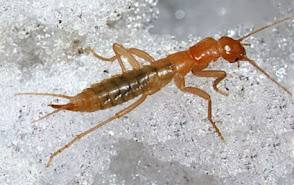
A brown Ice Crawler on grey ice.
As I write this, winter storms are creating misery across huge portions of the US. There’s just so much snow and ice a person can take. But that is not the case with the Ice Crawler (aka Rock Crawler, Ice Bug) of the Grylloblattodea order. These critically endangered insects are small insects (about an inch) that live in cold and snowy mountainous places like ice fields, glaciers, subterranean lava tubes, and ice caves.

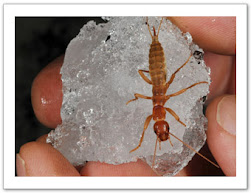
A female on a clump of ice in someone's hand. You an see her ovipostor at the rear of her body.
Ice Crawlers are only found in western North America and Canada and in northeast Asia. In these areas this plucky insect has carved out a place for itself where they have less risk of being preyed upon and are not competing with other insects. They thrive in temperatures that hover around the freezing mark, but they will freeze to death if it gets much lower. Conversely, temperatures much above that point will kill them as well. In fact, merely holding them in a warm hand too long can kill them. They have adapted to living on mountains as temperatures there tend to be more stable than in lower altitudes. And if it gets too cold, they will go underground or under the snow (an insect igloo). Their preferred temperature range is too cold for most insects; the ones that venture there quickly die. There are also fewer of the common predators (birds, small mammals) up there, but if one comes too close they will retreat into their underground lairs. In addition to all these adaptions, Ice Crawlers have adopted a nocturnal lifestyle to further enhance their survival chances.

A Mount Spokane Ice Crawler foraging in the ground.
If high altitude landscapes offer specific survival benefits for Ice Crawlers, they also offer little in the way of food. Ice Crawler has adapted to this in a very basic way – they’ll pretty much eat anything they come across. It is believed that they feed on aerial plankton, but they also scavenge under rocks for decaying plant
matter or mosses. Additionally, they will snap up any hapless flies or moths that made the fatal error of visiting the snowy realms. 

Ice Crawlers have an unusually long lifespan for an insect. Long lives are common amongst cold weather dwellers, and for the Ice Crawler it can take as much as 7 years to complete a life cycle from egg to adult. Add to that the year or so that an adult can live, and you got yourself the Methuselah of the insect world. 

Professor Sean Schoville at work on a mountaintop.
Unfortunately, all these adaptations that have allowed the Ice Crawler to survive in an environment that is inhospitable to most other living things is what is putting their species at risk for extinction. Just as amphibian health reflects the condition of the watery world they live in; Ice Crawlers reflect the ice that’s their home. As we lose ice to climate change, their numbers are falling. Scientists know that much, but there is still a lot to learn about these shy insects and the fear is that we are losing populations before we even know they existed. Luckily, we have some scientists who are willing to spend hours sitting on ice to get the needed data. Sean Schoville, a professor at the University of Wisconsin deserves a special shout-out .He has gone the extra mile (literally) to discover as much as he can about these little creatures. If you want to learn more about what he does, check out this fun article written by an adventurous man who joined him on an expedition (there are some great pictures). 


Submitted by Pam


Tuesday, April 20, 2021

Earth Day 2021

The Earth with a pale hand holding it in its palm. Photo by Greg Rosenke on Unsplash.

It’s been one trip around the sun and we find ourselves approaching another Earth Day under the influence of Covid-19. But at this point, things look a lot better than they did last year at this time. No matter how one feels about the vaccine and the virus-mitigation efforts that have been taken, there has inarguably been some amazing science done this year to get us to where we are now. Being cautiously optimistic seems way more reasonable now then it did in 2020.

A Monarch butterfly hanging off a yellow flower. Monarchs need our help. Photo by Marc Meyer on Unsplash.
Unfortunately, one thing that has not changed is the dire straits that many non-profits still find themselves in. The economic recovery that is on the horizon for some organizations is some distance away for those that depend on donations. Most people have to feel financially secure before they are comfortable sharing what they have. Knowing this, on Earth Day 2021 we are donating a portion of our proceeds to two exceptional non-profits. We hope that you will choose that day to shop on our site and that you may be inspired to support them yourself. Or, simply pass along the word, so that we can get as many people as possible to see what these people are doing for our community and beyond.  
An adult gray wolf with puppy. Help save America's wolves. Photo by ML on Unsplash.
Last year we sponsored the Center for Biological Diversity (CBD), a Tucson-based environmental activism group and we are such fans of what they do that we are sponsoring them again this year. These people don’t just live environmentally conscious lifestyles, they are fighting for our natural world in the trenches of courtrooms, boardrooms, and legislatures. Whether it is protecting a small endangered mammal of the Southwest, safeguarding tribal and public lands, addressing climate change, or conserving ocean waters, these dedicated people are indefatigable in their efforts. And while it may seem like they have too many irons in the fire, they know how to keep the forge running and every iron is being handled optimally. CBD is also very transparent as to where they are in every project, and what their next steps will be. I encourage everyone to go to their website and see for themselves all the incredible work they’re doing. If you are unable to support them financially, there are petitions to sign and information on other ways you can help. After all, they are working for all of us by working to protect all life on Earth.  

Red, ripe pomegranates amongst green branches. Desert Survivors has heirloom pomegranate trees.
Our other chosen non-profit is Desert Survivors,  which is celebrating its 40th anniversary of respected service to our community this year. Desert Survivors combines a love for desert plants (and their conservation and protection) with an employment program for adults with intellectual and developmental disabilities. Both are combined into a retail enterprise that provides reasonably-priced local plants and trees that are not just beautiful but are kind to our harsh-yet-delicate ecosystem. They even have a little shop on the Chuck Huckleberry Loop along the Santa Cruz River that offers drinks, snacks, and other items that passing bicyclists and walkers may enjoy (the Loop, by the way, was recently named the best recreational trail in the US by USA Today). I have a beloved family member with developmental disabilities, so I am always deeply touched and grateful for those people who dedicate themselves to helping all members of society live their lives with dignity and purpose. So, whether you feel inspired by what they do for others, or you are a local plant enthusiast or heirloom tree lover, I hope you will check them out (please go to their website for any Covid restrictions that may be in effect). They are located where Tucson’s earliest inhabitants lived, at the base of Sentinel Peak (“A” Mountain). Ditch the big box stores and buy local plants from local people. A portion of our proceeds on Thursday, April 22nd will go to Desert Survivors, so shop with us on that day and help them out. Or, you can go to them at any time to support them.

Sabino Canyon, Tucson, AZ. Photo by James Lee on Unsplash.
This Earth Day, I hope we all take a moment to step outside and look around in appreciation of the planet we live on.                                                                                                                                                                           
 Happy Earth Day!
Submitted by Pam.


An alien looking out of a spaceship. A reflection of Earth can be seen in its eyes.


Featured Post

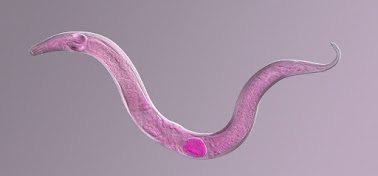
5 Cool Things About Nematodes

It’s September, and here at ARBICO, it’s Beneficial Nematode season. Every year we put our Beneficial Nematodes on sale at this time to enc...