Showing posts with label desert trees. Show all posts

Tuesday, April 20, 2021

Earth Day 2021

The Earth with a pale hand holding it in its palm. Photo by Greg Rosenke on Unsplash.

It’s been one trip around the sun and we find ourselves approaching another Earth Day under the influence of Covid-19. But at this point, things look a lot better than they did last year at this time. No matter how one feels about the vaccine and the virus-mitigation efforts that have been taken, there has inarguably been some amazing science done this year to get us to where we are now. Being cautiously optimistic seems way more reasonable now then it did in 2020.

A Monarch butterfly hanging off a yellow flower. Monarchs need our help. Photo by Marc Meyer on Unsplash.
Unfortunately, one thing that has not changed is the dire straits that many non-profits still find themselves in. The economic recovery that is on the horizon for some organizations is some distance away for those that depend on donations. Most people have to feel financially secure before they are comfortable sharing what they have. Knowing this, on Earth Day 2021 we are donating a portion of our proceeds to two exceptional non-profits. We hope that you will choose that day to shop on our site and that you may be inspired to support them yourself. Or, simply pass along the word, so that we can get as many people as possible to see what these people are doing for our community and beyond.  
An adult gray wolf with puppy. Help save America's wolves. Photo by ML on Unsplash.
Last year we sponsored the Center for Biological Diversity (CBD), a Tucson-based environmental activism group and we are such fans of what they do that we are sponsoring them again this year. These people don’t just live environmentally conscious lifestyles, they are fighting for our natural world in the trenches of courtrooms, boardrooms, and legislatures. Whether it is protecting a small endangered mammal of the Southwest, safeguarding tribal and public lands, addressing climate change, or conserving ocean waters, these dedicated people are indefatigable in their efforts. And while it may seem like they have too many irons in the fire, they know how to keep the forge running and every iron is being handled optimally. CBD is also very transparent as to where they are in every project, and what their next steps will be. I encourage everyone to go to their website and see for themselves all the incredible work they’re doing. If you are unable to support them financially, there are petitions to sign and information on other ways you can help. After all, they are working for all of us by working to protect all life on Earth.  

Red, ripe pomegranates amongst green branches. Desert Survivors has heirloom pomegranate trees.
Our other chosen non-profit is Desert Survivors,  which is celebrating its 40th anniversary of respected service to our community this year. Desert Survivors combines a love for desert plants (and their conservation and protection) with an employment program for adults with intellectual and developmental disabilities. Both are combined into a retail enterprise that provides reasonably-priced local plants and trees that are not just beautiful but are kind to our harsh-yet-delicate ecosystem. They even have a little shop on the Chuck Huckleberry Loop along the Santa Cruz River that offers drinks, snacks, and other items that passing bicyclists and walkers may enjoy (the Loop, by the way, was recently named the best recreational trail in the US by USA Today). I have a beloved family member with developmental disabilities, so I am always deeply touched and grateful for those people who dedicate themselves to helping all members of society live their lives with dignity and purpose. So, whether you feel inspired by what they do for others, or you are a local plant enthusiast or heirloom tree lover, I hope you will check them out (please go to their website for any Covid restrictions that may be in effect). They are located where Tucson’s earliest inhabitants lived, at the base of Sentinel Peak (“A” Mountain). Ditch the big box stores and buy local plants from local people. A portion of our proceeds on Thursday, April 22nd will go to Desert Survivors, so shop with us on that day and help them out. Or, you can go to them at any time to support them.

Sabino Canyon, Tucson, AZ. Photo by James Lee on Unsplash.
This Earth Day, I hope we all take a moment to step outside and look around in appreciation of the planet we live on.                                                                                                                                                                           
 Happy Earth Day!
Submitted by Pam.


An alien looking out of a spaceship. A reflection of Earth can be seen in its eyes.


Wednesday, October 21, 2020

Yes, We Have Trees In Our Desert


Large shade trees over grass in Riverfront Park in Oro Valley, AZ
The biggest misconception non-desert dwellers have about our ecosystem is that we don't have trees. Or that our “trees” are saguaros. Both couldn’t be more untrue: We have a huge number of trees that grow happily here and, while we love our saguaros, they are the grandfathers of the desert cacti and not trees at all. The Sonoran Desert where I live is a harsh and arid place, but by no means the harshest or most arid of deserts (see here for those). The part of the Sonoran Desert I live in (Tucson) is not even the most extreme area in the region. Here we have some elevation, deep underground water resources, and, on occasion, are able to pull moisture from the Sea of Cortez and even the Gulf of Mexico. All of which means this ecosystem is able to maintain healthy trees and tree diversity.

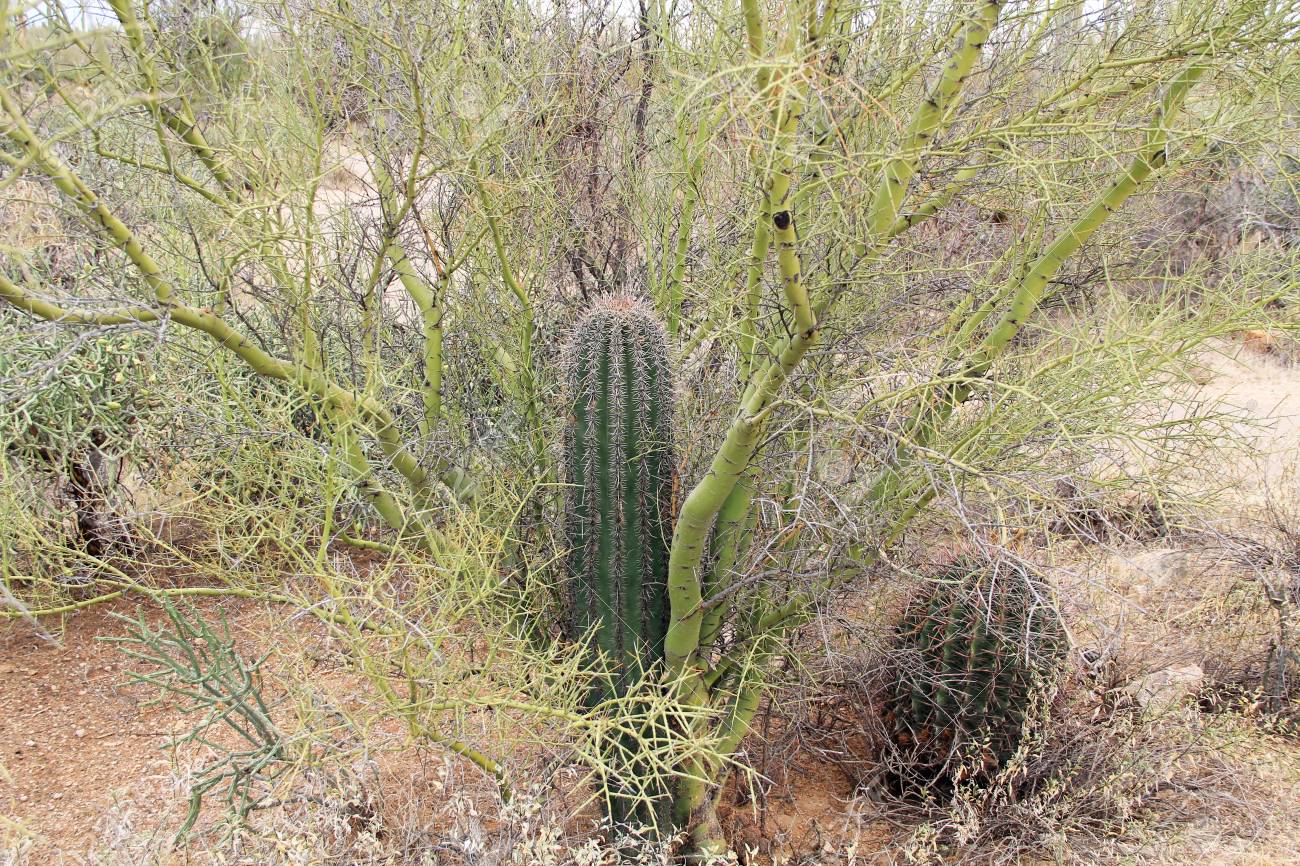
A Palo Verde serving as a nursery tree with a young Saguaro growing up amongst its branches.
Besides their aesthetic appeal and the alluring shade they offer to people, desert trees are entire ecosystems unto themselves. What goes on in their understory is a huge part of their story. Birds, small mammals, reptiles, arachnids, baby plants, and cacti all depend on the shade and protective cover of nursery trees. The shade of the branches of and the water-holding power of roots create a cool hide-away from the brutal sun. It is the perfect place for something small to grow in until it is strong enough to step out into the sun. The very-sharp spikes on many of these trees also adds a layer of protection from predators for small animals. Even the most determined of coyotes will hesitate before poking his nose into such a thorny situation. Without our native trees to nurture our wildlife, many species simply couldn’t survive. Here’s more on this.

A Mesquite tree with branches full of yellow polllen and pollen forming a carpet of yellow on the ground. Photo by Caroline Reilly.
Africa may have its Big 5 of animals, but here we have a big 5 of desert trees: Palo Verde, Mesquite, Catclaw Acacia, Desert Willow, and Desert Ironwood.  There are other natives, but these, in their various varieties, are the most prolific in our area. Palo Verdes are our state tree; they can grow up to 30 feet and live for hundreds of years. Their distinctive green bark provides their name; it means “green stick” in Spanish. Mesquites are the most common tree in the Tucson valley. They are fire-resistant and provide food from their seedpods for people, birds, and animals. They also have abundant golden pollen that can be mighty troublesome for allergy sufferers. Catclaw (aka Devil’s Claw) Acacia, (as the name implies), have imposing curved thorns that most creatures steer clear off. Birds and bees, however, love these trees and acacia honey is especially delicious. Desert Willows are not related to true willows but do have long,
A close-up of a Catclaw Acacia branch showing its curved thornes.
thin branches with graceful, drooping leaves like willows have. These trees have multiple trunks and fragrant, pink trumpet-shaped flowers that are a favorite of hummingbirds. Desert Ironwoods are the slowest-growing of our Big 5 group. They are also the tallest (up to 45 ft.) and longest-lived (as much as 1,500 years). They are essential to our native environment as nursery trees, but they also have deep cultural ties to our indigenous people. The dark, finely textured and dense wood of this tree has been used for artistic, utilitarian, and ceremonial purposes for untold hundreds of years. There is even an Ironwood Forest
An Ironwood tree with pinkish blooms surrounded by smaller mesquite trees.
National Monument in our state, a good portion of which is on Tohono O’Odham tribal lands to the west/northwest of Tucson. 

Many of the trees you may see in Tucson are not originally from here but have proven popular because they do so well in our sunny climate. These include palms (which you see everywhere), olive trees, citrus of all kinds, fig-trees, Texas Mountain Laurels, Vitex/Chaste trees, Pistache trees, guava, and even Southern Live Oaks. One non-native that all Tucson kids seem to love is the Pomegranate tree. As soon as kids find out about the juicy goodness that is their fruit, no neighbor’s tree is safe. Most mothers I know (myself included) have had their offspring come home with smeary, red faces and hopelessly stained T-shirts. 

A very large tree called Phina's tree towering over a 6 story building.
Another outsider species of note is the Eucalyptus tree. These aromatic Australian natives are fast-growing and undemanding water-wise and can grow to be 80 ft. tall and more. In fact, the tallest tree in the city is a Red Gum Eucalyptus near downtown Tucson known as Phina’s tree. It is between 110 and 120 feet tall and has a charming backstory (read more here). Great trees they may be, but the Eucalyptus has several things working against it: They have relatively weak limbs, which can become projectiles on a windy day. This can be especially dangerous during our violent monsoon storms. And then there is their immense size - in a neighborhood of closely placed homes they can be problematic. And, due to their high oil content, they are quite flammable. Even though they have fallen out of favor for these reasons, they were once a popular choice and there is still a lot to be found in older neighborhoods. 
Olive trees lining the walkways at the University of Arizona. There is a man in red shorts running in the foreground.
One last group of Tucson trees I’d like to mention make their home on the University of Arizona campus. Known as the Heritage Trees, there are 8,000 of them from 400 species around the world. Some of these trees date back to around the time that the U of A was founded in 1885. There is even a “Moon Tree”, an American sycamore that was grown from seeds that went to the moon with the Apollo 14 astronauts in 1971. I have always loved the trees at the U of A and enjoyed them as an undergrad, graduate student, and employee.

A moving images of trees and cacti along a pathway.
Even though we have a lot of trees around here, we can always use more to combat climate change and habitat loss. To that end, Mayor Regina Romero has started a Tucson Million Trees campaign. The aim is to get a million trees in the ground by 2030.

I’m sure there are some notable, or note-worthy, trees that I have missed. If so, I think that makes my point that there really are a lot of trees here in our desert. And they add so much to our lives – here is an excellent article (with fabulous pictures) about all they do.


Take Care.

Submitted by Pam


Featured Post

IT'S EARTH DAY 2026!

Happy Earth Day from ARBICO Organics! This year we'd like to introduce you to our newest local non-profit partner - Mission Garden. Loca...