I think it’s safe to say that insects are pretty high up on the creepiness scale for most people. And if you delve into their behaviors, the measurement goes even higher. But some are downright ghostly as well. Here are five prime examples:
- PHASMIDS –
 |
| Phasmid Face |
 These insects are from the order Phasmatodea and are commonly known as ghost insects. The Latin root of their name is “phantasma”, meaning an apparition or specter, and is the same root as phantom or phantasm. There are more than 3,000 species of phasmids and they include stick insects, walking sticks, stick-bugs and others of that ilk. So why have these insects been given a name that is so closely aligned with ghosts? It’s due to their incredible camouflage abilities, which phasmids rely on as their primary defense mechanism. At some point, an imaginative scientist decided that their ability to be nearly invisible creates a ghostly presence in the forest. This article has more on these fascinating insects.
- BLUE GHOST FIREFLIES –

Every year in late May and early June, in dark and moist forests thick with undergrowth of large rhododendron and mountain laurel, the blue ghost fireflies (Phausis reticulata) make their appearance. Found only in southern Appalachia, and mostly in western North Carolina, these small (about the size of a grain of rice) insects are revealed by their mating ritual in early summer. The males float a foot or two off the ground while emitting a ghostly blue light, which by all accounts is quite the eerie sight. As the males float around, the wingless and larvae-like females settle on a leaf and glow to show their presence while evaluating the passing male light parade. The blue-white color of their glow is unique among fireflies (which usually glow yellowish-green), as is their type of glow. Blue ghost fireflies can emit a bright and steady glow for 30 seconds to a minute, whereas other fireflies blink on and off continuously. The beauty and uniqueness of these creatures have spawned a specialized tourist industry, where locals take the curious to see beautiful and fleeting insects. Read more about these wonderful little wisps of nature here.
- GHOST SPIDERS –

 |
| Garden Ghost Spider |
Anyphaenidae family, are common in North America. They get their name from their ghostly white coloring and mostly nocturnal activities. To some people they look like little bitty albino wolf spiders, and it’s hard to argue with that observation. Ghost spiders don’t make webs, instead they use their silk to build shelters in out-of-the-way places like between rocks or in woodpiles. From there they rush out (they are very fast) and hunt down prey, which is mostly other insects. As ruthless as these little guys can be with other insects, they are harmless to humans. Due to their illusive nature, ghost spiders have not been extensively studied, so there are still unknown interesting facts to learn about them. One thing, however, is abundantly clear – their eyes form a cute little smiley face on their heads. For more details on these spiders, check out this article.
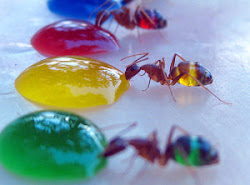 Ghost ants (Tapinoma melanocephalum), sometimes called sugar ants, are an invasive species that has made its way around the world from their probable-source in Africa or Asia. They are currently enjoying life in Florida and have become one the most common, and most hated, ants there. These tiny ants are less than a quarter-inch in size. They have dark heads, but their legs and abdomen are translucent. So much so, that you can actually see into their bodies and see what they’ve eaten. Scientists and others have had fun feeding these ants differently colored objects and watching how they change color. For instance, here’s a video of them drinking glow in the dark liquid candy. There are even classroom experiments geared to elementary school kids that show how the ants change color (here’s one). These ants multiply rapidly and are small enough to enter a house or other structure through even the most miniscule of openings. And, because they are so hard to see, they can quickly and easily swarm over something before one is even aware of them. But while ghost ants may be harder to see than other ants, they are not any harder to get rid of.
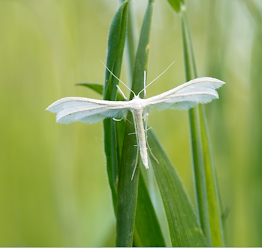 The white plume moth (Pterophorus pentadactyla) has a wingspan of 1-1/2 inches and is found in many parts of the world, but mostly Europe and North America. These moths have an ethereal quality to them that seems ghostly, which is reinforced by their nocturnal habits. But they could also be on a list of angel-like or fairy-like insects. Their delicate way of flying only reinforces this impression (see one fly here). Plume moths have a unique T-shape and wings that end in feather-like fingers. The stark whiteness of the white plume moth stands out amongst other plume moths, which are generally a brownish color. As pretty as these moths are, they can be plant-damaging in their caterpillar stage. According to this article, they threaten sweet potato crops in Nigeria.
 Everything is a little extra-ghostly at this time of year, but these insects are this cool all year round.
- GHOST ANTS –
 |
| Ghost Ant Face |
 Ghost ants (Tapinoma melanocephalum), sometimes called sugar ants, are an invasive species that has made its way around the world from their probable-source in Africa or Asia. They are currently enjoying life in Florida and have become one the most common, and most hated, ants there. These tiny ants are less than a quarter-inch in size. They have dark heads, but their legs and abdomen are translucent. So much so, that you can actually see into their bodies and see what they’ve eaten. Scientists and others have had fun feeding these ants differently colored objects and watching how they change color. For instance, here’s a video of them drinking glow in the dark liquid candy. There are even classroom experiments geared to elementary school kids that show how the ants change color (here’s one). These ants multiply rapidly and are small enough to enter a house or other structure through even the most miniscule of openings. And, because they are so hard to see, they can quickly and easily swarm over something before one is even aware of them. But while ghost ants may be harder to see than other ants, they are not any harder to get rid of.
- WHITE PLUME MOTH –


Take Care
Submitted by Pam