Showing posts with label saguaro blossoms. Show all posts

Tuesday, May 4, 2021

Flowers In May And Beyond

Multi-colored poppies on long stalks with a cloudy sky in the background. Photo by Schwoaze on Pixabay.
It’s May – and that means it’s the time of year when gardeners will delight as their long-planted bulbs bloom, and everyone is awed by nature’s spectacular wildflower displays. May flowers are truly a joy when they appear, but there are ways you can stretch the abundance of blooms through the summer months.

If you are seeing your bulbs bloom now, then you have spring (or hardy) bulbs. Tulips, hyacinth, and daffodils are all spring bulbs. These bulbs are planted in the fall, overwinter in your garden, and need that cold period to complete their growth cycle. But there’s another type of bulb – the summer (or tender) bulb. These bulbs don’t like cold temperatures at all and need to be planted well after a last frost date. Summer bulbs include gladioli, dahlias, and lilies. It is an easy transition from one type of bloom to the other, if you follow these few basic steps at this time of year:

A close-up of a purple dahlia. Photo by Couleur on Pixabay.

• Deadhead your spring-blooming bulbs but leave the foliage intact.

• While deadheading, examine your plants carefully for insect activity. Pest insects enjoy May flowers as much as we do, and you don’t want to introduce them to your next batch of flowers.

• Separate and remove any bulbs that did not thrive.

• Dig up and store any bulbs that need to be kept cool through the summer.

A blond girl holding a lily bulb up close to the camera.
• Keep an eye out for any soil-dwelling pests as you dig into the dirt.

• Plant your summer bulbs amongst your spring ones.

• Summer bulbs do well in containers and look lovely on a front step or porch when in bloom.

This article is a wealth of information on bulbs and is laid out in a very easy-to-read format.

Close-up of white and yellow saguaro flowers, with green buds behind them.
Nature rewards us in spring with wildflowers. Almost anywhere you go at this time of year, you’ll find some. Here in southern Arizona, we have been tickling summer temperatures for a while now, so our wildflower season is well behind us. But we do have reliable May blooms in the form of saguaro flowers (which is also our state flower). These gorgeous white blooms appear in jaunty clusters on the tops of the saguaros and/or the ends of their arms. Along with the flowery show comes the companion animal of the saguaro, the White-Winged Dove. This pretty little bird migrates to Mexico through the winter and early spring months and then returns to the Sonoran Desert just in time to enjoy the saguaro flowers (and subsequent fruit). This cactus and bird are a perfect example of mutualism in nature, where on species depends on another. I wrote a blog on the dove-saguaro relationship, if you want to know a little more.

A field of Trillium grandiflorum (a spring ephemeral)  in a forest
Desert ecosystems notwithstanding, some of nature’s greatest flower shows are found deep in the forest. It is there, thriving in undisturbed organic material and undiluted by mankind, that you can find truly authentic wildflowers. Some of these beauties only appear for a short time and are known as “spring ephemerals”. If you are lucky enough to have a forest that you can get to in May, I recommend you do so this month. You won’t be disappointed. Here is more on spring ephemerals and forest wildflowers in the Saranac Lake region of New York, but these types of flowers can be found many other places as well.


Wildflowers sprouting from the rocky shore on Gannon Beach, Oregon. There is a boulder-island in the background.
Whether you live in the woods, at the beach, or on the prairie, you can find flowers growing around you in May. Even in the biggest of cities, keep an eye out and you’ll see them alongside raucous highways or along a neighbor’s fence line. Granted, some people may call these weeds, but they are also wildflowers. If you don’t want to go looking for wildflowers, or you want specific varieties, you can easily plant your own. There are a great many seeds available commercially that will sprout and bloom quickly so that you can enjoy wildflowers all summer long. According to this article, when planting wildflowers the most important thing is to plant them on prepared, bare ground. If you are unsure as to what will work best for you, here are some glorious suggestions. Of course, it goes without saying that the best choice would be whichever wildflowers are native to your area. 

A partial view of a woman's face as she is looking down and smiling at a bunch of tulips wrapped in brown paper. Photo by Priscilla Du Preez on Unsplash.
There is one more flower that comes in May that I’d like to address: Mother’s Day flowers. Millions of women across America will be receiving some form of flower gift this coming weekend. Unfortunately, most will be dead by the next week. This article has some thorough guidelines, including type-specific care, while this floral company gives four simple steps.

Everything is blooming most recklessly; if it were voices instead of colors, there would be an unbelievable shrieking into the heart of the night – 
Rainier Maria Rilke


Happy May!

Submitted by Pam             


Friday, May 8, 2020

May Flowers Are Here Again

An assortment of brightly colored flowersWe all know the time-worn adage about April showers and May flowers, but in these pandemic times it seems to be a metaphor for what we are all going through. Troubles rained down on us in April, but in May hope for better days is blooming. Mother Nature is moving forward, with or without Covid-19, and she’s giving us beautiful flowers to enjoy as we work our way into our new reality.

White Mayflower blooms
Mayflowers
Before I get into all the flowers of May, I’d like to address the one that carries May in its name: the Mayflower (not to be mistaken for the ship that the pilgrims sailed on). Mayflower blooms spring from a creeping shrub found in undergrowth all along the East coast of North America. Their dainty white or pink flowers have a delightfully sweet scent and nectar that pollinators flock to. It is also known as Trailing Arbutus and is the state flower of Massachusetts.

Some of the most iconic flower beauties bloom naturally in May in the Northern Hemisphere. While many of these are commercially grown and available year-round, viewing these flowers in their “natural” habitat at this time of year can’t be beaten. Some of my personal favorites are:

Lovely lilacs in a glass vase. Photo by Rodion Kustaev on Unsplash.
Lovely Lilacs
Lilacs – It seems everyone likes the smell of lilacs (except for one child in my family who “is not a fan”), but not all varieties are equally fragrant (Syringa vulgaris is the one that has the strongest “lilac-y” aroma). If you decide you want to grow some lilac, be aware that it is prone to Powdery Mildew. Since this fungal pathogen is best treated pro-actively, you should be prepared to treat it as soon as possible. Our Powdery Mildew page has some excellent options to protect your plants.

An assortment of multicolored Snapdragon blooms. 
Snazzy Snapdragons

Snapdragons – These majestic towers of blooms remind me of my childhood in Virginia. My mother always planted these and we children were endlessly fascinated by their “mouths” and how we could make them open and close (I’m pretty sure we did that behind Mom’s back). Snapdragons may slow their flowering as summer heats up, but there are techniques to encourage them to keep blooming.  These flowers are susceptible to many common pests and diseases (see a list here), but the good news is that here at ARBICO we have something to combat each and every one of them.
Mixed peonies blooming in shades of pink and red.
A Plethora of Peonies
   
Peonies – This is an obvious choice for a list of favorites – they come in so many shapes, fragrances, varieties, and colors and all are as beautiful as the next. You can even eat them! It’s virtually impossible to not like peonies. To maximize their beauty in your garden, plant a number of varieties as some will bloom later than others. More on that and overall peony care, in this article here.

A magnificent white Magnolia flower amongst green leaves.
Magnificent Magnolia
Magnolias – This is
another flower that holds great personal nostalgia for me. A whiff of that unmistakable and delightful fragrance and I am transported back to my grandmother’s front yard in North Carolina. She had two huge magnolia trees growing on either side of the steps that ran from the front porch to the road. We children would climb those trees and spy on the adults as they visited on the front porch or we'd pretend we were in some sort of secret lair. This would be great fun unless our grandfather caught us up there – he didn’t like us climbing the trees and would holler at us until we scurried down. Nostalgia aside, I can’t say enough good things about magnolias – they make wonderful shade (and climbing) trees and their flowers are exquisite – beautiful and ridiculously fragrant. Read this to learn more about the regal magnolia.                   
Lily of the Valley flower against dark green leaves,
Lily of The Valley

Someone (probably a marketing-minded florist) designated a flower for each month. The flower for May is Lily of the Valley. Delicately beautiful, these little bell-shaped flowers hide the fact that they are toxic to humans and animals and considered by many to be invasive (more on that here). It may be best to appreciate these from afar and resist the urge to ring the little bell.
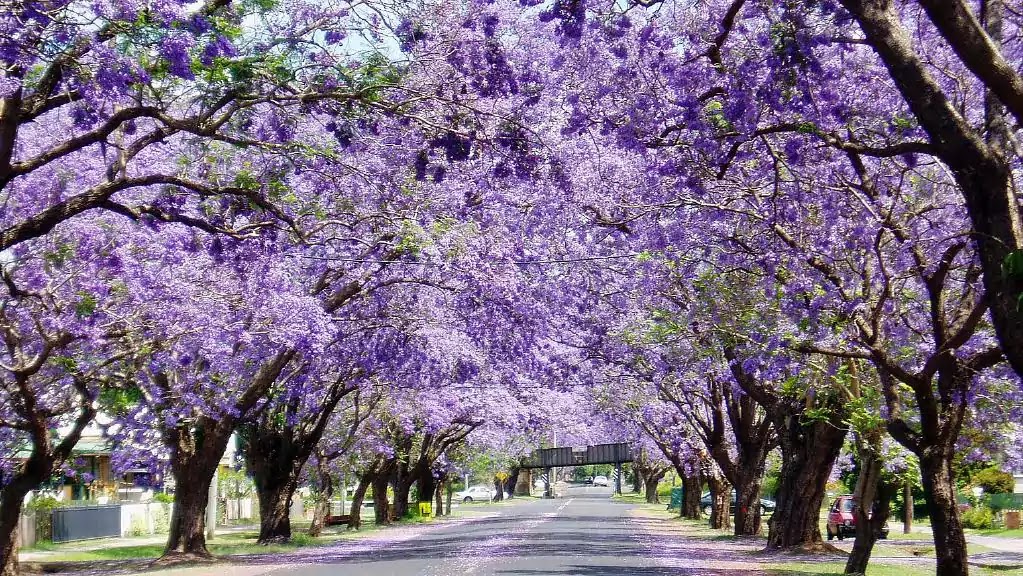
A row of purple Jacaranda trees with purple blooms and black trunks.
Jacaranda trees
All of the flowers I’ve mentioned so far are found in temperate parts of the world, but there are also flowers popping out all over the desert here in southern Arizona. One reliable May bloomer is the Jacaranda tree. When you see their purple, Wysteria-like blooms, you know the school year is ending (except in 2020, of course). These trees are not native to our area, but they have proven to be well adapted to our harsh climate and provide great shade. Cactus of all kinds are also blooming like crazy right now. Prickly pears are producing vivid flowers in a number of colors and saguaros are wearing their festive hats of white blooms and are often sporting the literal feather in the cap in the form of a white-winged dove (for more on this special relationship, see my blog from last year here).
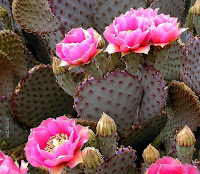
Purple-ish prickly pear cactus with hot pink flowers.
Prickly Pear bloom
A black figure embracing orange and yellow flowers.If you see all this burgeoning beauty blooming around you and wish you could participate, it is not too late. This article has some great suggestions and advice to help you create a flower garden that you can plant now to bloom in late summer and fall.

When you feel overwhelmed by all the negativity floating around these days, look at a  flower and think of what Ralph Waldo Emerson said:
                      "Earth laughs in flowers"

Submitted by Pam
                                   

Featured Post

5 Cool Things About Nematodes

It’s September, and here at ARBICO, it’s Beneficial Nematode season. Every year we put our Beneficial Nematodes on sale at this time to enc...