Showing posts with label flower bulbs. Show all posts

Tuesday, May 4, 2021

Flowers In May And Beyond

Multi-colored poppies on long stalks with a cloudy sky in the background. Photo by Schwoaze on Pixabay.
It’s May – and that means it’s the time of year when gardeners will delight as their long-planted bulbs bloom, and everyone is awed by nature’s spectacular wildflower displays. May flowers are truly a joy when they appear, but there are ways you can stretch the abundance of blooms through the summer months.

If you are seeing your bulbs bloom now, then you have spring (or hardy) bulbs. Tulips, hyacinth, and daffodils are all spring bulbs. These bulbs are planted in the fall, overwinter in your garden, and need that cold period to complete their growth cycle. But there’s another type of bulb – the summer (or tender) bulb. These bulbs don’t like cold temperatures at all and need to be planted well after a last frost date. Summer bulbs include gladioli, dahlias, and lilies. It is an easy transition from one type of bloom to the other, if you follow these few basic steps at this time of year:

A close-up of a purple dahlia. Photo by Couleur on Pixabay.

• Deadhead your spring-blooming bulbs but leave the foliage intact.

• While deadheading, examine your plants carefully for insect activity. Pest insects enjoy May flowers as much as we do, and you don’t want to introduce them to your next batch of flowers.

• Separate and remove any bulbs that did not thrive.

• Dig up and store any bulbs that need to be kept cool through the summer.

A blond girl holding a lily bulb up close to the camera.
• Keep an eye out for any soil-dwelling pests as you dig into the dirt.

• Plant your summer bulbs amongst your spring ones.

• Summer bulbs do well in containers and look lovely on a front step or porch when in bloom.

This article is a wealth of information on bulbs and is laid out in a very easy-to-read format.

Close-up of white and yellow saguaro flowers, with green buds behind them.
Nature rewards us in spring with wildflowers. Almost anywhere you go at this time of year, you’ll find some. Here in southern Arizona, we have been tickling summer temperatures for a while now, so our wildflower season is well behind us. But we do have reliable May blooms in the form of saguaro flowers (which is also our state flower). These gorgeous white blooms appear in jaunty clusters on the tops of the saguaros and/or the ends of their arms. Along with the flowery show comes the companion animal of the saguaro, the White-Winged Dove. This pretty little bird migrates to Mexico through the winter and early spring months and then returns to the Sonoran Desert just in time to enjoy the saguaro flowers (and subsequent fruit). This cactus and bird are a perfect example of mutualism in nature, where on species depends on another. I wrote a blog on the dove-saguaro relationship, if you want to know a little more.

A field of Trillium grandiflorum (a spring ephemeral)  in a forest
Desert ecosystems notwithstanding, some of nature’s greatest flower shows are found deep in the forest. It is there, thriving in undisturbed organic material and undiluted by mankind, that you can find truly authentic wildflowers. Some of these beauties only appear for a short time and are known as “spring ephemerals”. If you are lucky enough to have a forest that you can get to in May, I recommend you do so this month. You won’t be disappointed. Here is more on spring ephemerals and forest wildflowers in the Saranac Lake region of New York, but these types of flowers can be found many other places as well.


Wildflowers sprouting from the rocky shore on Gannon Beach, Oregon. There is a boulder-island in the background.
Whether you live in the woods, at the beach, or on the prairie, you can find flowers growing around you in May. Even in the biggest of cities, keep an eye out and you’ll see them alongside raucous highways or along a neighbor’s fence line. Granted, some people may call these weeds, but they are also wildflowers. If you don’t want to go looking for wildflowers, or you want specific varieties, you can easily plant your own. There are a great many seeds available commercially that will sprout and bloom quickly so that you can enjoy wildflowers all summer long. According to this article, when planting wildflowers the most important thing is to plant them on prepared, bare ground. If you are unsure as to what will work best for you, here are some glorious suggestions. Of course, it goes without saying that the best choice would be whichever wildflowers are native to your area. 

A partial view of a woman's face as she is looking down and smiling at a bunch of tulips wrapped in brown paper. Photo by Priscilla Du Preez on Unsplash.
There is one more flower that comes in May that I’d like to address: Mother’s Day flowers. Millions of women across America will be receiving some form of flower gift this coming weekend. Unfortunately, most will be dead by the next week. This article has some thorough guidelines, including type-specific care, while this floral company gives four simple steps.

Everything is blooming most recklessly; if it were voices instead of colors, there would be an unbelievable shrieking into the heart of the night – 
Rainier Maria Rilke


Happy May!

Submitted by Pam             


Thursday, April 1, 2021

A Tale of Two Easter Flowers

Easter lilies with pink and purple tulips in a clear glass vase on a grey table with white books in the background.
When we think of Easter, there are many images that come to mind: religious symbols, bunnies, baskets, and eggs. But there are also flowers – lots and lots of flowers (it’s spring after all). Two of the most iconic and beautiful are the Easter Lily and the tulip. At first glance, it may not seem that these two flowers are alike at all, but they have some surprising commonalities. These include their long international backstories that lead to the Pacific Northwest.

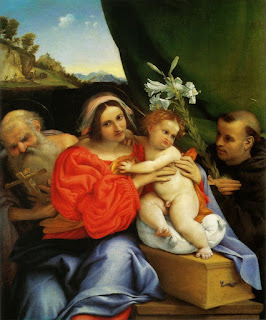
Lilies have been a symbol of purity, hope, and rebirth as far back as ancient Greece. With the rise of Christianity, this flower became associated with the Virgin Mary. One can find depictions of the lily in European religious art dating back at least to the 14th century (more on that here). Over time, the connotation of rebirth made these flowers an obvious choice for Easter celebrations, when Christians celebrate the resurrection of Christ. 

A 1521 painting showing Mary and the baby Jesus in the middle. In the background, left and right are two men. The man on the right is presenting them with a lilies on a stalk.
The lilies that have been so greatly admired for centuries in Europe are not the lilies that most Americans are familiar with. Europe has lilies that are native there, but the Easter Lily that we know is actually native to Japan. In the mid-19th century, Japanese bulbs were introduced to Bermuda and they did extremely well. In no time, Bermuda was providing 90% of these flowers to the US. Unfortunately, a virus struck in 1899 that decimated the crop (more here). After that, Japan was the only source for the lilies - until World War II changed everything.  Luckily, a WWI soldier, on his way home to Oregon from Japan in 1918, had smuggled some Easter Lily bulbs into the country to share with family and friends. That little bit of federal lawbreaking literally provided the seed for the Easter Lily economy in the Pacific Northwest today. So, after bouncing from Japan to Bermuda and back to Japan; 99% of the Easter Lily bulbs sold in North America are now produced by four family farms in Smith River, CA. Quite a journey for a flower. 

Eater lilies on a white background.
Tulips may not carry the religious symbolism that lilies do, but they have long been a cheerful harbinger of spring. One of the first flowers to bloom in springtime, these colorful beauties are always a welcome sight. Easter just wouldn’t be the same without the sight of tulips. People commonly gift tulips at this time of year, and apparently, their different colors carry meanings to recipients much like roses do. I know I’d be happy with any color.

Multicolored tulips for sale in Ukraine. Photo by John-Mark Smith on Unsplash.
Tulips are native to Central Asia, but we can thank the flower-lovers of the Ottoman Empire (based in modern-day Turkey)for introducing them to Europeans. The Ottomans prized these flowers and cultivated them in many colors and patterns. In the 17th century, Dutch tradesmen brought these beauties home. A quick side note: An important reason that lilies and tulips both traveled such great distances is their bulbs; unlike other types of flowers, bulbs take years to mature and can be transported in relative safety during this period.

Once tulips arrived in the Netherlands, they quickly became an obsession for many. Tulip Mania (1634-1637) was the height of this obsession, when tulips became the world’s most expensive flower and bulbs were sold that cost more than mansions. While this phenomenon was short-lived, the cultural and economic circumstances are still being studied. Luckily for all of us who appreciate their beauty, the bust of Tulip Mania did not mean the end of tulips in the Netherlands. To this day, the Dutch remain the world’s largest commercial producer; they export about 3 billion yearly. They even have a National Tulip Day in January (more on that, and other cool festivals, here).

A painting by Henrik Gerritz Pot, 1640, called Flora's Wagon of Fools. It shows people on a wagon with a sail. Many of them are dressed silly and are carrying tulips.
Tulips may be a national treasure in the Netherlands, but they have found a second home in Washington State. North of Seattle in the Skagit Valley, tulips have grown into a major industry that started with one man’s whim. George Gibbs, an English immigrant, was farming in the area in the 1890s when he randomly planted a few bulbs on his property. He dug them up a couple of years later and excitedly discovered that they had multiplied. With this new-found knowledge that the climate in Washington was perfect for tulip cultivation, he wrote to some Dutch growers for advice. Initially, they didn’t want to share their secrets, so he forged on without them. Later, though, he shipped some bulbs to them and they were so intrigued and impressed that they made the long trip to see his operation. From this one man’s dream, a world of tulips grew. Today, the Skagit Valley Tulip Festival attracts thousands every year from all over the world. If you’re in the area, the festivities start today and go through the end of April. 

Tulips in a field with structures in the background. Tulip Festival by Kelsey Dody on Unsplash.

While researching this blog, I was surprised to discover that both the Easter Lily and the tulip are edible. At least technically edible, most people do not claim they’re especially tasty. If you are interested in ingesting some beauty check out this article on eating tulips, which has an intense passage from a Dutch person who ate tulips when other food sources dried up during WWII. As far as Easter Lily food goes, this blogger is a real fan. 

                             White bunnies popping up in a field of tulips.

Take Care. Submitted by Pam


Featured Post

5 Cool Things About Nematodes

It’s September, and here at ARBICO, it’s Beneficial Nematode season. Every year we put our Beneficial Nematodes on sale at this time to enc...