Showing posts with label santa origin story. Show all posts

Monday, December 10, 2018

The Curious Christmas Tale of Amanita Muscaria

Santa and his reindeer have, over the years, become the ubiquitous symbol of western Christmas celebration. Despite the overarching religious narrative around Santa Claus and St. Nicholas, there are some that have called the true origin of a sleigh-driving man led by flying reindeer into question. Anthropologists and mycologists have traced a historical link back to mind-altering fungi.

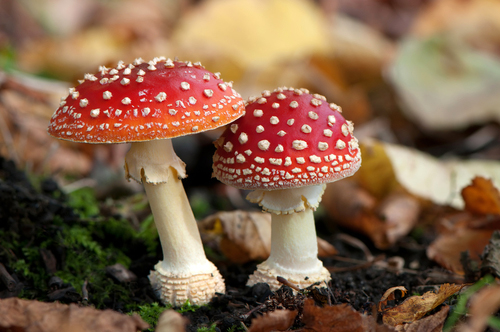
Fly Agaric, Amanita muscaria
The Gifts of Winter
This new origin theory suggests that the figure of Santa arose from the practices of shamans native to Siberian and Arctic areas. They would arrive in settlements around the Winter Solstice with a bag stocked full of “presents.” These presents came in the form of Amanita muscaria – a hallucinogenic mushroom more commonly known as the fly agaric or “holy mushroom.” The native people often lived in teepee-esque houses with a single opening to the ground. Since snow often blocked that entrance, the shamans would drop their tidings through an opening in the roof, hence the story of Santa coming through the chimney.
A Little Mushroom Forest
The Botanical Link
That is not the only link these entheogens (substances that induce a spiritual experience) have to our modern festivities. Have you ever wondered why placing presents under a tree came to be the norm or why pine trees are the preferred “Christmas tree”? Well, fly agaric mushrooms are commonly found lurking at the base of conifer and birch trees with their bright red coloration and white spots calling attention to them. From the native’s perspective, the trees were the resting place for their gifts – an important spiritual element of their lives. Moreover, their colors have been adopted for wrapping paper, seasonal decorations and Santa himself.

But Why The Flying Reindeer???
This is where it gets a bit more involved with the “experience.” Unfortunately, reindeer cannot fly, but our minds are palaces of imagination and wonder. The symbol of a flying sleigh led by reindeer embodies the taking of a “trip” and traveling to a different plane of consciousness. The vessel was more symbolic than practical and as Carl Ruck put it, “Amongst the Siberian shamans, you have an animal spirit you can journey with in your vision quest and reindeer are common and familiar to people in Eastern Siberia.” With the Amanita muscaria induced departure from reality, the people connected elements of their environment to their psychedelic experiences. These connections helped build spiritual importance of the animals to the people who lived with them. As other groups of people intermingled in time, stories were shared and mythos was merged.

Sassy Reindeer
As traditions and groups of people congealed, elements of the past remained. Reds and whites dominate the Christmas season, Santa still drops in through the chimney, conifers are sold as Christmas trees (even multi-colored), and airborne reindeer still dot the gift cards, decorations and movies of the season. No matter how far we come, traces of what came before can still be found. The Christmas that we know is just one example of that. So remember…instead of cookies, pick some mushrooms and leave those for your Christmas Eve visitor this year.

- Contributed by Sterling N.

Wednesday, October 3, 2018

Spooky, Funky, Strange and Freaky – Fungi!

There is always something amazing to discover in the Fungi universe. Sometimes it’s awe-inspiring, sometimes it’s kind of creepy, sometimes it’s a beautiful thing and other times it’s just gross. Whether you call them “fun-guy” or “fun-gy” (as they commonly do in the UK), these organisms are on us, in us and around us every day and most people give them very little notice.

Honey Mushroon growing out from under a log on the forest floor
Honey Mushroon
The largest organism on earth
is a Honey mushroom (Armillaria solidipes); a fact I find rather creepy. I mean, a 2.4 mile long organism growing under the earth in Oregon and feeding on trees? It sounds more like a horror movie than reality. Apparently, these mushrooms are quite tasty. If we started eating that shroom, we could feed a whole lot of people and save a forest at the same time. It’s just a random thought, I’m not advocating for that.

Fungi are also some of the smallest organisms on earth. These microfungi are literally everywhere around us. They are microscopic and consist of little more than filaments called hyphae (collectively known as mycelium). What they lack in size they make up in variety and volume, the spores they produce affect everything from diseases to food production. The number of microfungi species out there is still unknown. These fungi are on their own agenda doing what is best for them, we are not a part of it. That is a bit creepy as well.

Mushroom fairy ring in autumn leaves under a large tree
Fairy Ring on a bed of autumn leaves.
One fungal phenomenon that is not as spooky as it once was, is the Fairy Ring (aka Fairy Circles, Elf Circles, Pixie Rings and Witches Circles).For many hundreds of years, particularly in Western Europe, the sudden appearance of these rings in the grass was seen as something mysterious and mystical. What we now know is that these rings are caused by fungi in the soil. The fungi release nutrients in the soil (notably nitrogen) and then grow around the affected area. These rings usually grow to be between a few inches and 200 feet in diameter. However, the largest is in France and it is a whopping 2,000 ft. in diameter. There is definitely something eerie about Fairy Rings, but they are a natural event and can be treated in order to prevent damage to a lawn. Nitron Thatch Away can help break down the organic matter that the fungi feed on and Actinovate® Lawn and Garden Fungicide can keep away diseases born of fungal activity.

A mushroom with a red top with white spots on a white stem
Fly Agaric Mushroom
Some fungi are beautiful and others are funky (both in smell and appearance). Then there is the Fly Agaric (Amanita muscaria) which is a little of both. While it appears to be a prop from a Disney movie, this toadstool is definitely not for children. Although it is highly poisonous raw, it can be eaten after it’s parboiled. In some cultures, this mushroom is consumed during rituals for its hallucinogenic properties. As unlikely as it may seem, the legend of Santa Claus may have its roots in this little magic mushroom.

Fungi in all its forms is fascinating. Sometimes the fascinating aspect morphs into that morbid fascination that something macabre gives us. The following fungi definitely elicit the “ewww” factor:

Bleeding or Devil's Tooth Fungus
Bleeding Tooth/Devil’s Tooth (Hydnellum peckii): Found in North America, Europe, Iran and Korea, this fungus is not poisonous. There are people out there with questionable impulse control that may want to eat it; they will find out it tastes about as good as it looks.

A fungus growing out from the underside of a log that looks like fingers coming out.
Dead Man's Finger Fungus

Dead Man’s Fingers (Xylaria polymorpha): This is a saprotrophic fungus, meaning that it lives on dead and dying wood. It helps break down organic matter. On occasion this fungus will appear on a living tree, indicating that the tree has serious health issues.

A fungus shaped like a human ear growing on moss covered wood
Jew's Ear Fungus
Jew’s Ear/Wood Ear/Jelly Ear (Auricularia auricular-judae): This edible fungus can be found all over the world and is used in traditional medicines in many countries.  Its name is not meant to be anti-semitic, rather it is a reference to the belief that Judas Iscariot hung himself on an elder tree (Judas’ Ear became Jew’s Ear). This fungus can be found on beech and sycamore trees, but elder trees are where you will most commonly find them.

A red fungus that looks like a flower made of raw meat
Scarlet Waxcap Fungus
Scarlet Waxcap (Hygrocybe coccinea): This fungus is common and widespread across the globe in northern latitudes. It is edible, but the taste is fairly bland. For the purpose of this
blog, what is most interesting about this mushroom is that it can look like uncooked meat. This may be off-putting to some, but it's downright alluring to mycophiles.
An Immature Anemone
 Stinkhorn Fungus

Anemone Stinkhorn/Starfish Fungus (Aseroe rubra): This specimen is a native of Australia, Tasmania and the South Pacific in general. It changes its appearance as it ages; it goes from a whitish gelatinous form to an upright figure with arms. To many people, it resembles one form of sea life or another in one or more of these stages (thus the “anemone” and “starfish”). At maturity it secretes a vile-smelling slime. All in all, the grossness factor is high on this guy.

All these fungi, no matter how unsettling some may seem, have their place in the universe. This blog could easily have shone a light on some of the most beautiful of fungi. But, since this is the season of Halloween and All Soul’s Day, I just had to bring out some less-than-lovely ones.

Submitted by Pam


Featured Post

IT'S EARTH DAY 2026!

Happy Earth Day from ARBICO Organics! This year we'd like to introduce you to our newest local non-profit partner - Mission Garden. Loca...