As part of the Plant Parenting craze that has surfaced in the last few years, succulents have seen a rise in popularity that is more of a tsunami than a surge. As a person who lives in and loves the
Sonoran Desert, it pleases me to know that cacti and succulents are getting the appreciation and respect they deserve. On the other hand, as with many things that suddenly become popular, their very popularity can be devastating to them. Desert habitats may seem tough and durable (and in many ways they are), but they are also finely balanced and the flora that thrives in them can be quite delicate. They can be damaged irreparably by the smallest amount of foot traffic, not to mention rampant and/or random harvesting. Here are two excellent articles on the effects of the succulent/cactus trade:
This one explains how all cacti are endangered and
this one lists the succulents that are almost gone already. There are several plants on the following list that are endangered and/or rare. If you are interested in them or are actively collecting any cacti or succulents, always order from a reputable dealer and never purchase from unknown sources online or attempt to collect them yourself.
As an aside: If you are unsure as to the difference between cacti and succulents,
this article explains it simply.
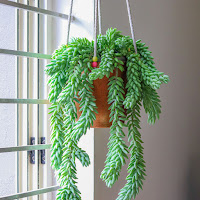 SEDUM MORGANIANUM
 – aka Burro’s Tail, Burrito, Donkey’s Tail, Lamb’s Tail, Horse’s Tail, Sedum Burrito. Originally from southern Mexico, this is a dramatic yet easy-to-grow succulent, with long, thick, trailing stems of overlapping grey-green leaves that look almost braided. This plant can get quite long (up to 4’) and heavy; it looks fantastic as a hanging plant, but make sure you have a strong enough pot and hanger.
Here's more on their care and here's a
video as well.
 CRASSULA UMBELLA
 – aka Crassula Wine Cups, Wine Cup Succulent. This unique succulent is native to South Africa. It has erect, smooth stems that end in leaves that are roundish and curved under around the edges to form an upside-down umbrella-like shape. Flowers will appear around an erect, inflorescence that pops out of the middle of the leaf. This lovely succulent is easy to grow but hard to find commercially, making it a desirable addition for any collection. Learn more
here.
 ESCOBARIA ABDITA
 – This cool-looking cactus was named after the Mexican naturalist Romulo Numa Escobar. It comes from a very dry basin in the Mexican state of Coahuila. In times of extreme drought, this plant can retract its stems and live partially (or even completely) underground. The unique spines that thickly crisscross the surface are white and look like spindles or flowers. The actual flowers are large and daisy-like and pop out from between the spines. This cactus is not easy to keep alive and thriving – it’s hard to duplicate the harshness of the environment it is accustomed to without actually killing it. But that does not mean it is impossible;
here's more.
CONOPHYTUM BURGERI – aka Burger’s Onion, Little Light Bulbs. This endangered South African plant is a simple, single-bodied succulent that can be green, white, strawberry-colored, vaguely purple, or some mix of each. It has a roundish, almost onion-like shape and a big ole purple and white flower that perches on top like a lady’s sun hat. It is reported that the flower smells like honey. The native habitat of this little gem is
protected by the current owner – a mining company, no less.
Here’s a video on the always-important watering of this family of succulents.
 PSEUDORHIPSALIS RAMULOSA
 – aka Red Rhipsalis, Red Mistletoe Cactus. This stunning
epiphytic cactus is native to rainforests in large parts of the Caribbean, Central America, and northern South America. The Red Mistletoe Cactus has long (up to 2’) stems full of flat, ribbon-like leaves. It starts out green, but bright sunlight will cause it to color up in shades from peach or light violet to a deep burgundy-red. Along the leaf edges, it will produce small white flowers that look like a trim of seed pearls. To learn more, read
this and watch
this short video.
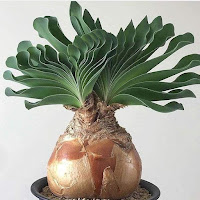 BOOPHONE HAEMANTHOIDES
 – aka Namaqua Century Plant, Cape Century Plant. This southern African native is unusual among succulents in that it does its active growing during winter months (because that’s when the rains come in its native land). The wavy, bluish-green leaves can get 15”-18” long and protrude from a massive (8+ inches) bulb. This bulb grows in layers like an onion and displays most of its bulk out of the ground. This plant will bloom, and the flowers are indeed beautiful and fragrant, but it is extremely slow to flower. This is because Boophone Haemanthoides is a long-living plant, with some bulbs living as long as 100 years in the wild, so it can easily take as much as 8-10 years for them to reach their blooming stage. Luckily, the foliage of this neat plant is so entertaining you may not care if it ever flowers. More on the intriguing plant
here and watch a woman talk about her first bloom from one
here.

XEROSICYOS DANGUYI – aka Silver Dollar Vine, Silver Dollar Plant, Dollar Vine, Penny Plant, String of Coins. This fast-growing vine from Madagascar is actually a member of the Cucurbitaceae family, which makes it a relative of the cucumber. This succulent is nearly all tendrils, which have thick, coin-shaped leaves at intervals along their length. In mid-to-late spring, you can expect tiny, four-petaled pale yellowy-green flowers. The arms of this succulent can get quite long (20” or so) and will spread nicely along a windowsill or tabletop - or allow it to make a statement as a hanging plant. Watch
this video and/or read
this for more information.
 EUPHORBIA TIRUCALLI
 – aka Pencil Cactus, Sticks on Fire, Milk Bush, Firesticks, Firestick Plant, Indian Tree Purge, Naked Lady. Think you have the chops for a “dangerous” plant? And the space for a large indoor tree? If so, this succulent may be for you. Euphorbia Tirucalli hails from the warmest climes of Africa and India, where it can grow up to 30 feet. Grown indoors, it can achieve six feet and, at certain times of the year, it glows in shades of orange, yellow, and pink. Its danger lies in its milky-white sap. The sap carries toxins that, for most people, are not a huge concern. But for some people, it can cause severe, even anaphylactic, reactions. And everyone should take precautions to keep it away from their eyes. If you take proper safety measures when handling and don’t have children or pets to worry about, this gorgeous plant could be a stunning addition to your collection. For more on the inherent risks in keeping this succulent, read
this article. For general information on this plant, check out
this article and
video.
 CRESTED SENECIO VITALIS
 – aka Mermaid Tails, Whale’s Tail, Blue Chalk Fingers, Blue Chalksticks, Narrow-Leaf Chalk Sticks. Here is another terrific South African succulent and this one gives off some serious under-the-sea vibes. The particular shaping of these specimens is caused when they crest, meaning they stop producing stems and branches and, instead, flatten out and grow out wild shapes on top. This process is natural and may only last a few years, at which time they can begin to take one another more “normal” shape, These look really cool in a pot, but keep in mind that they can grow 3-5’ wide 2’ tall. You can grow them outside in some areas, but they’ll need to be watched as they can turn invasive in certain environments. Watch
this video to see how to trim one and read
this article for more information overall.
AEONIUM ARBOREUM ZWARTKOPT – aka Black Rose, Black Rose Aeonium, Black Tree Aeonium, Black Beauty. Are you ready to add some unusual color to your collection? This exotic succulent has its roots in the Canary Islands and its delightful deep-burgundy, almost-black-looking leaves are a real treat. There is a caveat, however: these beauties need plenty of direct light – about 6 hours a day. This preference for sunbathing (they’re from the Canary Islands, after all) allows them to maintain their gorgeous coloring. Without it, they will fade to an ordinary green. They also can get pretty big (4’ high and 2’ wide), which is something else to take into consideration for an indoor plant. As a patio plant, they would do well. Once you get their space and light requirements down, they require little attention. See more
here and read more
here.

An essential component to growing any of these plants successfully is to have the right soil. We offer a really terrific one from a company right here in Tucson, where we know our cacti and succulents. Check it out
here. And for all you cactus lovers, t
here is a way to safely adorn yourself with our iconic Saguaro Cactus.
Stay cool out there.
Submitted by Pam