Showing posts with label Mexican Revolution. Show all posts

Wednesday, November 14, 2018

Hemp - From Favored Flora to Fake News and Fabricated Hate

A modern-day recreation of the colonial ship The Mayflower
The Mayflower
Hemp arrived on this continent with the first ships to troll its shores. When Columbus and his crew set sail in 1492, it was in ships fitted with sails and ropes made from hemp. If you are one of the many people that believe the Vikings got here first, there is evidence that they also used hemp for cloth and cordage. The plant was introduced into Mexico by Pedro Cuadrado, a Spanish Conquistador shortly after the conquest in the early 1500s. He brought the seeds to begin a business venture that was relatively short-lived, but more on that later.

Hemp is considered to be one of the oldest domesticated crop in the world. There is evidence that it has been used since 8,000 BCE. By the time the pilgrims arrived on their hemp-outfitted Mayflower in 1620 (see a fun video here), the plant was an unquestioned and important staple in their world. From the beginning of the colonies, the English decreed that the colonists grow hemp. The reason was simple: the British Navy was busy empire-building and there was a constant need for rigging and sails, a need that they were having a hard time keeping up with. The colonists never quite managed to supply the hoped-for hemp bounty, however, as they soon found that they needed all they could grow. They not only made cloth and ropes, they extracted the oil from seeds and burned it in lamps and bartered with all parts of the plant.

Black and white etching of early American colonists harvesting hemp
Early colonists harvesting hemp

Meanwhile, in Jamestown, Virginia, colonists had been struggling to survive since 1607. By 1619, they felt established enough to set down some laws. Included in these was the mandate that all settlers grow hemp, “For hemp also, both English and Indian, and for English flax and aniseeds, we do require and enjoin all householders of this colony, that have any of those seeds, to make trial thereof the next season.” This was America’s first, but by no means last, cannabis-related legislation.

Modern black and white drawing of Betsy Ross
Betsy Ross
Throughout most of the next 300 years, hemp maintained its position as a widely-used and valuable commodity. It was legal tender in the colonies of Pennsylvania, Virginia and Maryland and, for more than 150 years, taxes could be paid in hemp. Thomas Jefferson, George Washington and John Adams all grew industrial hemp. It is believed that Betsy Ross made the first U.S. flag with hemp cloth and scholars know that Benjamin Franklin used hemp string when he did his famous lightning experiment.

Hemp was held in high esteem in our country until the beginning of the 20th century, when a whispering campaign was begun against it. To explain, let’s go back to Pedro Cuadrado: his hemp seeds had created a lucrative business growing industrial hemp, but by 1550 the Spanish government restricted his endeavor. Apparently, the native people of the region had discovered a more eye-opening use for it than making rope and this disturbed the authorities (a theme that continues to plague the hemp plant). Despite the restrictions, cannabis from the hemp plant maintained its following in Mexico. When refugees began arriving as a result of the Mexican Revolution (1910-20), they brought their herb with them and introduced it into the American zeitgeist.

Black and white photo of a grim-faced William Randolph Hearst with his arms crossed in front of him
William Randolph Hearst
With the onset of the Great Depression and its massive job losses, resentment towards Mexican migrant workers grew in many areas. They were seen as taking jobs that American workers badly needed (sound familiar?). This is when the incredibly rich and powerful William Randolph Hearst entered the picture. He was unabashed in his disdain for Mexicans, once saying, “I really don’t see what is to prevent us from owning all Mexico and running it to suit ourselves.” Hearst used his papers to stoke the anti-Mexican fervor and to connect it to hemp by portraying them as drug-crazed from cannabis. Despite being a complete racist, his motivation for targeting hemp was probably to protect his timber holdings and eliminate hemp paper, which he was successful at doing.

The final nail in the hemp coffin was the appointment of Harry Anslinger in 1930 as the nation’s first Drug Czar. By most accounts, he was as reprehensible a racist as Hearst and a rabid evangelical to boot. He was all in on Prohibition and, when that was repealed he turned his to attention to other stimulants. His rhetoric was all about the dangers of minorities on drugs and it played well into the Depression narrative. Unfortunately, Anslinger stayed in the U.S. Treasury Department Bureau of Narcotics into the 1960’s and was able to firmly nail down anti-cannabis/hemp laws.

The pendulum is definitely swinging back in hemp’s favor these days. In time, the criminalization of this useful plant will undoubtedly be seen as what it was: fear-mongering in order to satisfy special interests. If we could only get rid of all the sensationalized reporting and fabricated hate we would all be better off.

Submitted by Pam

Friday, November 2, 2018

Day of the Dead: So Much More Than Cool Makeup


Man dancing in elaborate feathered headdress and costume, holding large rattles
Aztec Dancer - Day of the Dead in Los Angeles
Modern Americans have adopted the Mexican tradition of the Dia del los Muertos (Day of the Dead) into mainstream culture. Not too many years ago, it would have been difficult to find skulls and skeleton-embellished clothing readily available beyond Halloween. Today, commercially made items can be found everywhere from a nationwide chain like Party City to designers like Alexander McQueen. There is even a website that features everything skull and skeleton related for your accessorizing, décor and clothing needs.

A sure sign that the Day of the Dead is been taken over is that Disney made a movie about it – Coco. Fortunately, the creative forces behind Coco took great care to appropriately depict the cultural and spiritual event that is Dia de los Muertos. For its first movie to depict a minority character in the lead, they consulted extensively with the people whose traditions they were depicting. The result was a beautiful movie filled with heart and music that deserves the recognition it receives.

Mictecacihuatl - The Lady of the Dead
Celebrating death as a continuous part of human existence and remembering those that have passed on has extremely deep roots in Mexico. These traditions date as far back as 1800 BC and were practiced by indigenous people throughout Mesoamerica. The origins of contemporary Day of the Dead celebrations lie with the Aztecs, who believed in a complex and vibrant afterlife (for a fun few minutes in their underworld, click here). They had been celebrating death and harvest rituals for more than 500 years before the Spanish arrived in 1519. The Spanish quickly and aggressively converted indigenous people to  Catholicism, but many ancient traditions were tightly held and the Spanish wisely allowed the native people to meld the two belief systems. The result is a form of Catholicism that is unique to our continent. Modern Mayan and other native peoples continue their singular celebrations to this day. This includes the Pascua Yaqui tribe here in Tucson, whose observances last two days (Nov. 1-2) and are tied to All Soul's and All Saint's days.
La Calavera Garbancera (Catrina)
One of the most iconic symbols of the Day of the Dead is that of La Calavera Catrina (or just Catrina). This image was the creation of Jose Guadalupe Posada in 1910. Inspired by the Aztec Queen of the Underworld, Mictecacihuatl (The Lady of the Dead), Posada’s skeletal beauty was new and yet familiar to the Mexican people. Catrina was born the same year that the Mexican Revolution broke out in response to the long and corrupt dictatorship of Porfirio Diaz. The Diaz regime was characterized by a push to modernize Mexico by embracing all things European, further enriching the elite on the backs of the poor. Posada was a lithographer and his work was distributed widely among the huge numbers of illiterate workers. He named his creation “La Calavera Garbancera”, “Garbancera” being a derogatory phrase used at that time for native Mexicans who tried to pass as Europeans. When asked about Catrina, he is said to have replied, “We are all skeletons”. Their fight for a new Mexico was long and bloody but ultimately successful and Diaz was overthrown, in large part because the poor and disenfranchised were able to rally under symbols like Catrina.

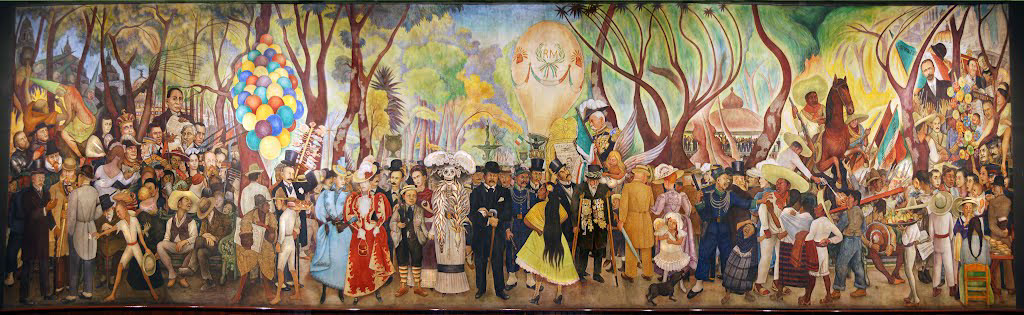
Image of a mural with many people in it depicting 400 years of Mexican history, titled Dream of a Sunday Afternoon in Alameda Park by Diego Rivera
Dream of a Sunday Afternoon in Alameda Park by Diego Rivera
Catrina was further entrenched in Mexican culture when the painter DiegoRivera painted the dandified skeleton into his masterpiece “Dream of a SundayAfternoon in Alameda Park” (1946-47). In the massive mural depicting 400 years of Mexican history, Diego placed Catrina front and center, with Posada on one side of her and himself and his wife, Frida Kahlo, on the other. Diego was a firebrand with strong Communist ties and he greatly admired Posada and looked up to him as a mentor. Even 35 years after she was created, the symbolism of Catrina was important enough to Rivera to make her a focal point in what was arguably his most important work.

In this time of picking sides and divisive politics in our own country, it seems important that we take a moment to look around and recognize what has come before us to get us to where we are now. Struggles for a better life and to work with dignity have taken place over and over again since mankind started creating societies. The crass commercialism of many American Day of the Dead events ignores the depth of culture and belief that these celebrations were founded on. I, for one, enjoy the day much more knowing the history behind it.

Submitted by Pam

Featured Post

5 Cool Things About Nematodes

It’s September, and here at ARBICO, it’s Beneficial Nematode season. Every year we put our Beneficial Nematodes on sale at this time to enc...