Showing posts with label indigenous people. Show all posts

Friday, February 26, 2021

Snow Moon Gardening

Full moon over a snowy river bank. Image from Pixabay.
This weekend we will be gifted with February’s full moon, known as the Snow Moon. For many of you out there, as you peer out the window at the snowscape that is your yard, the evocative nature of this name may not be all that appealing. But even for the snow-weary, this lunar event should produce some beautiful images and it gives us all an opportunity to consider gardening by the moon’s cycles.

It’s no secret that much of the US can expect snow in February, so the Snow Moon name is no surprise. It has been used by indigenous cultures for who-knows-how-many years. According to the Old Farmer’s Almanac, Captain Jonathan Carver visited the Naudowessie (Dakota) back in the 1760s and wrote that they called this time the Snow Moon, “because more snow commonly falls during this month than any other in the winter.” But other native peoples use different names. The Ojibe and Tlingit call it the Bear Moon and the Black Bear Moon respectively, because this is when bear cubs are born in their dens. Among the Mi’kmaq people in Eastern Canada, it is the Snow Blinding Moon due to the strong winds that accompany February snowstorms. Other tribes use names that speak for themselves: the Hunger Moon, the Little Famine Moon, and the Bony Moon. Here is a short video from the Old Father’s Almanac that tells you more about this cold moon and other moon lore.

Kalispel Indian people outside their teepee with tons of snow all around. Image credit to Yolanda Bowman of the tribe.
Indigenous peoples did more than just give moons cool names, as far back as we know agriculture-based societies around the world have followed the phases of the moon to guide their farming practices. For thousands of years, Mayans have used their calendar system to track the movement of the moon and to plan when to plant and when to harvest their crops. Planting by the moon has long been a common practice throughout North America. As European settlers colonized the land, many settlers brought these ideas from their own ancient past and adapted to and adopted ideas from the New World. These practices are part of what we have come to know as traditional or heirloom farming. 

Image of 2 hands holding a seedling in soil with a moon hovering over it.
Gardening by the moon is a fairly simple concept at its root. Simply put, the water in the soil is affected by the gravitational pull of the moon and plants respond to increased or decreased light of the moon. As the moon moves toward becoming a Full Moon, it is called a waxing moon. This phase brings the moisture in the soil closer to the surface. As it moves away from the Full Moon, it is in its waning phase, and soil moisture retreats from the surface. At the time of the Full Moon, the combination of the higher surface moisture in the soil and increased light from the moon makes it an optimal time to plant aboveground plants. As the light wanes and moisture moves down, the time is right to plant root crops. For more on this, check out this site. And the Old Father’s Almanac has a video on this as well
here.

Full moon above a dark forest. Photo by Jesse Orrico on Unsplash.
Many proponents of moon planting also take into consideration what sign of the zodiac the moon is moving through. The idea here is that since each sign of the zodiac is related to one of the four elements (Water, Air, Earth, and Fire), and these should be taken into consideration as well as the moon phase. According to this article, Air and Fire signs are barren and planting should never be done when the moon is in those signs (they also say never plant on Sundays, but I’m not clear where that comes from). Since each sign of the zodiac is also associated with a body part, some people may use terms related to said body parts when discussing this practice. Read this lady’s fun story for a better understanding of this.  

Moon gardening has become somewhat of a thing lately for cannabis growers. As more people get into the game and they are all striving for the biggest, brightest buds, “new” techniques are eagerly embraced. More on that here. I’m sure there is lots of back and forth on the cannabis forums on this; I will leave it to you, dear reader, to go down that rabbit hole.

A blue cannabis plant in the foreground with a full moon in the background.
It needs to be said that not everyone is buying all this. No matter how long people have been doing it. This man brings up some excellent points, including climate change, planting zones, and the lack of substantive scientific research on the topic. No matter how you feel regarding planting by the moon (and especially if you are undecided), his article is interesting, informative, and worth reading. 

Snow falling across a full moon.
We have an array of lunar events ahead of us in 2021. This article says that we'll have three supermoons (all in a row), a Blue Moon, and two lunar eclipses. But, before all that, we’ll have the Worm Moon in March. Which sounds way more unappetizing than a Snow Moon.

Stay warm and take care. 

Submitted by Pam


Thursday, November 14, 2019

Seeing The Future In The Past: Native American Women And Science

A woman with long dark hair and a black hat holding up a white sign with red lettering. It says "Idigenous women will lead us forward" . Taken at the International Woman's Day 2019 March in Tucson, AZ. Photo by Dulcey Lima on Unsplash.
Tohono O'odham Woman - Tucson, AZ  2019
Since 1990, Americans have recognized November as Native American Heritage Month. In this piece, I am going to maintain the respectful acknowledgement that this calls for. I do this despite the recent proclamation that November will now be called,National American History and Founders Month.  I mean, c’mon…

I arrive at my topic today via a suggestion from a colleague, Anissa. Our Anissa is an active member of the Pascua Yaqui Tribe. The Yaquis (or Yo’emen) have lived in our part of southern Arizona and neighboring northern Mexico since at least 552 AD (for their history as told by the tribal historian, go here). Of course, there was no US/Mexico border then and, to this day, Yaquis traditionally disregard it as an abstract construct. They maintain communities on both sides and travel back and forth at will. For obvious good reasons, Anissa is proud of her deep-rooted heritage and wholeheartedly participates in tribal life. She especially loves to watch the Deer Dancer, an ancient and moving experience (here is a video). Beyond her indigenous roots, Anissa is very much a modern, educated and forward-thinking woman. Her degree in Bio-Engineering no doubt played a part in suggesting I write about Native American women scientists.

A bare-chested man with a deer headress and a gourd rattle in each hand leaping from the desert floor.A Yaqui Deer Dancer.  Photo by David Hinojos.
Yaqui Deer Dancer
Native Americans and scientists may not seem a natural pairing to many people, but let me assure you that nothing could be further from the truth. In fact, there a great many things that were invented or developed by native peoples long before Columbus was anywhere near our continent. Some of the things that are an integral part of our lives today we owe to the indigenous scientists of the American continent. A short list would include anaesthetic, chocolate, aspirin, hammocks, chewing gum and gold plating. As it turned out, they may have been better off without the gold plating. Europeans, unfamiliar with the concept of plating, believed that everything glittery was solid gold and their gold fever outweighed the actual gold resources. This led to dire consequences for those that could not produce the desired, unreasonable amount. Native Americans also developed the agriculture for many foods that are now essential resources world-wide. The very short list of these includes potatoes, corn, beans, chili peppers and squash. The peoples that gave all these things to the rest of the world may not have had labs to work in or data to input, but they were
scientists nonetheless.
A drawing of several women in bucksKins tending to their garden. There are thatch buildings in the background.
Women played a huge role in ancient contributions to the sciences. They were the ones who cared for and fed the families and knew how, where and when to do so. In more modern times, Native American women have stepped forward to lead their communities. Here are a couple of exceptional ladies from the not-so-distant past:

A portrait of a woman with short brown hair in a green dress - Mary Golda Ross.
Mary Golda Ross

Mary Golda Ross (1908-2008) – Engineer/Cherokee – This figure in US aviation history was hidden from public acclaim for decades. A good portion of this was, of course, because she was a woman of color; but much of her work was (and still remains) classified. Complicated math came easy to her and she put this skill to good use developing fighter planes during WWII and, later, to getting Man to space. Before college, she went to Cherokee schools and gave credit to their cultural insistence on equal education for boys and girls for her initial push towards STEM. For more on this fascinating lady, here is a short article – it also contains a fun video of her on a game show back in the day. One more thing: She has her own Google Doodle.

An portrait from the late 1800's of a woman with swept-up dark hair and a high-collared dark dress. Susan La Flesche Picotte.
Susan La Flesche Picotte
Susan La Flesche Picotte (1865-1915) – Doctor/Omaha – This pioneering woman was the first Native American woman to earn a medical degree in the United States, doing so at the age of 24. The daughter of the last recognized chief of the Omaha (Joseph La Flesche, aka Iron Eye), she was inspired by the lack of and racist quality of health care among her people. After earning her degree,she worked tirelessly on the reservation as its only doctor, often serving over 1,000 patients. In time, she and her husband opened the first private hospital on a reservation. She died too young at 50, but she remains beloved in her community.

A woman with dark hair and glasses wearing a grey turtleneck and a colorful pendant. Rosalyn LaPier
Roslyn LaPier
These women are stand-outs for their intellect and dedication to learning. They are a strong link to the same type of modern Native American woman in the scientific field today. For Anissa (who is currently working on her Master’s in Plant Biology), I have chosen to highlight the following women who are reclaiming native plants for their cultural significance, health benefits and food security:

Rosalyn LaPierBlackfeet Nation – She researches Ethnobotany and Ethnopharmacology, specifically the medicinal qualities of plants and Native American beliefs. Dr. LaPier has also been a researcher at the Harvard School of Divinity, where she wrote this interesting and edifying article on science and religion in Native American cultures. If that is not enough, she is also an environmental activist and speaker. Here is a video of her speaking at the Society for Advancement of Chicanos/Hispanics and Native Americans in Science 2017 conference.

A close-up of a woman with grey hair and dangly bead earrings in a colorful sweater. Robin Wall Kimmerer
Robin Wall Kimmerer
Robin Wall. KimmererCitizen Potawatomi Nation – The list of things this dynamic woman researches and teaches is way too long for me to do it justice by summarizing it. But, I’ll do my best: Dr. Kimmerer studies the role of ecological knowledge in ecological restoration, the ecology and restoration of culturally significant plants and (whew!) integrating scientific tools and indigenous philosophy to benefit the people and the land. She also the founding director of the Center for Native Peoples and the Environment, which creates programs that use a combination of traditional science and indigenous knowledge to move towards a shared goal of sustainability. And she researches mosses. I am sure I’ve missed something; I encourage you to learn more about her here.
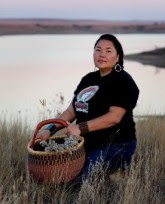
A brunette woman standing in a field with a large basket full of plants. There is a lake in the background, Linda Black Elk
Linda Black Elk
Linda Black ElkCatawba Nation – This ethnobotanist, restoration ecologist and activist is truly a 21st century woman. She has many YouTube videos and regularly posts articles online. In this way, her voice carries beyond the Standing Rock Reservation, where she lives with her family, and Sitting Bull College where she teaches. She is the Ethnobotanist for the Standing Rock Sioux Tribe and is very active in promoting tribal food sovereignty and better health through the use of native plants. Lately, she has been vocal and involved in the ongoing fight against the Dakota Access Pipeline. Here she is talking about the spirits in plants.

A black and white clip from the Doctor Who TV series. A man in the background is asking a woman in the front," What's a girl like you doing in a job like this?"For all of these strong women, there are others that are equally strong but whose voices are never heard. There are also many dazzlingly successful Native American men. Nevertheless, the vast majority of the traditional guardians of the land we call home are still stymied by poverty, prejudice and lack of opportunities. During this month especially, take some time to appreciate what came before us Europeans and open your mind to those who are with us today.

Submitted by Pam


Friday, November 2, 2018

Day of the Dead: So Much More Than Cool Makeup


Man dancing in elaborate feathered headdress and costume, holding large rattles
Aztec Dancer - Day of the Dead in Los Angeles
Modern Americans have adopted the Mexican tradition of the Dia del los Muertos (Day of the Dead) into mainstream culture. Not too many years ago, it would have been difficult to find skulls and skeleton-embellished clothing readily available beyond Halloween. Today, commercially made items can be found everywhere from a nationwide chain like Party City to designers like Alexander McQueen. There is even a website that features everything skull and skeleton related for your accessorizing, décor and clothing needs.

A sure sign that the Day of the Dead is been taken over is that Disney made a movie about it – Coco. Fortunately, the creative forces behind Coco took great care to appropriately depict the cultural and spiritual event that is Dia de los Muertos. For its first movie to depict a minority character in the lead, they consulted extensively with the people whose traditions they were depicting. The result was a beautiful movie filled with heart and music that deserves the recognition it receives.

Mictecacihuatl - The Lady of the Dead
Celebrating death as a continuous part of human existence and remembering those that have passed on has extremely deep roots in Mexico. These traditions date as far back as 1800 BC and were practiced by indigenous people throughout Mesoamerica. The origins of contemporary Day of the Dead celebrations lie with the Aztecs, who believed in a complex and vibrant afterlife (for a fun few minutes in their underworld, click here). They had been celebrating death and harvest rituals for more than 500 years before the Spanish arrived in 1519. The Spanish quickly and aggressively converted indigenous people to  Catholicism, but many ancient traditions were tightly held and the Spanish wisely allowed the native people to meld the two belief systems. The result is a form of Catholicism that is unique to our continent. Modern Mayan and other native peoples continue their singular celebrations to this day. This includes the Pascua Yaqui tribe here in Tucson, whose observances last two days (Nov. 1-2) and are tied to All Soul's and All Saint's days.
La Calavera Garbancera (Catrina)
One of the most iconic symbols of the Day of the Dead is that of La Calavera Catrina (or just Catrina). This image was the creation of Jose Guadalupe Posada in 1910. Inspired by the Aztec Queen of the Underworld, Mictecacihuatl (The Lady of the Dead), Posada’s skeletal beauty was new and yet familiar to the Mexican people. Catrina was born the same year that the Mexican Revolution broke out in response to the long and corrupt dictatorship of Porfirio Diaz. The Diaz regime was characterized by a push to modernize Mexico by embracing all things European, further enriching the elite on the backs of the poor. Posada was a lithographer and his work was distributed widely among the huge numbers of illiterate workers. He named his creation “La Calavera Garbancera”, “Garbancera” being a derogatory phrase used at that time for native Mexicans who tried to pass as Europeans. When asked about Catrina, he is said to have replied, “We are all skeletons”. Their fight for a new Mexico was long and bloody but ultimately successful and Diaz was overthrown, in large part because the poor and disenfranchised were able to rally under symbols like Catrina.

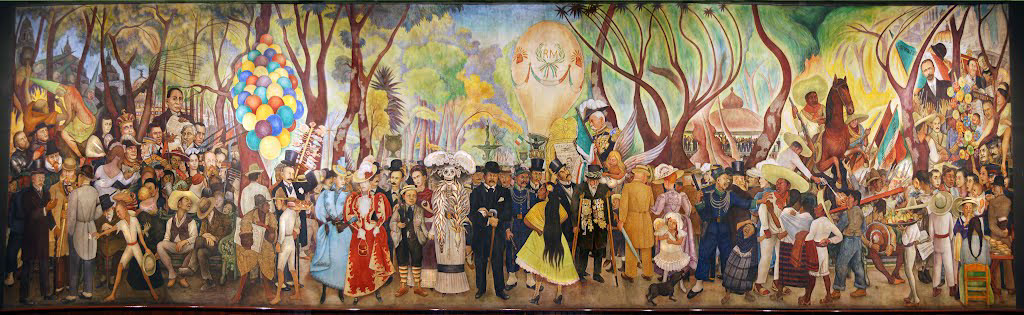
Image of a mural with many people in it depicting 400 years of Mexican history, titled Dream of a Sunday Afternoon in Alameda Park by Diego Rivera
Dream of a Sunday Afternoon in Alameda Park by Diego Rivera
Catrina was further entrenched in Mexican culture when the painter DiegoRivera painted the dandified skeleton into his masterpiece “Dream of a SundayAfternoon in Alameda Park” (1946-47). In the massive mural depicting 400 years of Mexican history, Diego placed Catrina front and center, with Posada on one side of her and himself and his wife, Frida Kahlo, on the other. Diego was a firebrand with strong Communist ties and he greatly admired Posada and looked up to him as a mentor. Even 35 years after she was created, the symbolism of Catrina was important enough to Rivera to make her a focal point in what was arguably his most important work.

In this time of picking sides and divisive politics in our own country, it seems important that we take a moment to look around and recognize what has come before us to get us to where we are now. Struggles for a better life and to work with dignity have taken place over and over again since mankind started creating societies. The crass commercialism of many American Day of the Dead events ignores the depth of culture and belief that these celebrations were founded on. I, for one, enjoy the day much more knowing the history behind it.

Submitted by Pam

Featured Post

IT'S EARTH DAY 2026!

Happy Earth Day from ARBICO Organics! This year we'd like to introduce you to our newest local non-profit partner - Mission Garden. Loca...