Friday, August 26, 2022

Genre-Bending Fruits and Vegetables


A selection of fruits and vegetables.
With most plants, the botanists have the last say in how to define them. With fruits and vegetables, however, the culinary world gets in the game. Botanically speaking, fruits are produced by a flower and contain seeds while vegetables are the other parts of the plant that are eaten (leaves, stems, roots, etc.). A culinarian, on the other hand, may classify them by flavor profile and when/how they are eaten. In other words, fruit is sweeter and is eaten in desserts and baked goods while vegetables are savory and are eaten as side dishes or as a part of a main dish. With both voices having their say in the matter, the whole thing is inevitably confusing for some people. When you add in plants that can be cooked in a number of ways, the confusion can mount. Let’s examine some of the most genre-bending plants out there:

    Avocado 

Cut and whole avocados sitting on a wooden table next to a jar of mashed avocado.
This ridiculously popular food is  botanically a fruit. What’s more it’s not a pome fruit or stone fruit as one might think, it’s a berry fruit. Be that as it may, avocados are considered savory and eaten like vegetables. They make an extraordinary addition to main courses, side dishes and salads (here are some savory ways to eat avocados that go beyond guacamole). But avocados are nothing if not versatile and although they not generally considered as dessert, they can go sweet with great success. You can probably get most people to agree that avocados are fruit, but the berry bit would make an excellent talking point the next time you serve avocado.

Leafy Greens

A variety of leafy greens sitting in a green colander.
This category of vegetables has flavors that can be polarizing. Kale, for instance, is a hard sell for many people (myself included). Nevertheless, greens are well-loved additions to salads, side dishes, sauces and entrees. But they can also be used in desserts. You could try the Slow Cooker Bok Choy Brownies, Vanilla Spinach Cake, or a traditional southern French dessert, Tourte des Blettes. This confection dates back to before the 16th century and contains a Swiss chard-based filling within a buttery crust. As far-fetched as it may seem to the American palate, a recipe that’s been popular for more than 500 years must have something going for it.

Okra

Whole okra sitting next to a glass bowl of cut okra.
Fried okra, gumbo, succotash - all of these are decidedly savory dishes. I know my Southern grandma would have a hard time believing it, but these “vegetable” dishes are actually made using a fruit. And while okra holds a place of honor in old-school Southern cooking, modern vegan and vegetarian chefs have gotten super-creative with ways to make old standards new. This is how we got Okra Ice Cream. I’m really not sure how I feel about this (and my grandma would be really skeptical of it), but it does have plenty of coconut and sugar, which is always a good thing. Another Southern standard that has been re-imagined as a no-meat dish is Pulled Pork. This recipe uses jackfruit and claims to be a good representation of pork. That said, this may be the one that sends Grandma spinning.

Tomato
A white plate holding sliced tomatoes with yellow and read tomatoes scattered around it on the table.

This is the poster child for the fruit or vegetable question. We’ve all heard the discussions surrounding this fruit; genre-switching is nothing new for tomatoes. In fact, back in 1893 the U.S. Supreme Court heard a case to determine (for taxing purposes) whether the tomato was indeed a fruit or a vegetable. Their final decision was that it was a vegetable, which goes to show that the Supreme Court has been making controversial decisions for quite some time (read more about this case here).Tomatoes are firmly in control in some of America’s favorite foods and flavorings like spaghetti, salads, pizza and ketchup. But some brave cooks have turned them into dessert as well. There is the Tomato Cheesecake, which I’m not sure I want to try. There is also a Tomato Soup Cake, made with the ubiquitous canned tomato soup we’ve all had in our kitchen. I have to admit I‘m somewhat intrigued by this one – it seems like something that was created because there wasn’t much else in the pantry. And I can appreciate the creativity in that.

A spinning spiral of fruits and vegetables.

If you are dealing with a bumper crop of fruit and/or vegetables, I hope this blog has plucked the strings of culinary inspiration in you. Think outside the usual ways of cooking things and you may just find greatness.

Take Care.

Submitted by Pam


Friday, August 19, 2022

Wasps of the World Deserve Our Appreciation

Closeup of a wasp face
If it seems to you that lately every time you go outside there are more and more wasps around, then you are correct. In the latter part of summer and early fall, wasp populations are at their largest and all those wasps are out and about busily bulking up their queens and colonies. Wasps get a bad rap; they are amazing creatures that are crucial for a healthy ecosystem and not aggressive, people-hating bad guys. The more you know about them, the easier they are to like.   
   
                                                    Types of Wasps

Wasp on green plant stalk. Photo by Jose Frolian Diaz on Unsplash.
There are two main types of wasps: solitary and social. The solitary wasp species are the vast majority of 75,000 or so wasp species out there. Solitary wasps are mostly predatory and parasitic (we sell some as aphid predators). While their habits may be horrific to their arthropod and insect prey, they couldn’t care less about people. As their names suggest, solitary wasps live on their own and social wasps live in colonies. Wasp colonies are usually a great deal smaller than bee colonies. They will typically have only a dozen or so individuals, although some species can have hives with up to 10,000 inhabitants. Bees, on the other hand, routinely have colonies of 50,000 or more. So, mathematically speaking, you have a greater chance of coming into conflict with bees than wasp. For more information, check out this article.

To Sting or Not to Sting
The Velvet Ant - aka Cow Killer - Don't ever touch one of these!
Velvet Ant

The fear of getting stung is what seems to drive the irrational hatred for wasps. But, unless you have an allergy (which can be very serious), the pain of the sting should not be overwhelming for most adults. The exception would be certain solitary wasps, like the wingless Velvet Ant wasp, that may sting if provoked and can be VERY painful. Any wasp will sting if it feels threatened, but the majority of stings occur when people get too close to or disrupt the activity of the hive  Since solitary wasps do not live in hives, they have no reason to sting to protect one. On the other hand, like most animals, social wasps will aggressively defend their homes and offspring. They will fearlessly dive-bomb and sting intruders. So, just as you would do with a mama bear, back away and leave them alone.

                                   Wasp Nests

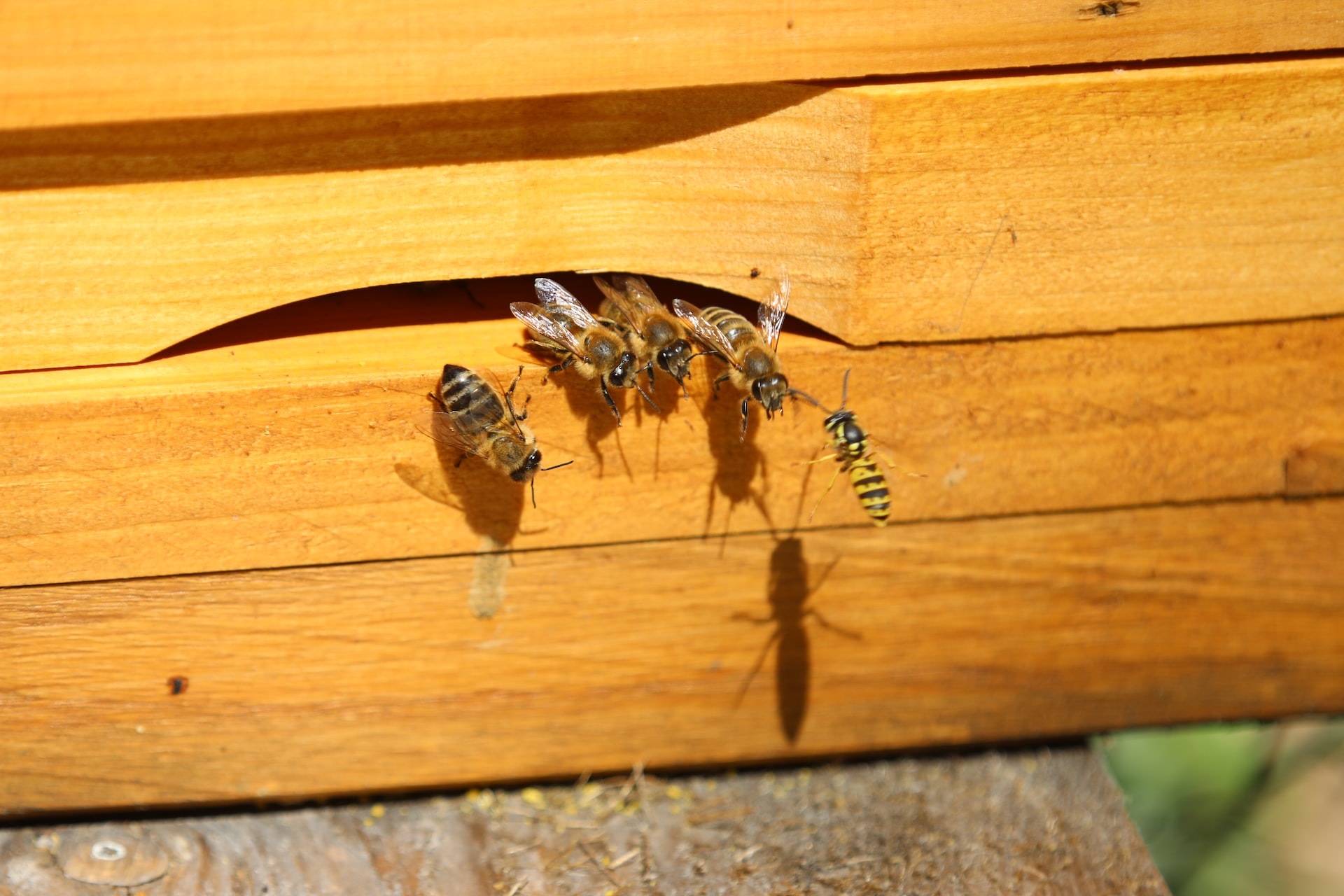
Wasps entering a wooden structure that most likely has a nest inside. Photo by Georg Eiermann on Unsplash.
Wasp nests, and their proximity to humans, seems to be the flashpoint for confrontation between wasps and people. But the solution is not necessarily to seek out and destroy the hives. In most cases, it is probably better to leave them where they are. First, try to determine if there is in fact a hive nearby (not all are easily visible) – observe their comings and goings to see if they regularly fly to the same sheltered areas (unused equipment like barbecues, sheds, under the eaves) or crevices (cracks in foundations, wall cavities). Once you know where they are, you can plan where not to be. Bear in mind that wasps don’t swarm and that most nests will be abandoned once summer is over. If you are still uncomfortable with the nest being nearby, have it removed by a professional. While wasps don’t swarm, if you try to get at a nest you will be stung many times by many individuals. From more information on how to avoid confrontations with wasps, read this article.  
Biodiversity 

A Sand Wasp in mid-flight carrying prey back to its nest.
Sand Wasp with prey
The presence of a thriving wasp population helps keep the biodiversity therein robust. Wasps are at the top of the inveterate food chain and, as generalist predators, wasps will prey on all manner of spiders, millipedes, caterpillars and soft-bodied insects. Whether through parasitization or direct consumption, they keep pest populations of insects and arthropods in check. In this way they protect lower invertebrates and plants from indiscriminate predation that could cause an imbalance in the system which could lead to many serious consequences, including crop failure. 

Wasps as Pollinators

A closeup of a wasp covered in yellow pollen,
Those chubby little honeybees get all the pollinator love, but wasps do their part as well. While they do not gather pollen to take to their hive and turn into honey, they become covered in pollen as they search all parts of flowers and plants for prey. As they move on in their hunt, they take the pollen with them and spread it around. And then there are the specialist wasps like the Fig Wasps. These insects have developed a symbiotic relationship with the plants they visit. In tropical ecosystems, the fig is an essential food source for a great many species, and without this particular wasp that would be gone.
A long, skinny Fig wasp sitting on a green fig.
Fig Wasp

Wasps Could Cure Cancer 

Could it be that a lowly wasp is the key to wiping out the curse of cancer? Scientists are learning that a certain Brazilian wasp has venom that destroys cancer cells. It’s still early days on a possible cure, but this illustrates just how important wasps can be. 

A cartoon gif showing a little boy trying to knock down a wasp nest with a rake.

I hope that this has changed some thinking about the importance of wasps in the ecosystem. If you still want to control them around you, our Yellow Jackets, Hornets and Wasps page has more information and a variety of non-poisonous controls.

Take Care 

Submitted by Pam


Friday, July 29, 2022

The Drowned Lands: New York’s Black Dirt Region

Rows of bright green radish tops growing in the black dirt . Photo by Gigi Eustace.
In May I was lucky enough to spend some time on a farm in the Black Dirt Region in Orange County, New York. Only about 50 miles northwest of New York City in the lower Hudson Valley, this area is characterized by beautiful estates, orchards and vineyards, charming Colonial-era villages, picturesque farms and fields of deep black dirt. All of these can be found elsewhere, except for that dirt.

Before I go any further, I want you to imagine the softest and silkiest potting soil that you’ve ever seen. That is what New York’s black dirt is like – in fact, it’s more like powder than soil. This special soil was formed some 12,000 years ago after a glacier receded, leaving a bog in place of the ancient lakebed. After that, repeated flooding in the area augmented the development of the swamp-land and added to the soil profile. The deep layers of decayed plant matter in the bog created a soil rich in nutrients (notably sulfur) that is anywhere from 3 to 30 feet deep (some claim as much as 300 feet). This region of New York contains 26,000 acres of Black Dirt, making it the largest concentration of farmable soil of this sort in the US. The only other place you’ll find as much is deep in the Everglades and inaccessible to farming.
An Historical Marker for the Drowned Lands, can be found in Pine Island, NY.

The earliest settlers to the region dubbed this area the “Drowned Lands” due to the soggy nature of the soil. There were many attempts made to drain and manage the land, with various levels of success and resistance to the attempts (see here for more on that story). In the later part of the 1800s, Polish and Volga German immigrants began arriving in the area. Unlike many of their earlier counterparts, they recognized the soil as similar to the humus-rich soil in their homelands and knew just how to handle it. They proceeded to dig a network of drainage ditches that dried out the soil and created perfect fields of fertile farmland, with crowns of dry land popping up in here and there like islands (which is exactly what they’re called by locals). To this day, Pine Island, New York remains the epicenter of the Black Dirt Region.

A view of a drainage ditch with an "island" in the background.


The physical qualities of this soil are remarkable, but its nutrient-rich composition is the star of this show. Black Dirt is between 30-90 percent organic material (most soil is roughly 10 percent). According to Maire Ullrich, an Orange County agricultural extension agent, “It’s basically a giant bowl of compost”. The decayed plant material that creates this compost-like soil also provides a healthy dose of nitrogen and sulfur. This unique sulfur-richness is what makes it exceptional for growing the most famous crop of the Black Dirt Region - the onion.

Black Dirt Onions. Photo by Gigi Eustace.
Onions, onions, onions – the cultivation, tradition, and business of onions is always swirling around the Drowned Lands. The predominant onions of this area are the tennis ball-sized yellow onions with papery skin that we are all familiar with. The sulfur in the soil increases the sugar content in onions and gives it a delicious strong, rich onion taste that turns exceptional when caramelized. It’s also hard to beat in a soup (here's a local recipe to try). 

It's not just onions that grow well in black dirt, of course. All the root vegetables (beets, carrots, garlic, radishes) love to grow down into that rich soil. Lettuce of all types, kale, kohlrabi and cabbages all thrive as well. In the last 25 years or so, growing sod has become a reliable venture and, even more recently, hemp has proven itself in the area. As you can see, it might be challenging to find something that does not grow well in black dirt.

Pulling radishes from the field. Photo by Gigi Eustace.

A vivid purple kohlrabi. Photo by Gigi Eustace.
Plants are not the only things that farmers are pulling out of the black dirt. As a testament to what was once a robust prehistorical world in the lower Hudson Valley, there have been an abundance of fossils found. There are actually three distinct geological layers in the area: the deepest level is clay, the middle level is a mix of peat and clay and the black dirt makes up the top layer. Peat bogs are famous for preserving artifacts; in some parts of the world, they may be “bog bodies”, but in this part of New York the peat/clay layer of the black dirt has been holding onto prehistoric fauna. Mastodon finds are arguably the most impressive; not just for their size (the largest animals that roamed the area) but due to their rarity. More mastodon remains have been found in New York State than any other place on Earth and more have been found in Orange County than any other part of the state (more on that here).
A mastodon on the move.
Mastodons are not the only ancient creatures coming to light, stag-moose, giant beavers, peccaries, reindeer and ground sloths have also been found. Many of these fossils are discovered as farmers do maintenance on their drainage ditches after the growing season, but they are under no obligation to turn them over to authorities so there very well may be other types of animal fossils out there that the public has not seen. 

The Black Dirt Region truly has something for everybody. If you are an American History buff, you can drink and eat in establishments that date to the American Revolution. If you are a flora and fauna type person, the countryside and mountains are simply gorgeous and filled with wildlife (I saw a big ole black bear lumbering along). If you enjoy a good adult beverage, there are many first-class vineyards, cideries and breweries to visit. If you are a foodie, the options are nearly limitless. And, of course, if you are a person who loves to grow things, the black dirt is a thing of beauty and wonder.
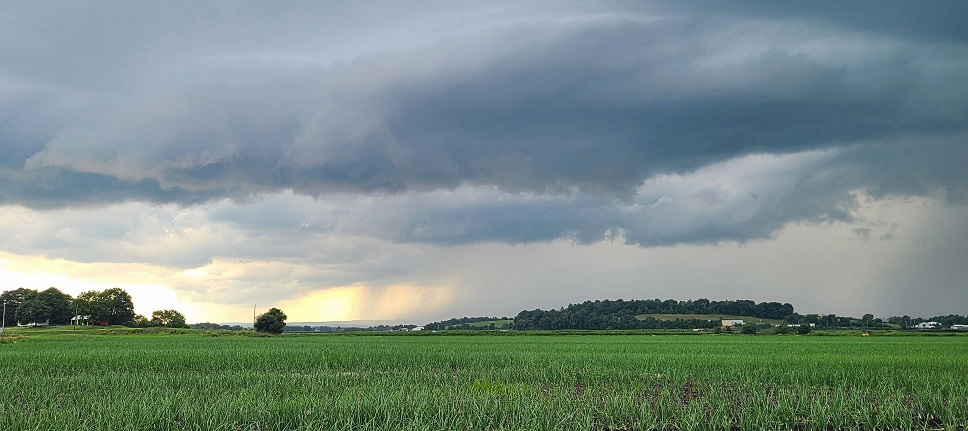
A storm over an onion field.

Hands fondling some black dirt.I want to thank Gigi and Farmer Bobby for their hospitality. It was a joy to see the endless enthusiasm they showed for their beautiful part of the world. Oh, and thanks Gigi for the great pictures!

Submitted by Pam 


Monday, July 18, 2022

What’s This Bug? The Solufigid/Camel Spider.

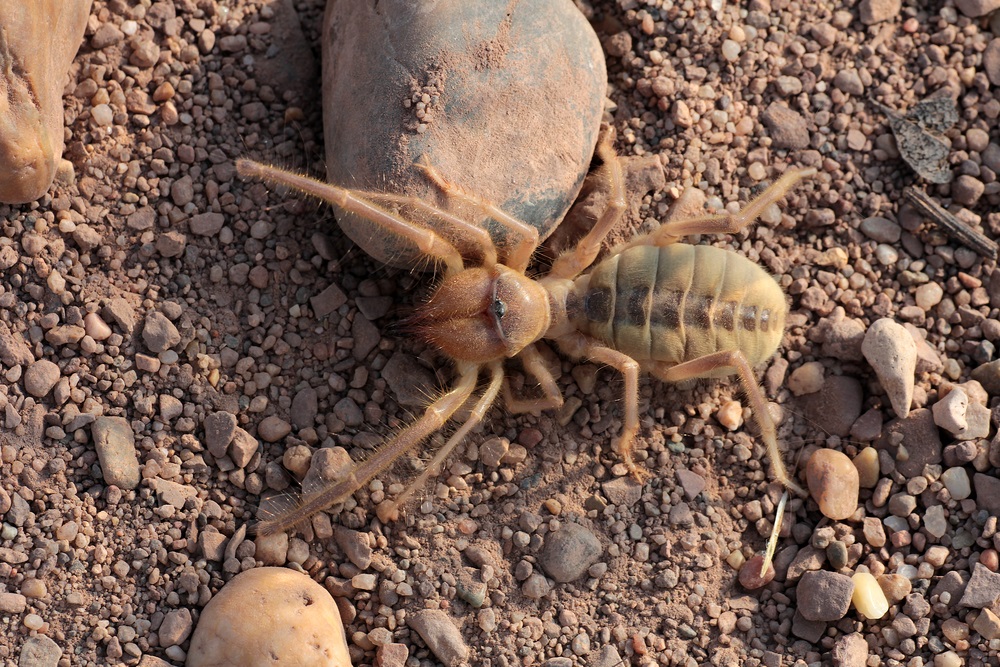
 What we have here is a solufigid (Arachnida solifugae). They are found in arid regions around the world and have many, many names: solifuges, solpugids, wind scorpions, wind spiders, sun spiders, false spiders, jerrymanders, madres de alacran and camel spiders (probably the most widely-known name here in our country). Some names are specific to certain regions. For instance, in South Africa, they are called roman spiders, red roman spiders, rooi spiders, kalahari ferraris, haarskeerders (Afrikaans for “hair cutter) or baarskeerder (“beard cutter); the latter two so-named for the local belief that they cut people’s hair in their sleep to use it for nesting material (Solufigids like hair that’s been shed from humans and animals, but the harvesting part is myth). And that’s not all of the South African names, see more here.

When the US military went into Iran and other parts of the desert Middle East, our troops came across these unusual-to-them creatures and, of course, told everyone back home about them. They adopted the prominent name from the area, camel spiders (For clarity, I’m going to use this name for the remainder of this blog). This awareness of camel spiders to Americans, spawned many urban myths. It just so happens that the misconceptions highlight some of the most unique aspects of this creature. It’s been said:

Some of the many species of solufigids

 -  that camel spiders are spiders from Hell.

Clearly these creatures are not literally from the underworld. In fact, they are not true spiders, although they come from the Arachnid genus. There are over 1,000 species of camel spiders, and none have the correct anatomy to qualify as spiders. They do have the eight legs (the two front “legs” are called palps and function more as feelers or hands for grasping prey), but little else a spider has. They don’t have venom or spinnerets. Additionally, spiders have separate heads and thoraxes, while camel spiders have a large one-piece head/thorax combination (which takes up 1/3 of its body).
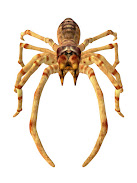
- that camel spiders charge at people.

These are animals that avoid the sun and/or daylight exposure. In fact, the Solifugae name is derived from Latin and means “fleeing from the sun”. If caught out in the sun, they will rush into whatever shade they find and sometimes that is the shade a human is making. They’ve also been known to use a walking person’s shadow as moving shade, which makes it seem they are chasing that person. At night, they will rush towards any light they see, including flashlights and campfires. Seeing them approaching rapidly from the darkness would give anyone a fright.

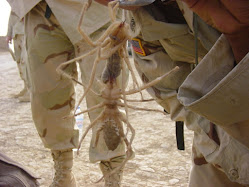
- that camel spiders can grow to the size of a dinner plate.
A camel spider sitting on a hand.
Two soldiers holding what appears to be gigantic camel spiders, but the photo is deceiving.A widely-shared picture from Iraq shows soldiers holding two locked-together gigantic camel spiders. While this made for titillating conversation, the photo is a classic case of false perspective. Camel spiders in the Middle East don’t grow to more than 2“, and most are around 1”. If you consider that dinner plates are 10½-12” in diameter, it’s clear just how much their size has been exaggerated. 

- that camel spiders can jump up to 6 feet and run up to 25 mph.
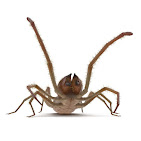
A camel spider amongst the rocks.In reality, camel spiders are not good jumpers. However, their chief hunting behavior is to run at breakneck speed towards their prey. I mean run – while they can’t go 25 mph, they can do 10 mph. And they can keep up this speed indefinitely; there is no “slow” switch. Once night falls, they barrel out of their hiding places and start running. According to this man, they have a preferred route that they transverse over and over. While this article tells of researchers who tried to keep up with these speed demons and had to give up after a non-stop two-hour dash. As it zooms around, a camel spider will attack and devour any prey that is unfortunate enough to cross it’s path. They will literally run into something, rear up, slap/grab it with their palps and then begin chewing on it immediately. In no time, the camel spider will have shredded, liquified and consumed It and be off looking for something else. As horrifying as this running-attacking seems to be, camel spiders should be considered beneficial due to some of their food choices. Their diet is varied and includes many creatures that are deemed undesirable by humans, like venomous insects, spiders, scorpions and centipedes. Here's a video showing an attack on a millipede that shows just how fast they work (it is not sped-up, it’s in real time).

A camel spider reared up with its impressive jaws wide open.

- that camel spiders will screech as they attack.

They do not scream (again, an anatomy thing), but their powerful jaws can cut through feathers, bones and shells and that could create an ugly sound. And some species do clack their jaws as they attack. Or perhaps the noise in question is that of onlookers screaming in horror.
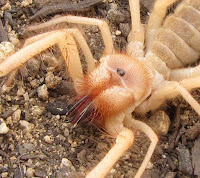
The face of a camel spider. - that camel spiders lay their eggs in animal’s fur (particularly camels) and eat camel bellies.

Camel spiders are not parasitic, nor are they blood-eaters, so they have no reason to seek out an animal host to lay their eggs on. They lay them in out-of-sight and underground places like burrow and under rocks or logs. As far as eating camels goes, these arachnids are fierce and have a varied diet, but it does not include large mammals (although a small mammal may become a meal if it runs into it).

A camel spider covering itself with sand.
Camel spiders have so many interesting behaviors, but my favorite is their ant-slaughtering. It appears that they like to accost ants at the opening to their colony and cut them to pieces as they come out to defend their home. The camels spiders are not eating the ants, they are simply killing them. And in a way that seems almost gleeful. Scientists have theories (scientists always have theories), but there is no real explanation for these attacks. Be that as it may, this behavior is inexplicably mesmerizing to watch. Here’s a video and here’s another. 

Submitted by Pam


Wednesday, June 29, 2022

Innovative Mosquito Control Products

Cartoon "No Mosquito" sign

It’s officially summer, but most of us have been dealing with heat for quite some time already. And this means we’ve been dealing with mosquitoes for quite some time already as well. Luckily, there are more products than ever before that control these dangerous flying pests. They are, after all, the most dangerous animal in the world (here’s more on that). Here at ARBICO we have a great selection of highly-effective mosquito control products. Many of them are of the tried-and-true variety (personal repellents, sprays, zappers), which most people are familiar with, while others are the result of years (even decades) of creative thinking and innovative research and development. 

 - Bacillus thuringiensis israelensis (Bti) – 

A cartoon mosquito just hanging aroundBti is the OG of biological mosquito control. In 1976, Dr. Yoel Margalith (aka Mr. Mosquito) discovered Bti in samples from dying mosquitoes found in a pond in the Negev Desert of Israel. With further study, he determined that this naturally-occurring soil bacterium is deadly to mosquitoes when ingested but has no negative impact on non-target species and the environment (more on his work here). Bti causes mosquito larvae to stop feeding within one hour, followed by paralysis and death. This biocontrol can be applied directly to water (including drinking water), which makes it especially useful in a variety of circumstances from horse throughs to large-scale municipal water treatment facilities. We offer several different varieties of Bti, at a price point accessible to most anyone. If you have areas of standing water (large or small) that are your main mosquito-breeding locations, this is a no-fuss, no-worry product with a proven history of effectiveness. An added bonus: it is also effective against black flies and fungus gnats.

A cartoon mosquito screaming in feaR

 - Bacillus sphaericus (Bs) – 

Bs is similar to Bti in that it contains spores that are toxic to mosquito larvae when ingested but is not harmful to other creatures or the environment. This is a selective larvicide and only works on certain types of mosquitoes; luckily these are some of the most common and deadly. It has several key differences from Bti: It is a selective larvicide; it cannot be used in drinking water; it works in highly organic aquatic environments (something Bti struggles with), and it persists where it is applied for longer periods of time than Bti. If you have a considerable area to treat and need that treatment to last as long as possible, this is an excellent choice for you. We have two exceptional Spheratax products that utilize this particular strain of Bacillus.

A cartoon mosquito that appears to be flying fast to get away.
 - No-Bait Traps – 

The Enoz® Trap-N-Kill A-G-O Mosquito Trap and Skeet-O-Trap™ are traps that use a mosquito’s natural behaviors to lure them in instead of baits. They are designed to mimic the dark places with stagnant water that mosquitoes favor as a place to lay their eggs. Instead of baits, they use grass or hay clippings in water to get that stagnant water effect. The Skeet-O-Trap does not capture the adults; it only works to keep the larvae from escaping. The Enoz trap will kill both adults and larvae. Both traps are designed to work year after year and are effective against multiple mosquito species.A cartoon mosquito lying dead

 - SKEETER Mosquito Control – 

SKEETER Mosquito Control is brand new in 2022 and is no less than ground-breaking. It combines botanical oils (garlic and soybean) with nematodes (Heterorhabditis megidis) to provide quick and long-lasting control of larvae, pupae, and any young adults who may still be hanging around. The oils suffocate and kill on contact and the nematodes search out the larvae, enter their bodies, and release a bacterium into their bloodstream. This kills the larvae within 48 hours and the nematodes use the dead and dying larvae as a food source, which extends the efficacy of SKEETER to 30 days. The use of oils combined with nematodes makes for an exciting, and definitely innovative, product.

A cartoon mosquito with a big red X in front of it - Spatial Repellents – 

We are all familiar with the type of repellents that we apply to ourselves or to an outside area, but this type of repellent is a bit different. Bradshaw’s 4 Ring Protection Spatial Repellents form a dome of protection around an area using DEET-free botanical oils. Simply hang a pouch near the area you want to protect and the pleasant-smelling vapor it emits will draw the mosquitoes to it and away from where you want to be. It not only lures the mosquito, but it also interferes with their receptors so that they stop seeking a blood meal. This is not just an easy-to-use and cost-effective mosquito control product; it also lasts for days – considerably longer than other products. A cartoon of a mosquito's grave - his image is on the headstone.

 - Spinosad – 

Spinosad is nothing new in the world of pest control, but Natular® DT and Natular® G30 WSP bring it in a water-soluble form to control mosquito larvae. Natular DT is an effervescent tablet with an outer layer that dissolves quickly and begins killing immediately, but it also contains a layer that lasts 90 days for continued control. Natular G30 WSP comes in pouches with 10 grams of product in each. They last 30 days each in water but break down quickly in sun and soil. These are truly apply-and-forget forms of mosquito control.  

No matter which of these first-rate products fits your needs and wallet, you can be assured that it has the potential to keep summer-spoiling mosquitoes away.


Submitted by Pam


Tuesday, June 14, 2022

Mosquito Deterrents

Cartoon mosquito looking at stop sign
There’s just no getting around the fact that mosquitoes are more than nuisances – they’re dangerous and formidable opponents. We carry many excellent mosquito control products, but there are additional things one can do to improve their chances in the war between humans and mosquitoes. 

- BODY OINTMENTS - 
If you’re going to be out and about and know that mosquitoes will be a problem, you can begin your defense plan as soon as you get out of the shower. There are oils and lotions that are very helpful in repelling mosquitoes but choose carefully because some may actually be inviting bites.
A group of smiling cartoon mosquitoes. Certain essential oils, including lemon eucalyptus peppermint, lavender, geranium and citronella oil, have time-proven efficacy as repellents so apply them to your body generously. A secondary benefit of using these oils is the delightful scent that will surround you.  
Catnip oil is another oil to try. According to this article, the oil is extracted from the catnip plant via steam distillation, and the process eliminates the chemicals that make catnip irresistible to cats. The catnip plant is known to have a scent mosquitoes dislike, so it only makes sense that the distilled oil would be even more repellent to them.
A smiling cartoon mosquito.
For the most part, flowery perfumes and body lotions should be avoided. However, there is one strong exception to this rule: Avon’s Skin So Soft. Over many, many years millions of people have found this body oil to be an exceptional mosquito repellent. In fact, this product has been used by U.S. Marines as a mosquito repellent for more than 50 years on and around their training facility on Parris Island South Carolina. In the low country down there, mosquitoes are voracious, so these tough marines douse themselves in this sweet-smelling stuff. After all, it’s better to smell girly than be eaten alive. 
A leering cartoon mosquito with a knife and fork.
You should be aware that the above types of oils do not have the long-lasting effect that many commercial mosquito repellents do. On average, they last about two hours.

 - CLOTHING - 
After you have carefully considered what to put on your bare body, put a little extra thought into what you wear (after all, you’ll look good in anything). 
Mosquitoes are attracted to the CO2 that mammals produce, but they also use their vision to zero in on a target. According to this article, as they fly characteristically slow and low to the ground, they respond to dark objects on the horizon. Which means you should probably choose a pastel as opposed to your favorite Goth outfit.
This study takes the whole color thing one step further. It finds that mosquitoes like red, orange, black and cyan and snub green, purple, blue and white.
A cartoon mosquito quivering in fear.
Mosquitoes love the sweaty dirtiness of feet and there is very little as annoying as mosquito bites between your toes. For these reasons, skip the sandals and put some shoes on (even better, with socks).
While summer seems more bearable in cool and flowing clothing, if you are interested in doing everything you can to avoid mosquitoes than you need to don some tightly woven synthetic clothing (extra points for a high tech athletic wear made for sun protection). Mosquitoes may seem small, but their proboscises are rather large insect-wise and simply cannot fit through some of these fabrics. The downside is that  you’ll need to wear long sleeves and pants for optimal results, which may be a little too much coverage on a particularly hot day.
A group of cartoon mosquitoes looking scared and worried.

 - OUTSIDE SPACES - 
No one is able to control the whole outdoors, of course, but you should look at the outdoor space you can control – your backyard, patio, porch or balcony.
You probably already know that you should remove all standing water, but you may not be aware that mosquitoes only need a bottle-cap of water to lay their eggs in. It is also easy to overlook breeding spots like gutters, recycling bins, drains and saucers under plants. Instead of a quick once-over, give your outdoor space some careful
A cartoon mosquito screaming in fear.
consideration to root out standing water.
Reconsider the plants in your space to make sure you don’t have any that are welcoming to mosquitoes. If you do, remove them and add plants that repel skeeters. Nectar-producing flowers and water plants are attractive to mosquitoes, while the plants that contain the aforementioned oils are excellent repellents (there are others too). 
Keep all your grasses cut down and remove any yard debris. Mosquitoes love to hide out in the relative safety of such places; it protects them from the elements – particularly sun and wind.
A cartoon mosquito running in fear.
Speaking of wind, mosquitoes are poor flyers so put a fan in your outdoor space. If it is set high enough mosquitoes will not be able to fight the wind it produces in order to get to you
A short clip of two cartoon mosquitoes in love, until  one gets squished and the other drinks its blood. The proper outdoor lighting can also help with mosquito control. We are all familiar with the horde of insects beating against a porch or backdoor light, but a change of bulbs can element that behavior. Use incandescent or LED lighting, especially that which has a yellow glow, and you’ll see fewer mosquitoes and other flying insects.

Hopefully this has given you some ideas on how to lessen the effect of mosquitoes. All of these tips are valuable, but when used in conjunction with commercial mosquito control products you should see a marked improvement. If none of this works for you, you may just want to stay inside until the first frost kills the mosquitoes.

Submitted by Pam


Featured Post

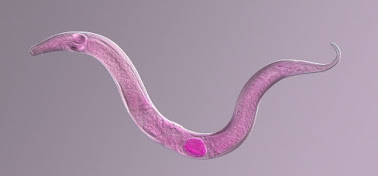
5 Cool Things About Nematodes

It’s September, and here at ARBICO, it’s Beneficial Nematode season. Every year we put our Beneficial Nematodes on sale at this time to enc...