Showing posts with label vegetables. Show all posts

Friday, August 26, 2022

Genre-Bending Fruits and Vegetables


A selection of fruits and vegetables.
With most plants, the botanists have the last say in how to define them. With fruits and vegetables, however, the culinary world gets in the game. Botanically speaking, fruits are produced by a flower and contain seeds while vegetables are the other parts of the plant that are eaten (leaves, stems, roots, etc.). A culinarian, on the other hand, may classify them by flavor profile and when/how they are eaten. In other words, fruit is sweeter and is eaten in desserts and baked goods while vegetables are savory and are eaten as side dishes or as a part of a main dish. With both voices having their say in the matter, the whole thing is inevitably confusing for some people. When you add in plants that can be cooked in a number of ways, the confusion can mount. Let’s examine some of the most genre-bending plants out there:

    Avocado 

Cut and whole avocados sitting on a wooden table next to a jar of mashed avocado.
This ridiculously popular food is  botanically a fruit. What’s more it’s not a pome fruit or stone fruit as one might think, it’s a berry fruit. Be that as it may, avocados are considered savory and eaten like vegetables. They make an extraordinary addition to main courses, side dishes and salads (here are some savory ways to eat avocados that go beyond guacamole). But avocados are nothing if not versatile and although they not generally considered as dessert, they can go sweet with great success. You can probably get most people to agree that avocados are fruit, but the berry bit would make an excellent talking point the next time you serve avocado.

Leafy Greens

A variety of leafy greens sitting in a green colander.
This category of vegetables has flavors that can be polarizing. Kale, for instance, is a hard sell for many people (myself included). Nevertheless, greens are well-loved additions to salads, side dishes, sauces and entrees. But they can also be used in desserts. You could try the Slow Cooker Bok Choy Brownies, Vanilla Spinach Cake, or a traditional southern French dessert, Tourte des Blettes. This confection dates back to before the 16th century and contains a Swiss chard-based filling within a buttery crust. As far-fetched as it may seem to the American palate, a recipe that’s been popular for more than 500 years must have something going for it.

Okra

Whole okra sitting next to a glass bowl of cut okra.
Fried okra, gumbo, succotash - all of these are decidedly savory dishes. I know my Southern grandma would have a hard time believing it, but these “vegetable” dishes are actually made using a fruit. And while okra holds a place of honor in old-school Southern cooking, modern vegan and vegetarian chefs have gotten super-creative with ways to make old standards new. This is how we got Okra Ice Cream. I’m really not sure how I feel about this (and my grandma would be really skeptical of it), but it does have plenty of coconut and sugar, which is always a good thing. Another Southern standard that has been re-imagined as a no-meat dish is Pulled Pork. This recipe uses jackfruit and claims to be a good representation of pork. That said, this may be the one that sends Grandma spinning.

Tomato
A white plate holding sliced tomatoes with yellow and read tomatoes scattered around it on the table.

This is the poster child for the fruit or vegetable question. We’ve all heard the discussions surrounding this fruit; genre-switching is nothing new for tomatoes. In fact, back in 1893 the U.S. Supreme Court heard a case to determine (for taxing purposes) whether the tomato was indeed a fruit or a vegetable. Their final decision was that it was a vegetable, which goes to show that the Supreme Court has been making controversial decisions for quite some time (read more about this case here).Tomatoes are firmly in control in some of America’s favorite foods and flavorings like spaghetti, salads, pizza and ketchup. But some brave cooks have turned them into dessert as well. There is the Tomato Cheesecake, which I’m not sure I want to try. There is also a Tomato Soup Cake, made with the ubiquitous canned tomato soup we’ve all had in our kitchen. I have to admit I‘m somewhat intrigued by this one – it seems like something that was created because there wasn’t much else in the pantry. And I can appreciate the creativity in that.

A spinning spiral of fruits and vegetables.

If you are dealing with a bumper crop of fruit and/or vegetables, I hope this blog has plucked the strings of culinary inspiration in you. Think outside the usual ways of cooking things and you may just find greatness.

Take Care.

Submitted by Pam


Friday, July 29, 2022

The Drowned Lands: New York’s Black Dirt Region

Rows of bright green radish tops growing in the black dirt . Photo by Gigi Eustace.
In May I was lucky enough to spend some time on a farm in the Black Dirt Region in Orange County, New York. Only about 50 miles northwest of New York City in the lower Hudson Valley, this area is characterized by beautiful estates, orchards and vineyards, charming Colonial-era villages, picturesque farms and fields of deep black dirt. All of these can be found elsewhere, except for that dirt.

Before I go any further, I want you to imagine the softest and silkiest potting soil that you’ve ever seen. That is what New York’s black dirt is like – in fact, it’s more like powder than soil. This special soil was formed some 12,000 years ago after a glacier receded, leaving a bog in place of the ancient lakebed. After that, repeated flooding in the area augmented the development of the swamp-land and added to the soil profile. The deep layers of decayed plant matter in the bog created a soil rich in nutrients (notably sulfur) that is anywhere from 3 to 30 feet deep (some claim as much as 300 feet). This region of New York contains 26,000 acres of Black Dirt, making it the largest concentration of farmable soil of this sort in the US. The only other place you’ll find as much is deep in the Everglades and inaccessible to farming.
An Historical Marker for the Drowned Lands, can be found in Pine Island, NY.

The earliest settlers to the region dubbed this area the “Drowned Lands” due to the soggy nature of the soil. There were many attempts made to drain and manage the land, with various levels of success and resistance to the attempts (see here for more on that story). In the later part of the 1800s, Polish and Volga German immigrants began arriving in the area. Unlike many of their earlier counterparts, they recognized the soil as similar to the humus-rich soil in their homelands and knew just how to handle it. They proceeded to dig a network of drainage ditches that dried out the soil and created perfect fields of fertile farmland, with crowns of dry land popping up in here and there like islands (which is exactly what they’re called by locals). To this day, Pine Island, New York remains the epicenter of the Black Dirt Region.

A view of a drainage ditch with an "island" in the background.


The physical qualities of this soil are remarkable, but its nutrient-rich composition is the star of this show. Black Dirt is between 30-90 percent organic material (most soil is roughly 10 percent). According to Maire Ullrich, an Orange County agricultural extension agent, “It’s basically a giant bowl of compost”. The decayed plant material that creates this compost-like soil also provides a healthy dose of nitrogen and sulfur. This unique sulfur-richness is what makes it exceptional for growing the most famous crop of the Black Dirt Region - the onion.

Black Dirt Onions. Photo by Gigi Eustace.
Onions, onions, onions – the cultivation, tradition, and business of onions is always swirling around the Drowned Lands. The predominant onions of this area are the tennis ball-sized yellow onions with papery skin that we are all familiar with. The sulfur in the soil increases the sugar content in onions and gives it a delicious strong, rich onion taste that turns exceptional when caramelized. It’s also hard to beat in a soup (here's a local recipe to try). 

It's not just onions that grow well in black dirt, of course. All the root vegetables (beets, carrots, garlic, radishes) love to grow down into that rich soil. Lettuce of all types, kale, kohlrabi and cabbages all thrive as well. In the last 25 years or so, growing sod has become a reliable venture and, even more recently, hemp has proven itself in the area. As you can see, it might be challenging to find something that does not grow well in black dirt.

Pulling radishes from the field. Photo by Gigi Eustace.

A vivid purple kohlrabi. Photo by Gigi Eustace.
Plants are not the only things that farmers are pulling out of the black dirt. As a testament to what was once a robust prehistorical world in the lower Hudson Valley, there have been an abundance of fossils found. There are actually three distinct geological layers in the area: the deepest level is clay, the middle level is a mix of peat and clay and the black dirt makes up the top layer. Peat bogs are famous for preserving artifacts; in some parts of the world, they may be “bog bodies”, but in this part of New York the peat/clay layer of the black dirt has been holding onto prehistoric fauna. Mastodon finds are arguably the most impressive; not just for their size (the largest animals that roamed the area) but due to their rarity. More mastodon remains have been found in New York State than any other place on Earth and more have been found in Orange County than any other part of the state (more on that here).
A mastodon on the move.
Mastodons are not the only ancient creatures coming to light, stag-moose, giant beavers, peccaries, reindeer and ground sloths have also been found. Many of these fossils are discovered as farmers do maintenance on their drainage ditches after the growing season, but they are under no obligation to turn them over to authorities so there very well may be other types of animal fossils out there that the public has not seen. 

The Black Dirt Region truly has something for everybody. If you are an American History buff, you can drink and eat in establishments that date to the American Revolution. If you are a flora and fauna type person, the countryside and mountains are simply gorgeous and filled with wildlife (I saw a big ole black bear lumbering along). If you enjoy a good adult beverage, there are many first-class vineyards, cideries and breweries to visit. If you are a foodie, the options are nearly limitless. And, of course, if you are a person who loves to grow things, the black dirt is a thing of beauty and wonder.
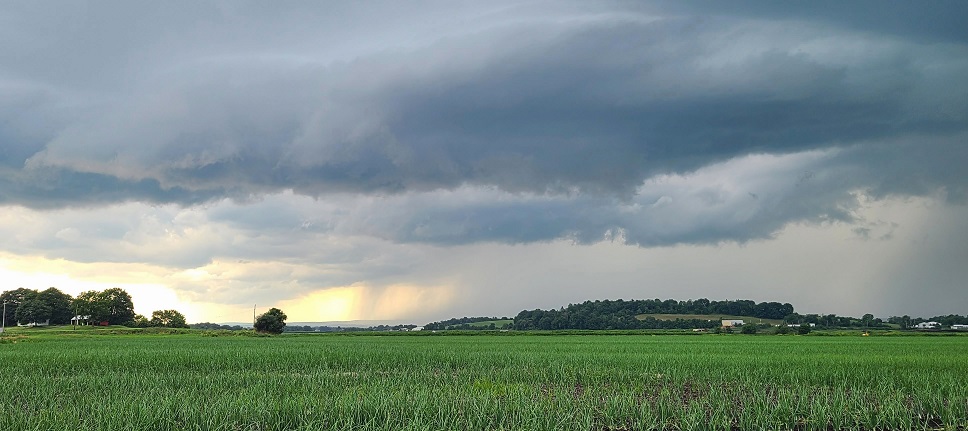
A storm over an onion field.

Hands fondling some black dirt.I want to thank Gigi and Farmer Bobby for their hospitality. It was a joy to see the endless enthusiasm they showed for their beautiful part of the world. Oh, and thanks Gigi for the great pictures!

Submitted by Pam 


Friday, September 27, 2019

When There’s Just Too Much Water…

Close-up of a white crocus flower in the rain
Hurricanes, flooding, rain for days, tornadoes, high tides, early snow, late snow, snowmelt – whatever is causing it, it seems that people everywhere are dealing with more water than anyone wants. Even here in Southern Arizona; this week we’ve been hit with days of heavy rain courtesy of Hurricane Lorena. For anyone who has cultivated property, enjoys their yard or lovingly tends a garden, bringing it back after it’s been underwater is not an easy process. What type of damage a flood causes and how to recover (if you can recover) can depend on many factors.

pencil cartoon of two people on the roof of a house with floodwaters all aroungd; one has an umbrella and is saying" At what point does it stop being goof good for the garden?" By RoystonWhere to begin: The only actions that can be taken while the water is still present are diversion or pumping it out, both of which can be impractical at best in an active flood situation. Plus, neither can reverse damage to soil that has already occurred if it has been underwater for 12-24 hours. It is best in general to stay out of floodwaters; they can be full of contaminants and creatures. Fire Ants, for instance, form rafts of many thousands of individuals to escape floodwaters and you do not want to bump into one of those!

Once the water is gone: If there is trash or tree and plant debris, you will want to get that out of your space. If you have flood-deposited soil, you’ll have to decide if it should be removed. Although as little as one inch of silt can kill a lawn and three inches or more can harm a tree, removing it may not be the best idea. Adding and removing soil can be very hard work, is quite costly, puts you in danger of handling contaminants and is damaging to the soil (more on that below). It might be best to simply scrape residue away from some of the bigger plants and start all over.

Close up a person in red and blue rain boots and jeans walking in the mud. Photo by Daiga Ellaby on Unsplash
Assess your soil: Whatever you do, do not work wet soil – it can cause serious damage to the soil structure. Wet soil can easily become compressed, which can lead to compaction and drainage issues when it dries. Wait at least several days to weeks before digging and if you plan to rototill, the recommended wait time is 90 days. You will want to determine how your soil biology held up to all the water. Soil microbes are an essential part to a healthy soil and they need oxygen. If the soil is submerged overly long, water displaces the oxygen in it and beneficial microorganisms can suffocate and die. Anaerobic microbes, which do not need oxygen, may take their place. A foul smelling soil is an excellent indicator that this has happened and that the soil needs to be brought back to a healthy balance before any planting is done.

Close-up of a green plant in clay pot full of water.Plant viability: How your plants are affected by flooding depends on many factors: length of time they were under water, what kind of plants and how old they are, time of year and the type of water that flooded. Warm weather flooding will affect plants more than flooding that occurs when plants are dormant in cold weather. Salt water will be much more damaging to most plants than will fresh water. Determining the condition of your plants can be tricky as symptoms can take weeks, and even years, to appear. Vegetables and flowering annuals will show symptoms before trees and shrubs. Damage caused by flooding mirrors common disease problems, so the root cause is often unclear. 

Vegetable gardens: First off, any produce that has gone through a flood should not be eaten. This is an EPA recommendation and it makes good sense. With all the unknowns in floodwater, it is the only way to be sure you are not ingesting contaminants. With fruiting vegetables, any fruit on them during the flood needs to be discarded, but whatever grows later should be fine. If you wish to err on the side of caution, wash those fruits thoroughly and plant a non-edible crop for a season.

Close-up of a white crocus flower in the sunWhat to do before replanting: As with all planting, start with your soil. A soil test is highly recommended after flooding.Water is notoriously good at leaching nutrients from soil, so even a minor water issue can affect what you’re planting in. If a soil test is not for you, you should still amend your soil and lightly fertilize (no heavy fertilizer while the plant struggles to come back). You can’t go wrong with the following products: Begin with TerraClean 5.0 to eliminate soil-borne pathogens; apply BioAct™ SD to chew through organic material; use products like ROOT, Biojuvant® Beny-Gro, Earth Alive™ Soil Activator™ or Inocucor Garden Solution® to return to a healthy microbial balance; add Earthworm Castings and, when the new plants are in, fertilize with DTE™ Liquid All Purpose or SaferGro® Biomin Starter®. Fungal diseases are common after floods and they are best controlled by applying proactively; so get ahead of the problem and plan to treat as soon as you can. Check out our Fungicides page for some excellent products to choose from.

Like fungal diseases, flood damage is best dealt with before it occurs. I will offer some suggestions on how to do that in this blog next week. Until then, stay dry out there.

Submitted by Pam

Thursday, August 8, 2019

It’s Time To Get Your Zuc On!

A beige house with white trim has a comically giant-sized  zucchini on it's front-sized
Today is August 8th, which means it’s National Sneak Some Zucchini Onto Your Neighbors Porch Day! Just one of the many wacky holidays out there, this one was created as a way to help abundantly successful gardeners get rid of their excess zucchini. This particular day was created by Thomas Roy (and his wife, Ruth) and is just one of the over 90 holidays he has invented and copyrighted in the course of 26 years. Find out how here how that all came to pass.

A large green zucchini on the ground in front of a white door with green trim. There is bush with purple flowers on the right.Two clear mixing bowls, one with eggs and one with sugar and two zucchinisWacky as this zucchini-centric day may be, the need to dispose of excess produce is real. Zucchini is notoriously prolific and when you consider that you can make a dozen or more loaves of bread from a single giant zucchini, it is easy to see how quickly an abundance can become too much. After making all the traditional recipes and moving on to pickling some, making a chocolate cake, wrapping it around fish for grilling and using it in nachos in place of tortilla chips, you may be out of ideas. Here are a few additional recipes anyway. Donating some to your local food bank (find one near you here) or a church is always a good plan. I am going to assume that, while moving through all the ways to cook it, you have pressed some onto your family and friends. You should be aware that this avenue can have unforeseen consequences. One summer a friend of mine had a bonanza of a tomato harvest. After days and weeks of cooking and eating them, she began handing bagfuls to everyone she came across. It got to be so much that some people began good-naturedly avoiding her, poor thing. Once you’ve exhausted all the options you can think of for using up your zucs, your neighbor’s porch might start looking pretty good.

Two green zucchinis on a brown wood railing
What I’ve found most interesting while reading up on NSSZOYNP Day is how people have taken the zucchini drop idea and made it their own. From Italy to the American West, bloggers, news entities and everyday people have been discussing and relaying experiences with squash subterfuge in all types of neighborhoods and dwellings. And no porch is necessary; zucchinis have been left in hallways, on desks, windowsills, welcome mats, railings and stoops. Many, if not most, of these zucchini are purchased for the express purpose of giving them away. In this way, the act of giving a zucchini has morphed from a need to find a home for extra squash into a way to get to know your neighbors and co-workers. So a personal need to get rid of something has become a way to spread kindness and build community. And that is just plain wonderful! The Zucchini Challenge, for instance, encourages creativity and a “pay it forward” mindset in a fun and easy-to-do manner. Some people embrace all the fun of the sneakiness and their neighbors’ puzzlement in their humorous adventures slinking around with vegetables. Others prefer a sweeter approach with a more thought-out presentation. There are even some cute tags to add to a zuc gift. It’s all about the positivity stream, no matter how it's approached.
Spinach leaves forming a heart atop pale green-white pasta in a square white bowl
So, if you have some zucchini lying around, leave it for a neighbor.You could even just leave it on a park bench or bus stop. Today, tomorrow or the next day would be fine. The idea is to share and be kind, however one does it, and those sentiments are needed every day. To keep the energy rolling, I think we should consider a day in the fall that could be Plop A Pumpkin On A Porch Day.


Submitted by Pam

Featured Post

5 Cool Things About Nematodes

It’s September, and here at ARBICO, it’s Beneficial Nematode season. Every year we put our Beneficial Nematodes on sale at this time to enc...