Showing posts with label pollinators. Show all posts

Friday, August 19, 2022

Wasps of the World Deserve Our Appreciation

Closeup of a wasp face
If it seems to you that lately every time you go outside there are more and more wasps around, then you are correct. In the latter part of summer and early fall, wasp populations are at their largest and all those wasps are out and about busily bulking up their queens and colonies. Wasps get a bad rap; they are amazing creatures that are crucial for a healthy ecosystem and not aggressive, people-hating bad guys. The more you know about them, the easier they are to like.   
   
                                                    Types of Wasps

Wasp on green plant stalk. Photo by Jose Frolian Diaz on Unsplash.
There are two main types of wasps: solitary and social. The solitary wasp species are the vast majority of 75,000 or so wasp species out there. Solitary wasps are mostly predatory and parasitic (we sell some as aphid predators). While their habits may be horrific to their arthropod and insect prey, they couldn’t care less about people. As their names suggest, solitary wasps live on their own and social wasps live in colonies. Wasp colonies are usually a great deal smaller than bee colonies. They will typically have only a dozen or so individuals, although some species can have hives with up to 10,000 inhabitants. Bees, on the other hand, routinely have colonies of 50,000 or more. So, mathematically speaking, you have a greater chance of coming into conflict with bees than wasp. For more information, check out this article.

To Sting or Not to Sting
The Velvet Ant - aka Cow Killer - Don't ever touch one of these!
Velvet Ant

The fear of getting stung is what seems to drive the irrational hatred for wasps. But, unless you have an allergy (which can be very serious), the pain of the sting should not be overwhelming for most adults. The exception would be certain solitary wasps, like the wingless Velvet Ant wasp, that may sting if provoked and can be VERY painful. Any wasp will sting if it feels threatened, but the majority of stings occur when people get too close to or disrupt the activity of the hive  Since solitary wasps do not live in hives, they have no reason to sting to protect one. On the other hand, like most animals, social wasps will aggressively defend their homes and offspring. They will fearlessly dive-bomb and sting intruders. So, just as you would do with a mama bear, back away and leave them alone.

                                   Wasp Nests

Wasps entering a wooden structure that most likely has a nest inside. Photo by Georg Eiermann on Unsplash.
Wasp nests, and their proximity to humans, seems to be the flashpoint for confrontation between wasps and people. But the solution is not necessarily to seek out and destroy the hives. In most cases, it is probably better to leave them where they are. First, try to determine if there is in fact a hive nearby (not all are easily visible) – observe their comings and goings to see if they regularly fly to the same sheltered areas (unused equipment like barbecues, sheds, under the eaves) or crevices (cracks in foundations, wall cavities). Once you know where they are, you can plan where not to be. Bear in mind that wasps don’t swarm and that most nests will be abandoned once summer is over. If you are still uncomfortable with the nest being nearby, have it removed by a professional. While wasps don’t swarm, if you try to get at a nest you will be stung many times by many individuals. From more information on how to avoid confrontations with wasps, read this article.  
Biodiversity 

A Sand Wasp in mid-flight carrying prey back to its nest.
Sand Wasp with prey
The presence of a thriving wasp population helps keep the biodiversity therein robust. Wasps are at the top of the inveterate food chain and, as generalist predators, wasps will prey on all manner of spiders, millipedes, caterpillars and soft-bodied insects. Whether through parasitization or direct consumption, they keep pest populations of insects and arthropods in check. In this way they protect lower invertebrates and plants from indiscriminate predation that could cause an imbalance in the system which could lead to many serious consequences, including crop failure. 

Wasps as Pollinators

A closeup of a wasp covered in yellow pollen,
Those chubby little honeybees get all the pollinator love, but wasps do their part as well. While they do not gather pollen to take to their hive and turn into honey, they become covered in pollen as they search all parts of flowers and plants for prey. As they move on in their hunt, they take the pollen with them and spread it around. And then there are the specialist wasps like the Fig Wasps. These insects have developed a symbiotic relationship with the plants they visit. In tropical ecosystems, the fig is an essential food source for a great many species, and without this particular wasp that would be gone.
A long, skinny Fig wasp sitting on a green fig.
Fig Wasp

Wasps Could Cure Cancer 

Could it be that a lowly wasp is the key to wiping out the curse of cancer? Scientists are learning that a certain Brazilian wasp has venom that destroys cancer cells. It’s still early days on a possible cure, but this illustrates just how important wasps can be. 

A cartoon gif showing a little boy trying to knock down a wasp nest with a rake.

I hope that this has changed some thinking about the importance of wasps in the ecosystem. If you still want to control them around you, our Yellow Jackets, Hornets and Wasps page has more information and a variety of non-poisonous controls.

Take Care 

Submitted by Pam


Tuesday, June 22, 2021

Not All Pollinators Are Bees

A bee completely covered in a flower's yellow pollen.Most people learn from a young age that bees are pollinators, and we need them to maintain our food supply. While all that is true (bees are the number-one pollinator after all), they are by far not the only creatures out there pollinating the world.  In fact, there are myriad pollinators at work keeping things going. Sometimes these pollinators are responsible for a specific plant species so their essential work can be overlooked by the world in general. Other times, the way they move through their lives makes them surprising pollinators. In honor of Pollinator Week this week, I’d like to introduce you to some of these lesser-known pollinators.

Chocolate Midges (Theobroma cacao)

A close-up of a cacao flower with a chocolate Midge inside it.
These two words shouldn’t go together – most people like chocolate and loath midges. But if you want chocolate, you’ll have to come to appreciate these particular midges because without them you wouldn’t have your favorite chocolate treat. This midge is the only pollinator of the cacao plant, from which we get our chocolate. They have come to this special job due to several unique circumstances: The cacao plant cannot self-pollinate, and the flowers of this plant are small (dime-sized), with intricate petals that curl down and overlap each other, creating a maze that most insects cannot enter. Also, the blooms either have no smell or an unpleasant one, so they are not particularly attractive to insects. Added to all that, for a long time the thought was that they did not have provide nectar for insects. But, upon microscopic inspection, they found the nectaries on the stems and at the base of the flowers. Why microscopic nectaries? For the little bitty flies that have made it their business to care for the plant, of course. Chocolate midges do not do well in the large-scale farming situation needed to supply the world’s near-insatiable demand for chocolate, so growers have had to resort to hand-pollination but that is not without its drawbacks. Growers and scientists are working hard to find a solution that can replace or subsidize all the efforts of one little midge. Read more about this cool little insect here.
 
A brown Honey Possum sitting on an orange flower.
Honey Possums (Tarsipes rostratus)

This adorable Australian creature serves as an important pollinator for a number of native Australian plant species. A mouse-sized marsupial, the Honey Possum does not actually eat honey. Instead, it lives on a diet of nectar and pollen, the only marsupial to do so. These cute little guys need up to 7mL of nectar a day and have long bristly tongues that are perfectly adapted to retrieve what they need from the flowers. They mostly spend their time scampering around in trees with their mouths and bodies dusted with pollen. This foraging behavior works perfectly to spread the pollen of their host plants. Honey Possums live in southwestern Western Australia. Their habitat was much broader at one point, but they’ve lost ground due to wildfires and human encroachment. Luckily, there are dedicated conservationists working to keep this unique species around (read more here). Australia is also home to another super-cute mammalian pollinator – the Sugar Glider. These nocturnal animals have become popular in the exotic pet trade in recent years, but they are not domestic animals and should not be kept in captivity. They should remain in the wild, pollinating like the Honey Possum.

A Snow Pool Mosquito on a Bog Orchid. It has two yellow balls of pollen on his head. Photo by Kylie Riffell.
Snow Pool Mosquitoes (Aedes communis) –

I know – “Mosquitoes? As Pollinators?”, but the answer is “Yes!”. For one thing, mosquitoes don’t live on blood. This is a common misconception, but the fact is that only females draw blood and that is solely for the purpose of enriching their eggs. The males, and non-egg-laying females will take advantage of the nutrition found in flower nectar. A visit to the nectar bar often results in pollen becoming attached and then distributed as the mosquito moves away. This behavior has been fine-tuned in one mosquito species, the Snow Pool Mosquito. These guys are pretty widespread across northern parts of the US and one particular native orchid species relies on them for pollen distribution. The Blunt-Leafed Bog Orchid (aka One Leaved Rein Orchid) is a pretty but unassuming flower that these mosquitoes have chosen to care for. The Snow Pool Mosquito will climb right into the orchid to partake of the nectar found on the floral spur and as it laps it up, pollen becomes attached to its eyes and head. As they move away with their new pollen hats, they look like they have devil horns. Granted, this is a small insect in an obscure environment, but it goes to show that even the heavily demonized mosquito can have an essential wildlife function.

A Blue-Tailed Day Gecko with half its body inside a pink flower.
Many Types of Lizards –

With these small reptiles scampering all over the world, it’s no wonder they get some pollinating done. But how does this work since these animals don’t have specially designed tongues or masses of pollen-capturing fur? Scientists in New Zealand have figured that out- In the course of their daily activities lizards will get tree sap and honeydew from aphids on their bodies. When they climb into a flower for a little sip of delicious nectar, pollen will adhere to the sticky substances. And, since one flower is never enough, the next sip can result in pollen transfer. In Mauritius, the Blue-Tailed Day Gecko is one of the many species of active lizard pollinators. In fact, lizards appear to be important pollinators in many island ecosystems. It is believed that lizards have had to adapt to limited (or declining) food sources on their island homes and so they’ve turned to calorie-rich flower nectar.

A Sumatran bull elephant peering out of the jungle

Sumatran Elephants – ?

Okay, I’m not really sure about this one but it makes for a good story. Some say that jungle elephants in Indonesia help to spread the pollen of the world’s largest flower, the Rafflesia. Extraordinarily large flowers have extraordinarily large pollen and need extraordinarily large pollinators. Or so the story goes. There is even a word for this kind of pollination – Elephophily. If any of this is truly true, it could be part of why these flowers are so very rare. 

A short cartoon of pollinators visiting plants, from which crops grow.
Everything in the natural world serves a purpose and even the smallest of creatures means the world to some other living thing. Humans are the only beings on Earth that don’t seem to appreciate this; let’s help change this.  

Take Care.

Submitted by Pam


Monday, June 17, 2019

Migrant Pollinators In My Backyard.

A White Winged Dove sitting amongst some white blossoms on top of a Saguaro cactus.In support of National Pollinator Week, I’ve decided to showcase a pair of very welcome summer visitors to Southern Arizona, the White Winged Dove (Zenaida asiatica) and the Lesser Long-Nosed Bat (Leptonycteris yerbabuenae). These species have several things in common: they are super-pollinators, they migrate between southern Arizona and Mexico and they are both flying around in abundance in my neighborhood.

Although I have lived in the Sonoran desert for many years, I have to admit that I paid very little attention to the doves around me. I had heard their calls (they are hard to miss), but I attributed most of that to Mourning Doves without giving it much thought. All that changed a little over a month ago when I opened my bedroom curtain and came face-to-face with a bird sitting on a nest. It was so close to my window that I could have reached out and touched it. In order not to disturb it, I quickly and quietly closed the curtain. But, not before surreptitiously taking a photo. I showed the picture to a co-worker who excitedly said. “That’s a White Winged Dove! They are so cool!” I
2 white winged doves (an adult and a juvenile) sitting in a nest in the branches of a tree.
White Winged Dove Adult & Juvenile
wondered why and thus began my new-found fascination with this bird.

White Winged Doves appear in southern Arizona in late spring to begin their breeding season here. What makes them special is that they migrate at this time to correspond with the reproductive cycle of the iconic Saguaro cactus (Carnegeia gigantea). Saguaros begin flowering from late April until mid-June; fruiting and ripening take place in June and July. As soon as they get to town, White Winged Doves start visiting the saguaros. They hop from one cactus to another sipping nectar and picking at seeds until the fruit comes in and the feasting begins. It is this flitting to and fro that makes them exceptional pollinators as they fly with pollen all over them. The doves are also adept at dispersing seeds; they scatter them everywhere they go. Here is a video of them in action.

The White Winged Dove and the saguaro are a perfect example of Mutualism in nature. This is when two species depend on and benefit from each other. The doves rely nearly exclusively on the saguaro for water and nutrients and the cactus needs the birds to spread its seeds and pollen.

Thousands of bats in flight at sunset.
Lesser Long-nosed Bats travel at least 1,000 miles north from Mexico to join us here in southern Arizona for pretty much the same reasons as the dove: to have babies and take advantage of the cactus buffet. In response to the presence of these pollinators, the saguaros have generously adapted to provide for both day and night feeders. Not only do their flowers bloom at night and stay open until the afternoon of the following day, nectar is produced in the night and in the morning. There is clearly enough for everyone!

a close up of a Lesser Long-nosed Bat on a black background approaching a white cactus blossom.
Lesser Long-nosed Bat
Saguaro cacti are not the only form of succulent on the menu for Lesser Long-nosed Bats. They also feed on various types of agave. In fact, those people who love tequila (okay, maybe not the morning after) owe a debt of gratitude to these bats. Simply put, without bats pollinating agave in the natural manner, there would be no tequila. As the demand for more, and higher quality, tequila has increased the attention paid to these creatures has also increased. Once on the endangered list, these little guys have made a comeback in part due to those growers preserving safe migratory pathways for them. Nothing has proven to be as successful in getting a good crop as the old bat standby. Rarely does increased human demands bring back a species from the brink, but this seems to be the case here. Here is an interesting video with more on this.

Two White Winged Doves sitting close together with their heads resting on each other.
Dove Love
I spent weeks peeking at the bird family in my bedroom tree; it was as if I was in on a secret world. I learned that both parents take turns sitting on the nest and, although their markings are essentially the same, I came to recognize each individual. They laid two eggs, but only one survived. That baby was remarkably strong and beautiful and gifted (do I sound like a proud relative?) and was up and out in no time. Now all that is left in their spindly little nest is the left-behind unhatched egg. It seems sad now. White Winged Doves are monogamous, at least through a mating season, and sometimes reuse a nest, so I take a look everyday hoping they’ve come back. I wish I had a picture to share, but I was worried about disrupting them, so the only pictures I have are through screen and glass and the details are hard to see. However, this blog has some pictures that show just what I was seeing. If you like birds in general or just want to see some truly amazing bird pictures, check out these 2018 Audubon Society Award Winners.

Submitted by Pam

Friday, April 19, 2019

Bring All The Pollinators To Your Yard

Close-up pf a Blue Thistle flower with 2 bees on it - photo by Ron Whitaker on Unsplash

We have all heard about the decline in pollinators and the real-world implications are truly frightening. But what can one person do? Plenty, as it turns out. Make the commitment to support pollinators in your own small part of the world – your yard or garden. It only takes a few thoughtfully considered steps to turn your space in a pollinators’ haven.

Close-up of a green and pink hummingbird at rest sitting on a white branch with purple flowers in the background. Photo by Joshua Wilking on Unsplash.
A hummer at rest - a rare site
When thinking of pollinators, it is important to remember that not all pollinators are honeybees. In North America, it is estimated that honey bees make up about 1/3 of active pollinators, with native bees providing slightly more than that and non-bees rounding it out. There are eye-opening 4,000 species of native bees (honey bees are native of Asia) out there doing their pollinating duty. Other insect pollinators include flies, dragonflies, wasps, ants, mosquitoes, butterflies, moths and flower beetles. And then there are the birds, reptiles and small mammals like bats and mice. There are also human pollinators (although they don’t rank a percentage). For instance, the vast majority of vanilla beans being grown these days are hand-pollinated, a result of the decline of the specific bee that pollinates them. Read more here about this interesting cautionary tale. With all these possible pollinators, there are many different avenues to consider when planning a pollinator-friendly space.

Close-up of a dragonfly perched on one flower in a field of purple flowers - Photo by Hisanari Kunimoto on Unsplash
Go Native: Native species are incredibly important to any healthy pollinator habitat; let’s encourage them.
Seek plants that are native to your area. This does not mean that you need to research the botanical roots of each plant you have and then rip up and replace the ones that have origins elsewhere. Many plants have been here long enough for the local pollinators to have adapted to them. The Camelia is a good example of this. This flower was first introduced to North America in 1797, but is now fully accepted and loved by our native insects.
Avoid flowers that have been bred to have double blooms. These varieties are undoubtedly beautiful but have less pollen and what they do have is harder to access.
Don’t forget night-blooming flowers for those nocturnal pollinators - moths and bats.
Plant Milkweed for the Monarchs. This native plant is crucial to the survival of these beautiful butterflies and it is quickly disappearing in the wild. Many other pollinators appreciate it as well. Two good reasons to plant it.
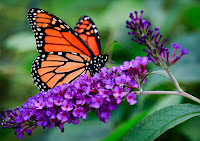
Monarch Butterfly on a purple flower• Still not sure what to choose? There are excellent lists available to help you choose the perfect pollinator-friendly plant to add to your garden.
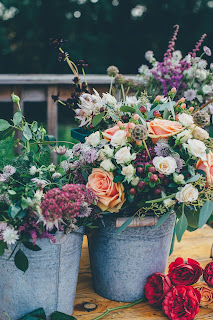
Two metal buckets filled with a variety of multi-colored flowers. Photo by Annie Spratt on Unsplash.Think Long Term:
To attract and keep pollinators in your yard, you need to create a constant source of pollen and nectar.
Native bees need to feed for months; plants that bloom just once (no matter how spectacularly) offer very little for these insects.
Throughout the growing season (spring to late fall), aim to have something bloom every week.Think variety to make your garden more attractive to a larger number of pollinators and more interesting visually.

Look Up: When considering planting for pollinators, look at trees.
Not all pollinators are found close to the ground, many trees harbor and nurture butterflies and other pollinators.

Looking up the trunk of a tree into the branches and the sky beyond. Photo by Edan Cohen. Oak trees can support 500 different species of butterflies and moths; for most common flowering perennials that number would be in the dozens at most.

Herbs Are Great: Herb gardens are especially attractive to bees, butterflies and hummingbirds.
Many popular herbs (dill, parsley, basil) are imports, but they are closely related to native herbs. This genetic similarity makes them eminently acceptable for our native bugs.
For maximum pollinator effect, only snip off half your plants. Allow the other half to flower. In otherwise, share the goodness.
Planting an herb garden is a no-brainer; even if you can’t lure pollinators to it you can enjoy its bounty yourself.


A mass of purple blooming trees and bushes surrounding a curved brown bridge. Photo by Cosmic Timetraveler on Unsplash
Don’t Over-groom: What you see as messy-looking is appealing to the creatures that fly and crawl.
Let plants wander and bloom at will. All the nooks and crannies create habitat or hiding places for our helpful insect partners.
Re-think weeds. Blooming weeds and wildflowers are the natural lifeline for native pollinators in the months following spring blossoms. Weeds may be unsightly to you, but they are highly desirous to a hungry insect. One option is to simply allow some weeds to flourish on the edge of your carefully cultivated space.
Leave some debris around to give native bees a place to nest. One dead limb is an excellent bee condo.

View of a person's legs in knee-high black boots lying on a field of clover - Photo by Sydney Rae on UnsplashLet’s Look At Lawns:
Lawns are the number one irrigated crop in America, which is problematic.
Lawns don’t provide food and offer very little to pollinators and wildlife in general. All good reasons to reduce our attachment to them.
If you are not ready to give up your lawn completely, try giving up a little bit around the edges and see how that feels. A slightly larger flower bed or a border around a sidewalk or driveway can be filled with lovely flowers. You’ll use less water and make our pollinators happy.
You could also transition some of your lawn to a cover crop. There are a number that make a lovely mat of low lying foliage and many (like the clovers) are flower-filled and beloved by pollinators.

There are many other things that can be helpful in building a pollinator friendly garden, such as providing water or a salt lick. Providing water can be as easy as finding plants that capture rainfall. Or build something; here are instructions for an easy water feature and here is a short video on salt licks.

Close-up of an orange and pink tulip getting doused with water. Photo by Michael Podger on Unsplash
In my research for this article, I came across the Million Pollinator Garden Challenge. They are doing some really cool stuff and I encourage everyone to join their movement. Or start your own movement right at home.

Paul Stametts, an American mycologist and author, has an interesting theory on how certain fungi can help bring our bees back to a healthy population. Here is a 10 minute clip that explains this further.

On another note: The big news this week was the fire at Notre Dame cathedral. From what I’ve read, they were able to save many (if not most) of the treasures that were inside. Another form of treasure also managed to make it out of the fire – their bees. It seems that there were three hives on the roof that miraculously survived. Read all about it here. Enjoy – it’s heartwarming.

Submitted by Pam

Tuesday, April 9, 2019

Pyrethrins, Pollinators and other Beneficials

Close up of a purple flower with the sun in the background and a bee approaching. Photo by Simon Matzinger on Unsplash.
When there is an infestation in a garden, often the first thing a person does is reach for the insecticide. While this is a totally understandable reaction, that insecticide will not differentiate between pest insects and beneficial ones. Not to mention the extremely important pollinators. In order to maintain a healthy ecosystem in a garden, there needs to be insects doing their jobs, so spraying insecticides needs to be
done cautiously.

Pyrethrin insecticides offer a reasonable solution for the environmentally conscious gardener. Derived from Chrysanthemum cinerarifolium (a flower genus that includes both the Chrysanthemum and the Daisy), these extracts have been used since ancient times to fight insect pests on both people and plants. Pyrethrin insecticides have been around for so long because they work so well. But, before you spray this power to kill should be taken into consideration.


Close up of a black and red wasp on a yellow flower. Photo by Krzysztof Niewolny on UnsplashFor the purposes of this blog, I am going to focus on bees. Although Honey Bees are the number one pollinator in the world and their existence is currently threatened, they are by no means the only pollinators. However, the efforts one can take to reduce harm to bees will also work to protect beneficial insects, other pollinating insects and even non-insect pollinators.

The dangers to bees from pyrethrins are the same as the danger from any other insecticide, but pyrethrins do not persist in the environment as other more toxic insecticides will. They will, instead, break down rapidly, especially when exposed to natural sunlight. This makes them by far the superior choice for putting in your garden or grow.

Close-up of a bee on white, pink and yellow flowers. Photo by Janosch Digglemann on UnsplashBee deaths from insecticides come from a combination of events; a perfect storm of pollinator danger. Most fatalities happen when pesticides are applied to flowering crops and then allowed to drift at a time when bees are actively foraging. To address and lessen these hazards, we can break them down to several things you should be aware of: temperature, drift/distance from treated area and timing of application.

Temperature: Bees forage only in sunlight and love high temperatures, so they are out and about on bright summer days. Additionally, sprays are more likely to vaporize under high temp and this vapor can be an even greater threat than the spray itself. Which means you should only apply insecticides in the late evening or night. Early morning applications can be done as long as you are sure that the insecticide will have dried before bees can get to it.

Drift/Distance from treated area:  
Pesticide drift is caused by multiple factors: weather, application method, equipment settings and spray formulation. Often, spraying will occur on flowering crops like fruits and vegetables and drift onto flowering plants like weeds and wildflowers, effectively stopping insect activities in both areas.

Close-up of a dandelion blowing in the wind in silhouette against an orange sky. Photo by Dawid Zawila on Unsplash Insecticides applied in one area can affect insects and wildlife more than a mile away. Create a buffer zone around your spray area. Most bees forage 1-2 miles from their hive, but can travel much farther; so the larger the buffer the better.

Be aware of the weather when you spray. Even light wind can enable drift and low humidity with high temperatures are optimal conditions for drift. Conversely, moderate temperatures with some humidity decrease the potential for drift.

Carefully calibrate your equipment (smaller droplets drift more) and avoid aerial applications and mist blowers.

Close-up of a bee on a long-stemmed white flower. Photo by William Warby on UnsplashHere are some more tips to manage your drift.

Timing of application: If possible, never apply pesticides to flowering plants. Insect control should take place either before or after flowering. If application is unavoidable, a pesticide with a short residual rate (pyrethrins are perfect!) can be applied in the evening when temperatures are under 60 degrees.

Here are a few other things to bear in mind before applying a pyrethrin (or any other) insecticide:

Before spraying, remove any flowering weeds around the area you will be spraying. This will reduce the temptation for pollinators and help form your buffer zone.

Avoid spraying any favorites of pollinators.

If possible, use pyrethrin insecticides in liquid formulations. Products with dusts or granules can easily stick to bee’s hairs and be taken back to the hive and cause damage there.

Always read the manufacturer’s label and apply insecticide at the minimum recommended rate. Never exceed the recommended amount.

If you would like more information on how to look out for pollinators, I highly recommend you check out the Xerces Society. They have been in the forefront of invertebrate conservation since 1971 and really know their stuff.
MGK logo


Looking for an effective, organic garden pest control spray? Check out the great organic pyrethrin-based liquid insecticides from our partner MGK Gardening - a proud producer of botanical pest control solutions for 100 years!


Submitted by Pam

Featured Post

Season Three of The EASY Organic Gardener is Launching!

We are pleased to announce that our podcast is back!  The   EASY   ( E nvironmentally   A nd   S ustainably   Y ours ) Organic Gardener Podc...