Showing posts with label honeydew. Show all posts

Wednesday, April 7, 2021

What’s This Bug? The Wooly Aphid.

Closeup of a Wooly Aphid
If you see drifting bits of white fuzz in your garden, you might not pay much attention to them, or you might discount them as pollen, lint, or even little fairies. But you may want to pay a little closer attention because they could be Wooly Aphids (Mult spp) hidden as innocuous debris.

The distinctive white fuzziness of these insects isn’t hair or fur – it’s the result of waxy strands that they secrete that create the wooly effect. It is believed that this wool is meant to protect them and deter predators. Underneath all that adornment they are small (about ¼” diameter), pale green to purplish-brown aphids. When they cluster together, they look more like a fungal growth than individual insects. If you see a white mass and are unsure of what it is, give the area a little shake – if it’s aphids, they’ll move. In fact, there is one species that does a dance when they feel threatened; they raise their rear ends and wiggle them. See them do their thing in this video, it’s pretty entertaining.

Two fluffy white Wolly Aphids hanging off a stem.

Wooly Aphids, like all aphids, are one of the first insects to get moving in earnest in the spring. And,
like virtually every other creature in spring, they have a specific reproductive agenda at hand. Wooly aphids use two host trees/plants in their life cycle. They choose one to overwinter and lay eggs in, but when spring comes they move to another to establish a breeding colony. The nymphs that appear in spring are crawlers, but by late spring they will be a full-blown white fuzzy mass on spurs and branches. Throughout the summer, subsequent generations take flight to find their own spots and, as winter approaches, all the Wooly Aphids go in search of their winter homes. This is often when people first notice them.

A dense pile of Wooly Beech Aphids on a branch.
Many people consider Wooly Aphids to be less of a threat to crops than other types of aphids. There are two reasons for this: Their numbers are generally not large enough to cause extensive crop damage and many of their species are adapted to live off of trees. Wooly Aphids are not considered tree-killers, and rarely even harm a tree’s overall health. They do, however, cause unsightly leaf curling and galls If you’re worried about your trees, this article has some great pictures that show what to look for.

The biggest concern in regards to Wooly Aphids is Sooty Mold. This particular plant mold is caused by an accumulation of honeydew, the sticky-sweet excrement of aphids. When aphids gather in large numbers, the honeydew can really build up creating the perfect growing environment for mold. Sooty Mold seldom kills a plant outright, but it can weaken it to the point where the insects causing the honeydew can do real damage. And then there is the ant angle – where there is honeydew there will be ants. They love the stuff and will protect and farm the aphids to get their honeydew (here is a cool super-closeup
Close-up of dark-purplish Sooty Mold nearly covering a green leaf.
video that shows them milking the aphids). Ants are notorious vectors for some serious plant diseases, so their presence on any plant or tree is definitely undesirable. Too much honeydew is not only a problem for plants, it can drip onto surfaces and is a real pain to get off cars.

If you are not charmed by the fluff-balls that are Wooly Aphids, ARBICO Organic has a multitude of weapons you can deploy against them. We have everything from insects that prey on aphids, to sticky traps, to a large variety of organic and natural insecticides. Our Aphid Control page is the best first stop on your search for a solution to your aphid problem.

Cartoon ants emerging from a hole.


Take Care.

Submitted by Pam


Thursday, June 28, 2018

The 7 Weirdest Aphid Behaviors

Not much to look, at but a devil to deal with in the garden – aphids are fascinating and unique creatures of the insect kingdom. In my humble opinion they deserve respect. Here are some interesting factoids about the nefarious aphid:


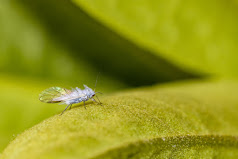
1. Is That Blue Bug Really an Aphid? 

Most commonly aphids are an off-white, cream color but don’t be fooled – if it looks like an aphid and eats the sugars out of the bottom of leaves like an aphid – it is an aphid. They come in virtually all colors: blueish-black, purple, pink, yellow and green. The way to identify them is to look at the underside of leaves with mottled yellow spots showing up. They cluster underneath leaves so it is critical when treating to get any sprays under the leaves and on top of the leaves.


2. Their Tailpipes Produce More Than Exhaust

The aphid has tailpipes called cornicles (or siphunculi) that produce a waxy fluid (cornicle wax) used for self-defense from predators and parasites. When attacked, aphids produce the cornicle wax to deter predators and trap parasitoid insects. It’s a bit like dropping the banana peel in the path of pursuers in the game Mario Kart. 


3. They Produce Double Duty Pheromones

While most insects are satisfied with pheromones that only help with the mating process, aphids have adapted to produce pheromones that also alert their compadres to insect threats. Once an aphid releases the alarm pheromone, the aphid colony rapidly moves en masse to another location. The colony may lose a few, but the majority will survive.  Always one step ahead of the game – ladybugs have adapted to locate this pheromone source to have a nice meal. 

4. Aphids Poop Sugar…and Lots of It 

One of the ways to identify an aphid infestation is if you find a thin, sticky substance on the plant leaves. Upon further investigation of the underside of the leaves you will most likely locate a colony of aphids. Aphids suck the sugars from plant foliage creating pinpoint mottled yellow spots on the leaves they are feeding on. 

Featured Post

Season Three of The EASY Organic Gardener is Launching!

We are pleased to announce that our podcast is back!  The   EASY   ( E nvironmentally   A nd   S ustainably   Y ours ) Organic Gardener Podc...