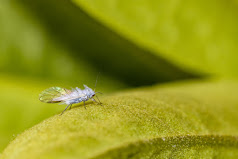
Mummies - like all good Halloween monsters, this icon of the season can be both delightful and frightening. This holds true for those mummies that are found in nature, specifically amongst insects. In the insect world, there are true mummies and those that are forever linked to mummies.
For many, the Brendan Fraser movie,
The Mummy (1999)
, provided the ultimate in mummy-centric scariness.
Their
depiction of an evil mummy was top-notch, but not all the horror came from him. The flesh-eating beetles that stream out of crypts and over and into people could give even the most fearless viewer the heebie-jeebies. In case you haven’t seen this mummy movie recently,
here is a compilation of the best beetle moments. They literally make people’s skin crawl.
 |
| Scarab beetle |
While the 1999 version of tomb beetles is more than a little over the top, there really are beetles that are associated with Egyptian mummies. These beetles are known as Egyptian scarab beetles (
Scarabaeus sacer) and they are in the dung beetle family. Despite what every mummy movie has said, scarab beetles do not feed on mummies. They feed on dung - the fresher the better. So, while they may be in ancient tombs, it is not the mummies they are after. They would be after the excrement of the small mammals that make such dark spaces their homes. The true connection between scarab beetles and mummies is that
ancient Egyptians worshiped this particular beetle as a symbol of creation and rebirth. Their god,
Khepri, even has the head of a scarab beetle. The Egyptians
 |
| Khepri |
related the way that dung beetles roll their balls of dung across the ground to the way that the sun moves across the sky. This reasoning may seem far-fetched to us today; but remember that there were long days and nights to fill with imagination before there was TV and an internet.
The connection between insects and mummies is actually much more direct than one would gather from reading up on scarab beetles. There are a number of insects that make mummies out of other insects. These insects behave similarly to those that create
insect zombies, but they do not keep their hosts alive for long and they do not practice mind control, they mummify and kill.
 |
| Aussie Sugarbag bee |
One such
insect mummifier is the stingless bee from Australia known as a
Sugarbag bee (these bees were originally called
Trigona carbonaria until they were reclassified as
Tetragonula carbonia in 2012). These Aussie bees have developed an interesting technique in the war against invasive
small hive beetle. Small hive beetles have led to devastating numbers of colony collapses in North American and Australia. Here at ARBICO, we recommend
Heterorhabditis indica nematodes to fight them in their larval stages, but Sugarbag bees have come up with another battle plan: Once a beetle invader is confronted in a hive it will react much like a turtle and pull its legs and head into its shell. It will stay that way until the attacking bees eventually give up. Except Sugarbag bees don’t give up, they coat the beetle with the same mixture of wax and resin that they use to build their nests. The beetle is stuck inside its mummified shell of doom while the bees go on about their business around him. Unfortunately for North American bee lovers, these clever bees are only found in Australia.
 |
| Aleiodes shakira wasp |
Back in 2014, scientists announced that they had discovered
24 new species of mummy-making wasps in the cloud forests of Ecuador. The female wasp picks its preferred caterpillar host and injects it with an egg. The caterpillar remains alive for a bit as the wasp larvae gorges on it from the inside. As the feeding continues, the caterpillar shrinks and mummifies;eventually it will be a just a husk that the immature wasps make a cocoon in. The scientists that discovered these wasps colorfully named them after famous people, including Jimmy Fallon, Ellen DeGeneres and poet Robert Frost. The
Aleiodes shakirae was named for the Colombian singer, Shakira. The entomologists thought that the twisting and turning of the agonal death throes of the caterpillars looked like
Shakira dancing. I’m not sure how they decided on how to name the others, hopefully the thought process wasn't quite as morbid.
 |
| Aphid mummies |
We have a couple of mummy-makers here at ARBICO that we are particularly fond of. We offer
Aphidius colemani and
Aphelinus abdominalis to our clients as an natural alternative for aphid control and an ideal part of an
Integrated Pest Management program. These helpful insects seek out aphids and lay their eggs inside the aphid nymphs. In time, the nymphs will turn into leathery greyish-brown mummies. The aphid parasites will eventually emerge as adults to begin their aphid hunting cycle again. These beneficial insects are extremely effective in cleaning up aphid infestations in both home gardens and large scale growing.
Happy Halloween and be on the lookout - mummies are all around you!
Submitted by Pam