Showing posts with label native americans. Show all posts

Thursday, March 30, 2023

Sunflower Joy

A blonde girl in a field of sunflowers. Sunflowerr petals cover most of her face.
Who doesn’t like sunflowers? Sunflowers belong to the small group of plants that everyone seems to like and can identify, but they are much more than a pretty face. The sunflower plant  has given people joy for tens of thousands of years, by virtue of its beauty but also for all the cool things it gives us. At this point in spring, it's time to plant sunflowers, so let’s dig into them a bit before planting them.

Sunflower seeds in a flat straw basket and grilled sunflower heads in a black bowl.
Sunflowers (Helianthus spp) were once just a pretty wildflower native to North America. But as early as 5,000 years ago, Indigenous people in modern-day New Mexico and Arizona were cultivating them. These ancient people didn’t just domesticate the sunflower plant, they selectively cultivated it to produce certain colors and specific amounts of flowers and seeds. Across the tribes, sunflowers had a great many uses beyond their value as a food source. Sunflower oil was used in cooking and to soothe skin and smooth hair, the flowers made great dyes for textiles and body applications, and their stalks could be used as building materials. Sunflowers were also used for ceremonial purposes and had extensive medicinal applications - they were used to treat snake bites, chest problems, wound treatments and much, much more. Read more about all this here

A brunette woman in a blue dress standing in a sunflower field. She is facing away from the camera an is wearing a blue dress and holding up a Ukranian flag.
The Spaniards, and other colonists, took the sunflower to Europe beginning in the early 1500s. It was treated as an ornamental with tasty seeds until the 1700s when the Russian Tsar, Peter the Great, recognized its value as a food and oil crop and initiated it’s commercial cultivation. Russia is still a leading producer of sunflowers, but the top producer is Ukraine. In 2021 it provided a 47% share of global sunflower oil exports. Since the Russian’s war on Ukraine, production of this vital crop has been disrupted, which has led to shortages. The sunflower is the national flower of Ukraine and it’s bright yellow is part of their flag. In the early days after the Russian invasion, a video got out of a Ukrainian woman giving sunflower seeds to Russian soldiers. As she handed them out she was telling the soldiers to put the seeds in their pockets so that when they die the flowers would grow on Ukrainian soil (watch it here). Since that remarkable act, sunflowers have become a symbol of peace, solidarity with Ukraine, and resistance. 

A collage of 16 different species of sunflowers.

The original wildflower would have looked very different from the sunflower we know today. Over the centuries since the Indigenous botanists first made changes to the plant, many growers have done the same. There are about 70 species in the Helianthus genus today and they range from little-bitty ones of about 1-2 feet to majestic, towering ones (the tallest was 30'1"). There are numerous versions of the familiar cheery yellow flower, but there are also terra-cotta, orange, white, purple and pink varieties. Here are some of them.

A sunflower facing towards the sun. Photo by Aaron Burden on Unsplash.With all the choices at hand, picking just one variety could be a bit difficult, but once you do it is essential that you pick the spot to plant your sunflowers carefully. These are sunflowers after all, so you’ll want to make sure that they have sun all day (at least 6-8 hours). As they grow you will be able to watch them exhibit a behavior known as heliotropism. This is when the buds and small blossoms face east in the morning and move with the sun throughout the day to maximize their light intake. As the plants mature, when the stems thicken and the heads become heavy with seeds, this behavior ends. 

Another reason to pick your planting spot carefully is that sunflowers are allelopathic. Plants that are allelopathic emit chemicals that can inhibit the growth of (or kill out-right) other plants. For sunflowers, this means that they will eliminate resource-competitors to give their seeds the best chance to germinate and grow. This doesn’t mean that sunflowers have to be grown alone, it just means that you should do a little research before you decide what to plant around them as some plants are more at-risk than others. Here are some helpful guidelines.

A group of sunflowers grown to form a sunflower house. There is a red wheelbarrow and wagon in front.
If you have children, you may want to consider growing a sunflower house in your garden. This is simply a bower in the garden created by closely planted sunflowers. You can either leave the sunflowers to grow as they want or train them to grow over to form a “roof” for the sunflower house. Here are some super-simple instructions.

A chipmunk eating a sunflower headIn case you need another reason to plant sunflowers, consider the fact that sunflowers can remediate soil. They  remove toxins and heavy metals and have even been used to absorb radiation around Fukushima and Chernobyl after the nuclear disasters there. Your yard may not have been the site of a disaster, but all soil could use a little freshening up and after growing sunflowers you'll have better soil for the next growing cycle. Here’s the story of  a young scholar who is working out ways to best utilize this awesome sunflower trait. 

Sunflower lovers have no shortage of sunflower-related stuff they can surround themselves with (check out this Amazon search), but the best way to love them is to plant them and watch them grow. Which will also let pollinators and other creatures show their love.

Take CareSunflowers moving in the wind under a blue sky. There is a bee buzzing around.

Submitted by Pam


Friday, February 26, 2021

Snow Moon Gardening

Full moon over a snowy river bank. Image from Pixabay.
This weekend we will be gifted with February’s full moon, known as the Snow Moon. For many of you out there, as you peer out the window at the snowscape that is your yard, the evocative nature of this name may not be all that appealing. But even for the snow-weary, this lunar event should produce some beautiful images and it gives us all an opportunity to consider gardening by the moon’s cycles.

It’s no secret that much of the US can expect snow in February, so the Snow Moon name is no surprise. It has been used by indigenous cultures for who-knows-how-many years. According to the Old Farmer’s Almanac, Captain Jonathan Carver visited the Naudowessie (Dakota) back in the 1760s and wrote that they called this time the Snow Moon, “because more snow commonly falls during this month than any other in the winter.” But other native peoples use different names. The Ojibe and Tlingit call it the Bear Moon and the Black Bear Moon respectively, because this is when bear cubs are born in their dens. Among the Mi’kmaq people in Eastern Canada, it is the Snow Blinding Moon due to the strong winds that accompany February snowstorms. Other tribes use names that speak for themselves: the Hunger Moon, the Little Famine Moon, and the Bony Moon. Here is a short video from the Old Father’s Almanac that tells you more about this cold moon and other moon lore.

Kalispel Indian people outside their teepee with tons of snow all around. Image credit to Yolanda Bowman of the tribe.
Indigenous peoples did more than just give moons cool names, as far back as we know agriculture-based societies around the world have followed the phases of the moon to guide their farming practices. For thousands of years, Mayans have used their calendar system to track the movement of the moon and to plan when to plant and when to harvest their crops. Planting by the moon has long been a common practice throughout North America. As European settlers colonized the land, many settlers brought these ideas from their own ancient past and adapted to and adopted ideas from the New World. These practices are part of what we have come to know as traditional or heirloom farming. 

Image of 2 hands holding a seedling in soil with a moon hovering over it.
Gardening by the moon is a fairly simple concept at its root. Simply put, the water in the soil is affected by the gravitational pull of the moon and plants respond to increased or decreased light of the moon. As the moon moves toward becoming a Full Moon, it is called a waxing moon. This phase brings the moisture in the soil closer to the surface. As it moves away from the Full Moon, it is in its waning phase, and soil moisture retreats from the surface. At the time of the Full Moon, the combination of the higher surface moisture in the soil and increased light from the moon makes it an optimal time to plant aboveground plants. As the light wanes and moisture moves down, the time is right to plant root crops. For more on this, check out this site. And the Old Father’s Almanac has a video on this as well
here.

Full moon above a dark forest. Photo by Jesse Orrico on Unsplash.
Many proponents of moon planting also take into consideration what sign of the zodiac the moon is moving through. The idea here is that since each sign of the zodiac is related to one of the four elements (Water, Air, Earth, and Fire), and these should be taken into consideration as well as the moon phase. According to this article, Air and Fire signs are barren and planting should never be done when the moon is in those signs (they also say never plant on Sundays, but I’m not clear where that comes from). Since each sign of the zodiac is also associated with a body part, some people may use terms related to said body parts when discussing this practice. Read this lady’s fun story for a better understanding of this.  

Moon gardening has become somewhat of a thing lately for cannabis growers. As more people get into the game and they are all striving for the biggest, brightest buds, “new” techniques are eagerly embraced. More on that here. I’m sure there is lots of back and forth on the cannabis forums on this; I will leave it to you, dear reader, to go down that rabbit hole.

A blue cannabis plant in the foreground with a full moon in the background.
It needs to be said that not everyone is buying all this. No matter how long people have been doing it. This man brings up some excellent points, including climate change, planting zones, and the lack of substantive scientific research on the topic. No matter how you feel regarding planting by the moon (and especially if you are undecided), his article is interesting, informative, and worth reading. 

Snow falling across a full moon.
We have an array of lunar events ahead of us in 2021. This article says that we'll have three supermoons (all in a row), a Blue Moon, and two lunar eclipses. But, before all that, we’ll have the Worm Moon in March. Which sounds way more unappetizing than a Snow Moon.

Stay warm and take care. 

Submitted by Pam


Wednesday, September 23, 2020

Trees - A Love Story

A heart-shaped silhouette in a tree at sunset.
We humans love our trees. Even those who would claim not to probably dreamed of a treehouse as a kid; or would enjoy swinging lazily in a hammock under a shade tree, or spending a cozy evening by the fire with the Christmas tree twinkling prettily in the corner. More than any other type of plant, trees are deeply intertwined with the human experience. Trees provide the air we breathe, of course, but they also provide goods, food, and shelter; they enable our dreams and creativity; they provide emotional and spiritual succor; they serve as entertainment and inspiration, and we arguably would not have thrived so spectacularly on this planet without them. Trees are really Man’s best friend (sorry dogs).

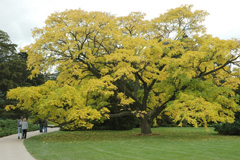
A magnificent Amur Cork tree next to a sidewalk with people on it.
The list of things that trees have done for humankind is probably endless (what we have done for them is decidedly shorter), but let’s just consider some products that we enjoy (aside from food; that’s a story for another day). The most basic, and the one used in most ways in most places, is wood. Wood for shelter, wood for transportation, wood for paper, wood for fencing – you get the idea. There are so many things that are tree-derived that we use regularly without appreciating their origin. They include: wine corks (so necessary in these trying times), dental floss, furniture and car wax, makeup, turpentine, latex (how could we fight COVID-19 without this?), charcoal, candy coatings, medicines, waterproof fabrics, tires, chocolate and more chocolate, deodorant, and maple syrup (the real, über delicious kind). One could write a book (and many have) of all the products we get from trees. I encourage you to look around and take notice of all they provide us.

A Native American Trail tree growing at an unusual angle.
 Humans have turned to trees to solve problems that nature has thrown at them since our prehistoric ancestors sheltered in trees. In modern times, indigenous people in the Meghalaya plateau of eastern India, create bridges from trees. In a mountainous region with deep ravines prone to extreme monsoonal flooding, reliable bridges are essential and these, made from the aerial roots of the Indian rubber tree, are strong and get even stronger as the trees grow over time. To see how they do this, check out this article. On this continent, some Native Americans used trees as markers to show the way to trails, burials, resources, or tribal lands. Young saplings were bent so that they would grow in a particular way that delivered a clear message to those that knew how to read them. To outsiders who did not know this language of trees, they seemed like any other tree, albeit a little quirky. Here is a man who has spent decades documenting these trees.

Viking Longships

Trees have also been the means by which people have been able to expand their resources and seek out better-living conditions. Take boats, for example: 10,000 years ago, someone used an ax to hack a canoe out of a Scotch pine tree. Known as the Pesse canoe, it is the oldest known boat and was found in the Netherlands. What were they after? Or what were they fleeing from? It’s an intriguing artifact. In the millennium since then, people have been taking to the water with help from trees. Ancient mariners traveled to Australia and throughout the Pacific islands. The Chinese built vessels during the Han dynasty (220 BC- 200 AD) and Romans built craft that enabled them to manage an expansive empire. The British were able to create an even larger empire, in part because they had plentiful forests to build their ships. And those ships ate up huge numbers of trees. Henry the VIII’s prized warship, the Mary Rose, required 600 oak trees to build in 1511. When you compare that to the 14 trees it took to build a Viking longship (also skilled sailors and colonizers), it is easy to see how the consumption of forest resources amped up over the centuries. As "new" lands and forests were populated (hello, America), the destruction of trees has continued unabated.

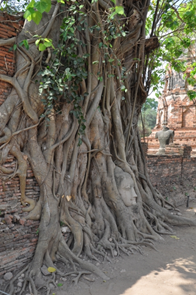
A sculpture of Buddha's head amongst the roots of a Bodhi tree.
Humans are experts at exploiting forest resources; things could be vastly different if we recognized the spiritual side of trees as eagerly as we do the economic advantage of them. It’s hard to understand why this is as trees play a role in every major (and most minor) religion. In the Old Testament of the Bible, there are 328 references to trees and, in Genesis, God created trees before Man. In the Quran, Muslims are instructed to plant trees, to treat them with respect, and to recognize their spiritual essence. In Buddhist tradition, the Buddha gained enlightenment under a Bodhi tree. In Christianity, think of how Jesus’ crucifixion and everything that sprang from that would not have happened without that wooden cross. Animist beliefs, the essence of most indigenous religions, directly assigns spirituality to trees. This can be seen in Madagascar, where the awe-inspiring Baobab tree is believed to hold the spirits of ancestors. Across all these beliefs there are special trees, ones that are said to be miracle-makers, hold supernatural powers or cosmic secrets. In a time of great human divisiveness, we are bonded together in a spiritual connection to trees, whether we acknowledge it or not.
Children playing at the feet of massive Baobab trees in Madagascar.
As I write this, trees are imperiled by bookend tragedies in the United States. Wildfires are decimating hundreds of thousands of acres in the Pacific Northwest and West and back-to-back hurricanes have sent untold thousands tumbling in southern states. Forest fires in Siberia have burned 42 million acres this year and the Amazon is burning. Given our close bond with trees, this devastation must be causing subliminal harm to the human psyche. Perhaps this (Covid-19 aside) is part of what is causing such angst in people. I fervently hope that people will become unhappy and uncomfortable enough to address the causes of such mass forest destruction and act to protect this glorious plant, in all its variations, that has meant so much to us.

A cartoon showing two arms coming out and hugging a tree.Stay tuned: my next few blogs will be about trees as well - there's just so much cool stuff to share!
Take care.
Submitted by Pam


Stay tuned: My next few blogs will be about trees as well - there's just so much cool stuff to share!


Take care.
Submitted by Pam

Thursday, November 14, 2019

Seeing The Future In The Past: Native American Women And Science

A woman with long dark hair and a black hat holding up a white sign with red lettering. It says "Idigenous women will lead us forward" . Taken at the International Woman's Day 2019 March in Tucson, AZ. Photo by Dulcey Lima on Unsplash.
Tohono O'odham Woman - Tucson, AZ  2019
Since 1990, Americans have recognized November as Native American Heritage Month. In this piece, I am going to maintain the respectful acknowledgement that this calls for. I do this despite the recent proclamation that November will now be called,National American History and Founders Month.  I mean, c’mon…

I arrive at my topic today via a suggestion from a colleague, Anissa. Our Anissa is an active member of the Pascua Yaqui Tribe. The Yaquis (or Yo’emen) have lived in our part of southern Arizona and neighboring northern Mexico since at least 552 AD (for their history as told by the tribal historian, go here). Of course, there was no US/Mexico border then and, to this day, Yaquis traditionally disregard it as an abstract construct. They maintain communities on both sides and travel back and forth at will. For obvious good reasons, Anissa is proud of her deep-rooted heritage and wholeheartedly participates in tribal life. She especially loves to watch the Deer Dancer, an ancient and moving experience (here is a video). Beyond her indigenous roots, Anissa is very much a modern, educated and forward-thinking woman. Her degree in Bio-Engineering no doubt played a part in suggesting I write about Native American women scientists.

A bare-chested man with a deer headress and a gourd rattle in each hand leaping from the desert floor.A Yaqui Deer Dancer.  Photo by David Hinojos.
Yaqui Deer Dancer
Native Americans and scientists may not seem a natural pairing to many people, but let me assure you that nothing could be further from the truth. In fact, there a great many things that were invented or developed by native peoples long before Columbus was anywhere near our continent. Some of the things that are an integral part of our lives today we owe to the indigenous scientists of the American continent. A short list would include anaesthetic, chocolate, aspirin, hammocks, chewing gum and gold plating. As it turned out, they may have been better off without the gold plating. Europeans, unfamiliar with the concept of plating, believed that everything glittery was solid gold and their gold fever outweighed the actual gold resources. This led to dire consequences for those that could not produce the desired, unreasonable amount. Native Americans also developed the agriculture for many foods that are now essential resources world-wide. The very short list of these includes potatoes, corn, beans, chili peppers and squash. The peoples that gave all these things to the rest of the world may not have had labs to work in or data to input, but they were
scientists nonetheless.
A drawing of several women in bucksKins tending to their garden. There are thatch buildings in the background.
Women played a huge role in ancient contributions to the sciences. They were the ones who cared for and fed the families and knew how, where and when to do so. In more modern times, Native American women have stepped forward to lead their communities. Here are a couple of exceptional ladies from the not-so-distant past:

A portrait of a woman with short brown hair in a green dress - Mary Golda Ross.
Mary Golda Ross

Mary Golda Ross (1908-2008) – Engineer/Cherokee – This figure in US aviation history was hidden from public acclaim for decades. A good portion of this was, of course, because she was a woman of color; but much of her work was (and still remains) classified. Complicated math came easy to her and she put this skill to good use developing fighter planes during WWII and, later, to getting Man to space. Before college, she went to Cherokee schools and gave credit to their cultural insistence on equal education for boys and girls for her initial push towards STEM. For more on this fascinating lady, here is a short article – it also contains a fun video of her on a game show back in the day. One more thing: She has her own Google Doodle.

An portrait from the late 1800's of a woman with swept-up dark hair and a high-collared dark dress. Susan La Flesche Picotte.
Susan La Flesche Picotte
Susan La Flesche Picotte (1865-1915) – Doctor/Omaha – This pioneering woman was the first Native American woman to earn a medical degree in the United States, doing so at the age of 24. The daughter of the last recognized chief of the Omaha (Joseph La Flesche, aka Iron Eye), she was inspired by the lack of and racist quality of health care among her people. After earning her degree,she worked tirelessly on the reservation as its only doctor, often serving over 1,000 patients. In time, she and her husband opened the first private hospital on a reservation. She died too young at 50, but she remains beloved in her community.

A woman with dark hair and glasses wearing a grey turtleneck and a colorful pendant. Rosalyn LaPier
Roslyn LaPier
These women are stand-outs for their intellect and dedication to learning. They are a strong link to the same type of modern Native American woman in the scientific field today. For Anissa (who is currently working on her Master’s in Plant Biology), I have chosen to highlight the following women who are reclaiming native plants for their cultural significance, health benefits and food security:

Rosalyn LaPierBlackfeet Nation – She researches Ethnobotany and Ethnopharmacology, specifically the medicinal qualities of plants and Native American beliefs. Dr. LaPier has also been a researcher at the Harvard School of Divinity, where she wrote this interesting and edifying article on science and religion in Native American cultures. If that is not enough, she is also an environmental activist and speaker. Here is a video of her speaking at the Society for Advancement of Chicanos/Hispanics and Native Americans in Science 2017 conference.

A close-up of a woman with grey hair and dangly bead earrings in a colorful sweater. Robin Wall Kimmerer
Robin Wall Kimmerer
Robin Wall. KimmererCitizen Potawatomi Nation – The list of things this dynamic woman researches and teaches is way too long for me to do it justice by summarizing it. But, I’ll do my best: Dr. Kimmerer studies the role of ecological knowledge in ecological restoration, the ecology and restoration of culturally significant plants and (whew!) integrating scientific tools and indigenous philosophy to benefit the people and the land. She also the founding director of the Center for Native Peoples and the Environment, which creates programs that use a combination of traditional science and indigenous knowledge to move towards a shared goal of sustainability. And she researches mosses. I am sure I’ve missed something; I encourage you to learn more about her here.
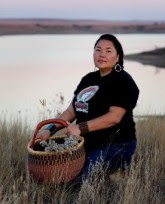
A brunette woman standing in a field with a large basket full of plants. There is a lake in the background, Linda Black Elk
Linda Black Elk
Linda Black ElkCatawba Nation – This ethnobotanist, restoration ecologist and activist is truly a 21st century woman. She has many YouTube videos and regularly posts articles online. In this way, her voice carries beyond the Standing Rock Reservation, where she lives with her family, and Sitting Bull College where she teaches. She is the Ethnobotanist for the Standing Rock Sioux Tribe and is very active in promoting tribal food sovereignty and better health through the use of native plants. Lately, she has been vocal and involved in the ongoing fight against the Dakota Access Pipeline. Here she is talking about the spirits in plants.

A black and white clip from the Doctor Who TV series. A man in the background is asking a woman in the front," What's a girl like you doing in a job like this?"For all of these strong women, there are others that are equally strong but whose voices are never heard. There are also many dazzlingly successful Native American men. Nevertheless, the vast majority of the traditional guardians of the land we call home are still stymied by poverty, prejudice and lack of opportunities. During this month especially, take some time to appreciate what came before us Europeans and open your mind to those who are with us today.

Submitted by Pam


Featured Post

Common Pests of Hemp and Cannabis Plants

The cannabis industry has steadily grown over the years, and with that expansion comes a remarkably diverse set of insects that want a piece...