Showing posts with label plants. Show all posts

Thursday, November 14, 2019

Seeing The Future In The Past: Native American Women And Science

A woman with long dark hair and a black hat holding up a white sign with red lettering. It says "Idigenous women will lead us forward" . Taken at the International Woman's Day 2019 March in Tucson, AZ. Photo by Dulcey Lima on Unsplash.
Tohono O'odham Woman - Tucson, AZ  2019
Since 1990, Americans have recognized November as Native American Heritage Month. In this piece, I am going to maintain the respectful acknowledgement that this calls for. I do this despite the recent proclamation that November will now be called,“National American History and Founders Month”.  I mean, c’mon…

I arrive at my topic today via a suggestion from a colleague, Anissa. Our Anissa is an active member of the Pascua Yaqui Tribe. The Yaquis (or Yo’emen) have lived in our part of southern Arizona and neighboring northern Mexico since at least 552 AD. Of course, there was no US/Mexico border then and, to this day, Yaquis traditionally disregard it as an abstract construct. They maintain communities on both sides and travel back and forth at will. For obvious good reasons, Anissa is proud of her deep-rooted heritage and wholeheartedly participates in tribal life. She especially loves to watch the Deer Dancer, an ancient and moving experience (here is a video). Beyond her indigenous roots, Anissa is very much a modern, educated and forward-thinking woman. Her degree in Bio-Engineering no doubt played a part in suggesting I write about Native American women scientists.

A bare-chested man with a deer headress and a gourd rattle in each hand leaping from the desert floor.A Yaqui Deer Dancer.  Photo by David Hinojos.
Yaqui Deer Dancer
Native Americans and scientists may not seem a natural pairing to many people, but let me assure you that nothing could be further from the truth. In fact, there a great many things that were invented or developed by native peoples long before Columbus was anywhere near our continent. Some of the things that are an integral part of our lives today we owe to the indigenous scientists of the American continent. A short list would include anaesthetic, chocolate, aspirin, hammocks, chewing gum and gold plating. As it turned out, they may have been better off without the gold plating. Europeans, unfamiliar with the concept of plating, believed that everything glittery was solid gold and their gold fever outweighed the actual gold resources. This led to dire consequences for those that could not produce the desired, unreasonable amount. Native Americans also developed the agriculture for many foods that are now essential resources world-wide. The very short list of these includes potatoes, corn, beans, chili peppers and squash. The peoples that gave all these things to the rest of the world may not have had labs to work in or data to input, but they were
scientists nonetheless.
A drawing of several women in bucksKins tending to their garden. There are thatch buildings in the background.
Women played a huge role in ancient contributions to the sciences. They were the ones who cared for and fed the families and knew how, where and when to do so. In more modern times, Native American women have stepped forward to lead their communities. Here are a couple of exceptional ladies from the not-so-distant past:

A portrait of a woman with short brown hair in a green dress - Mary Golda Ross.
Mary Golda Ross

Mary Golda Ross (1908-2008) – Engineer/Cherokee – This figure in US aviation history was hidden from public acclaim for decades. A good portion of this was, of course, because she was a woman of color; but much of her work was (and still remains) classified. Complicated math came easy to her and she put this skill to good use developing fighter planes during WWII and, later, to getting Man to space. Before college, she went to Cherokee schools and gave credit to their cultural insistence on equal education for boys and girls for her initial push towards STEM. For more on this fascinating lady, here is a short article – it also contains a fun video of her on a game show back in the day. One more thing: She has her own Google Doodle.

An portrait from the late 1800's of a woman with swept-up dark hair and a high-collared dark dress. Susan La Flesche Picotte.
Susan La Flesche Picotte
Susan La Flesche Picotte (1865-1915) – Doctor/Omaha – This pioneering woman was the first Native American woman to earn a medical degree in the United States, doing so at the age of 24. The daughter of the last recognized chief of the Omaha (Joseph La Flesche, aka Iron Eye), she was inspired by the lack of and racist quality of health care among her people. After earning her degree,she worked tirelessly on the reservation as its only doctor, often serving over 1,000 patients. In time, she and her husband opened the first private hospital on a reservation. She died too young at 50, but she remains beloved in her community.

A woman with dark hair and glasses wearing a grey turtleneck and a colorful pendant. Rosalyn LaPier
Roslyn LaPier
These women are stand-outs for their intellect and dedication to learning. They are a strong link to the same type of modern Native American woman in the scientific field today. For Anissa (who is currently working on her Master’s in Plant Biology), I have chosen to highlight the following women who are reclaiming native plants for their cultural significance, health benefits and food security:

Rosalyn LaPier – Blackfeet Nation – She researches Ethnobotany and Ethnopharmacology, specifically the medicinal qualities of plants and Native American beliefs. Dr. LaPier has also been a researcher at the Harvard School of Divinity, where she wrote this interesting and edifying article on science and religion in Native American cultures. If that is not enough, she is also an environmental activist and speaker. Here is a video of her speaking at the Society for Advancement of Chicanos/Hispanics and Native Americans in Science 2017 conference.

A close-up of a woman with grey hair and dangly bead earrings in a colorful sweater. Robin Wall Kimmerer
Robin Wall Kimmerer
Robin Wall. Kimmerer – Citizen Potawatomi Nation – The list of things this dynamic woman researches and teaches is way too long for me to do it justice by summarizing it. But, I’ll do my best: Dr. Kimmerer studies the role of ecological knowledge in ecological restoration, the ecology and restoration of culturally significant plants and (whew!) integrating scientific tools and indigenous philosophy to benefit the people and the land. She also the founding director of the Center for Native Peoples and the Environment, which creates programs that use a combination of traditional science and indigenous knowledge to move towards a shared goal of sustainability. And she researches mosses. I am sure I’ve missed something; I encourage you to learn more about her here.
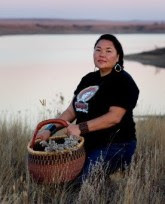
A brunette woman standing in a field with a large basket full of plants. There is a lake in the background, Linda Black Elk
Linda Black Elk
Linda Black Elk – Catawba Nation – This ethnobotanist, restoration ecologist and activist is truly a 21st century woman. She has many YouTube videos and regularly posts articles online. In this way, her voice carries beyond the Standing Rock Reservation, where she lives with her family, and Sitting Bull College where she teaches. She is the Ethnobotanist for the Standing Rock Sioux Tribe and is very active in promoting tribal food sovereignty and better health through the use of native plants. Lately, she has been vocal and involved in the ongoing fight against the Dakota Access Pipeline. Here she is talking about the spirits in plants.

A black and white clip from the Doctor Who TV series. A man in the background is asking a woman in the front," What's a girl like you doing in a job like this?"For all of these strong women, there are others that are equally strong but whose voices are never heard. There are also many dazzlingly successful Native American men. Nevertheless, the vast majority of the traditional guardians of the land we call home are still stymied by poverty, prejudice and lack of opportunities. During this month especially, take some time to appreciate what came before us Europeans and open your mind to those who are with us today.

Submitted by Pam


Friday, October 4, 2019

When You Know The Water's Coming

Animated images of rain falling in water with tall trees in the background. gif by giphyWater, water, water everywhere – this has been the reality for millions of people this year. If you are one of those affected, the consequences can be devastating. Hopefully, as you are reading this you have moved passed the drying out and cleaning up phase and are ready to assess what’s next. Because there will be a ‘next” and it will bring more water your way. Climate change is real and one of the undeniable effects it has on real people is that storms are bigger and more destructive than ever. As we work our way through autumn and into winter, it is a good time to determine what you can do before spring rain (or perhaps an unseasonable snowmelt) arrives. Preparing your home and family for even minor flooding encompasses a long list of variables (here is a flooding preparedness checklist from the Red Cross), but preparing your lawn or garden is something that need not be overwhelming. Many of these things you can even do in stages, to reduce time and money spent.

Backyard patio alongside raised terraces and rock channels (aka swales and berms
Swale and Berm landscaping
Runoff rundown: The objective here is for you to be able to determine where the water will go when it comes. Swales and berms are landscaping techniques that have been used since ancient times to direct water. Swales are depressions in the earth that hold water. They are often used in conjunction with dams, cisterns and other water catchment systems. Where swales are dips, berms are rises – they are raised beds or hills that move the water down into swales and/or other preferred drainage areas. French drains are another method that can be used to channel water. Simply put, they are sloping trenches lined with stones that has a pipe leading water away (here is a video on how they work). These are used extensively here in Southern Arizona, where our rain comes fast and furious Their name, by the way, has nothing to do with a country in Europe; it comes from Henry French, who wrote about them in 1859. While you are considering runoff, look at your rain spouts; redirecting their flow can be done relatively easily with great results (here are some wondrous examples). If you have them empty into rain barrels or a cistern, the water you don’t want in your yard can be stored and used later on your terms.when it comes.

A orange rain spout in the shape of a giant watering can against a grey wall. In Anacortes, WA by Joe Mahl
Anacortes, WA by Joe Mahl
Soaking it up: As an extension of some of the ideas above, you may want to look into better drainage around the hard surfaces in your yard (patios, driveways, etc.). You can always create drainage alongside these areas, but a better (albeit more costly) solution would be to change out concrete or asphalt for gravel, rock, brick or permeable paving materials. Loosely apply these materials so that water can slip right through and into the ground. You will have less water in your yard and be doing your part to recharge ground water.

A cluster of decorative plants in a depression at the foot of a tree.
Rain garden
Planting with purpose: Before planting anything in your newly flood-proofed yard, make sure you’ve got your soil right. Why? Because, that’s always the first step in planting. And (if you read my blog last week you already know this) soil that has been flooded will most likely need to be amended to bring it an optimal condition. Well-structured soils are able to absorb and drain well, with sandy soils being able to drain better than clay-like soil. If you are more committed to a flood-busting landscape than you are to a particular look, it would pay to seek out those plants that like the sandy stuff. Likewise, if you feel that you will still have standing water at some point, pick plants that are tolerant to wet roots. Additional ways to improve your chances of success are planting native plants, diversifying the plant species you choose and aggressively cleaning and clearing out any area or thing that can dam up or hold water. Still unsure what plants will work for you? Here are some ideas to get you moving down that path.

A closeup of a water droplet on a green leaf.
Embrace the rain: Instead of trying to create a garden that can handle excess water, why not just go all in and plant a rain garden? A rain garden is similar to a swale in that it is on a downslope or depression and meant to catch water, but these gardens are filled with decorative plants, while swales are meant simply as water catchment systems. Determine how much and for how long water will be in your garden and pick plants that will flourish in those conditions (here are some plants that can handle extended submersion). If you are dealing with sea spray and/or salt water, be particularly careful to choose plants that can literally stand up to those elements. Let your imagination fly and create a beautiful garden in what would have been an area of standing water.

Preparing for a natural disaster and praying it won’t happen seems to be the sensible way to roll these days. It is widely accepted that certain steps can and should be taken to lessen the effect of wildfire on property, flooding should be viewed in the same way.

Submitted by Pam


Friday, March 29, 2019

In a Garden of April Fools

A close-up of bare tree branches with light & dark blue colored circular evil eye amulets. Photo by Hulki Okan Tabak.
An Evil Eye Tree - native to Cappadocia, Nevsehir, Turkey
Ah, Spring! – a time for love, bountiful blossom displays and,inevitably, April Fools’ Day. This quasi-holiday has traditional roots in Old World Europe but is now celebrated in places as far-flung as India and Brazil. Although the exact reason for pranking on April 1st have been blurred by history, many possible origin stories point to celebrations of the Vernal Equinox and end-of-winter festivities as far back as the Celts and Romans. Spring planting traditions come into play at this time of year and many people believe that April Fools’ Day speaks to the foolishness of planting in the unpredictable weather of early spring.

Multi-colored tulips on display. Photo by John Mark Smith
Close-up of brown Lichops succulent plants interspersed with brown stones and a couple white and yellow flowers.
Which ones are the Lichops?
A surprising number of pranks and hoaxes have grown out of the gardening and botanical worlds over the years. Perhaps, in part, because there are many plants who are tricksters in their own right. Take the Lithops, for example: Also known as “Living Stones”, these southern African succulents have evolved to look like just another rock in the ground (a “no need to look here” for any herbivore searching for lunch). Then there are the Fooled You Peppers: These fascinating little green gems have the look and flavor of jalapeños without any of the heat. This is a wonderful thing for people like me who cannot handle the heat. I also think there is a juicy prank in here somewhere (like: I’ll bet you I can eat 15 of these jalapeños without stopping” kind of thing). Here is an article from the Smithsonian with more interesting prankster plants and here is a link to my blog from last October about strange plants (who are also mostly fakers).

Black and white picture of three people standing before a tree with spaghetti noodles hanging down. One woman is on a ladder, and a man and woman standing at the foot. He is holding a round flat basket.
1957 Spaghetti Harvest in Ticino, Switzerland
As I mentioned before, plants and gardening seem to find their way into April Fools’ pranks quite a bit. One famous example is the 1957 BBC presentation of “Spaghetti - Harvest in Ticino”. In this bit, their news program, Panorama, “reported” on the bumper crop of spaghetti that grew from spaghetti trees due to mild spring weather. A well-known war correspondent narrated the piece with the utmost gravitas, giving it extra credibility. Many people were fooled, of course, and some even tried to book holidays to go see the crop for themselves. This is a perfect example of how something that is clearly absurd can be said with enough sincerity that people will believe it.

Maple trees with orange leaves on a forest lane strewn with fallen orange foliage.
Beautiful Maple Trees
In 2005, another legitimate news source, NPR (National Public Radio) perpetrated its own tree-related hoax. As heard on their program All Things Considered, they claimed that Maple trees in New England were exploding and causing serious injuries and even death. According to this fanciful report, the trees were exploding due to a decrease in maple sugar consumption, which meant that the trees were not being tapped and had built up sugar pressure. Apparently, this this hoax has stuck around; here is an article where they are still trying to debunk the myth in 2015. Hear the NPR program here. 

An ad with a picture of bananas that have the texture of pineapples.
It seems like people these days are willing to believe anything can be hybridized; go on the internet and you can find hundreds, if not thousands, of stories of fantastical hybridized living things. While there are amazing hybrids, the pinana is not one of them. This banana-pineapple hybrid was the 2009 April Fools prank of the British supermarket chain Waitrose. Although it’s not a real fruit hybrid, I think they should get on this and create it for real – it sounds delicious.

Google has even got into the garden hoax business with their 2017 “announcement” of a smart device for your yard – the Google Garden Gnome. The video is really funny – it almost makes me wish this were real.

Black and white picture of a brunette woman in a white dunce cap seated and holding an April Fool sign.I have not participated in any April Fools’ pranks since my brother and I decided it was a good idea to interchange the sugar and salt on our kitchen table. Soon after our father sat down for his morning coffee we discovered that it was a really bad idea. That said, after all these years I am willing to present my own botanical hoax, albeit in a halfhearted way - I am going to see if anyone wants to bite on the Evil Eye Tree that I posted at the top of this blog. Would there be someone out there who believes that it really grows evil eye amulets?

If you are an unrepentant prank-puller, here are some ideas for you. I hope that you can find something fun and new to do, but do so cautiously - not everyone will think they are as funny as you do!

Submitted by Pam

Featured Post

5 Cool Things About Nematodes

It’s September, and here at ARBICO, it’s Beneficial Nematode season. Every year we put our Beneficial Nematodes on sale at this time to enc...