|
| Tohono O'odham Woman - Tucson, AZ 2019 |
Since 1990, Americans have recognized November as Native American Heritage Month. In this piece, I am going to maintain the respectful acknowledgement that this calls for. I do this despite the recent proclamation that November will now be called,
“National American History and Founders Month”. I mean, c’mon…
I arrive at my topic today via a suggestion from a colleague, Anissa. Our Anissa is an active member of the
Pascua Yaqui Tribe. The Yaquis (or Yo’emen) have lived in our part of southern Arizona and neighboring northern Mexico since at least 552 AD. Of course, there was
no US/Mexico border then and, to this day, Yaquis traditionally disregard it as an abstract construct. They maintain communities on both sides and travel back and forth at will. For obvious good reasons, Anissa is proud of her deep-rooted heritage and wholeheartedly participates in tribal life. She especially loves to watch the Deer Dancer, an ancient and moving experience (
here is a video). Beyond her indigenous roots, Anissa is very much a modern, educated and forward-thinking woman. Her degree in Bio-Engineering no doubt played a part in suggesting I write about Native American women scientists.
 |
| Yaqui Deer Dancer |
Native Americans and scientists may not seem a natural pairing to many people, but let me assure you that nothing could be further from the truth. In fact, there a great many things that were invented or developed by native peoples long before Columbus was anywhere near our continent. Some of the things that are an integral part of our lives today we owe to the indigenous scientists of the American continent. A short list would include anaesthetic, chocolate, aspirin, hammocks, chewing gum and gold plating. As it turned out, they may have been better off without the gold plating. Europeans, unfamiliar with the concept of plating, believed that everything glittery was solid gold and their gold fever outweighed the actual gold resources. This led to dire consequences for those that could not produce the desired, unreasonable amount. Native Americans also developed the agriculture for many foods that are now essential resources world-wide. The very short list of these includes potatoes, corn, beans, chili peppers and squash. The peoples that gave all these things to the rest of the world may not have had labs to work in or data to input, but they were
scientists nonetheless.

Women played a huge role in ancient contributions to the sciences. They were the ones who cared for and fed the families and knew how, where and when to do so. In more modern times, Native American women have stepped forward to lead their communities. Here are a couple of exceptional ladies from the not-so-distant past:
 |
| Mary Golda Ross |
Mary Golda Ross (1908-2008) – Engineer/
Cherokee – This figure in US aviation history was hidden from public acclaim for decades. A good portion of this was, of course, because she was a woman of color; but much of her work was (and still remains) classified. Complicated math came easy to her and she put this skill to good use developing fighter planes during WWII and, later, to getting Man to space. Before college, she went to Cherokee schools and gave credit to their cultural insistence on equal education for boys and girls for her initial push towards
STEM. For more on this fascinating lady,
here is a short article – it also contains a fun video of her on a game show back in the day. One more thing: She has her own
Google Doodle.
 |
| Susan La Flesche Picotte |
Susan La Flesche Picotte (1865-1915) – Doctor
/Omaha – This pioneering woman was the first Native American woman to earn a medical degree in the United States, doing so at the age of 24. The daughter of the last recognized chief of the Omaha (Joseph La Flesche, aka Iron Eye), she was inspired by the lack of and racist quality of health care among her people. After earning her degree,she worked tirelessly on the reservation as its only doctor, often serving over 1,000 patients. In time, she and her husband opened the first private hospital on a reservation. She died too young at 50, but she remains beloved in her community.
 |
| Roslyn LaPier |
These women are stand-outs for their intellect and dedication to learning. They are a strong link to the same type of modern Native American woman in the scientific field today. For Anissa (who is currently working on her Master’s in Plant Biology), I have chosen to highlight the following women who are reclaiming native plants for their cultural significance, health benefits and food security:
Rosalyn LaPier –
Blackfeet Nation – She researches Ethnobotany and
Ethnopharmacology, specifically the medicinal qualities of plants and Native American beliefs. Dr. LaPier has also been a researcher at the Harvard School of Divinity, where she wrote
this interesting and edifying article on science and religion in Native American cultures. If that is not enough, she is also an environmental activist and speaker.
Here is a video of her speaking at the Society for Advancement of Chicanos/Hispanics and Native Americans in Science 2017 conference.
 |
| Robin Wall Kimmerer |
Robin Wall. Kimmerer –
Citizen Potawatomi Nation – The list of things this dynamic woman researches and teaches is way too long for me to do it justice by summarizing it. But, I’ll do my best: Dr. Kimmerer studies the role of ecological knowledge in ecological restoration, the ecology and restoration of culturally significant plants and (whew!) integrating scientific tools and indigenous philosophy to benefit the people and the land. She also the founding director of the Center for Native Peoples and the Environment, which creates programs that use a combination of traditional science and indigenous knowledge to move towards a shared goal of sustainability. And she researches mosses. I am sure I’ve missed something; I encourage you to learn more about her
here.
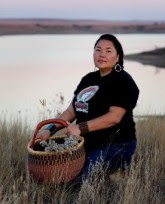 |
| Linda Black Elk |
Linda Black Elk –
Catawba Nation – This ethnobotanist, restoration ecologist and activist is truly a 21st century woman. She has many YouTube videos and regularly posts articles online. In this way, her voice carries beyond the Standing Rock Reservation, where she lives with her family, and Sitting Bull College where she teaches. She is the Ethnobotanist for the Standing Rock Sioux Tribe and is very active in promoting tribal food sovereignty and better health through the use of native plants. Lately, she has been vocal and involved in the
ongoing fight against the Dakota Access Pipeline. Here she is talking about the spirits in plants.

For all of these strong women, there are others that are equally strong but whose voices are never heard. There are also many dazzlingly successful Native American men. Nevertheless, the vast majority of the traditional guardians of the land we call home are still stymied by poverty, prejudice and lack of opportunities. During this month especially, take some time to appreciate what came before us Europeans and open your mind to those who are with us today.
Submitted by Pam