If you are deep in the throes of
Plant Parenting (or just a Plant Lover), you are probably always looking for a new plant to add to your collection. I would like to suggest the following 10 candidates. These plants aren’t wildly new; in fact, you’ve probably seen most of them before. But give them a second look anyway - even the smallest, scrawniest brown dog in the pound has untold stories to share with you.
These are not in any particular order and I have thrown in a mix of types to (hopefully) offer something for everyone. Additionally, they are all fairly-easy to very-easy to grow, for those people whose eyes are bigger than their
nurturing skills. With the exception of the Fiber Optic Grass, this selection consists of tropical plants and several of them are toxic to a degree. While that should not necessarily disqualify them, it is something to consider for many people. I have also included links to more information on caring for them, so you can get the low-down quickly.
 BRAZILIAN FIREWORKS
 (
Porphytocoma pohliana) – aka Rose Pine Cone, Purple Shrimp, South African Acanthus, Jade Magic, and more. This South American native is nearly as flashy as a Carnival night in Rio. It's an evergreen with deep green leaves laced prettily with silver veins. But it’s the flowers that steal the show – they have fuchsia-colored bracts that clash beautifully with its small purple true flowers. The fireworks name may come from this explosion of color, but this plant also forcefully shoots out its seeds when the time is right. For more insight into this exceptional plant, check out
this blog.
 NERVE PLANTS
 (
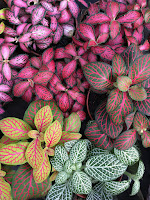
Fittonia argyroneura) – aka Fittonia, Mosaic Plant, and Net Plant. This plant comes from deep in the rainforests of South America. The foliage has an olive green background contrasted with bright veins of pink, white or red – the color variations seem endless. These low-growing plants are perfectly suited for a wide range of growing situations from tabletops to cover crops. Nerve Plants are very forgiving should you forget to water them - they can bounce back quickly. Check it out on
this time-lapse video. Read more about these tropical beauties
here and see more
here.
 STAGHORN FERNS
 (
Platycerium spp) – aka Elkhorn Ferns and Antelope Ears. This fern is native to the jungles of Java, New Guinea and parts of Australia. What makes this plant unique (besides its antler-like foliage) is that it is both an air plant and a fern. Since this plant grows on tree trunks and rocks in its native habitat, it’s commonly mounted on a surface and then displayed on a wall or fence. This presentation can amplify the resemblance to antlers. But it can also be grown in a traditional pot and enjoyed as a hanging plant.
Here’s more on this cool plant and
here’s a tutorial on how to mount it.
 AECHMEA BLUE RAIN
 (
Aechmea spp) – aka Blue Rain Bromeliad. This stunner has its roots in Brazil and is decidedly low maintenance (which is probably not the case with other Brazilian stunners). This bromeliad only flowers once, but the flamboyant blue-violet flowers on orange spikes will last for months. After blooming, pups will appear around the mother plant. These pups will feed off their mother plant until it has deteriorated and they are big enough to produce blooms. Nature can be hardcore.
Here’s more on this beautiful plant and
here’s something to watch.
 BUTTERFLY PLANT
 (
Christia obcordata) – aka Swallowtail Plant. This herbaceous perennial is from East Asia and can grow up to 3 ft. tall. The exquisite triangular-shaped leaves with burgundy stripes are real show-stoppers. To some people, they look like the veining on a bird’s tail feathers, while others think they resemble butterflies at rest. However you see it, this is a spectacular addition to any plant collection. For more on the
Christia obcordata, read
this. For a little something on a different variety,
Christia vespertilionis, check out
this video.
 AFRICAN MASK PLANT
 (
Alocasia Sanderiana) – aka Kris Plant and Elephant Ear. These tropical plants have no connection to Africa, they are native to the Philippines, but they look like African ceremonial masks to enough people to have the name stick. This plant brings the drama with forest green leaves that have wide, stripe-like veining. According to the
International Union for Conservation of Nature (IUCN), the
Alocasia Sanderiana is critically endangered in its native environment, so in growing this plant you are literally helping to save a species.
Here is more information and
here is an interesting video.
 FIBER OPTIC GRASS
 (
Isolepis cernua) – aka Livewire, Live Wire of
Fairy Lights. This fun plant is reminiscent of those funky fiber optic lamps. It’s a clumping plant with small flower spikes on the end of thin, bright-green stalks. Not technically a grass (it’s part of the sedge family), one variety or another is native to wide areas of the globe. Fiber Optic Grass is a multi-purpose plant in that it does well in most areas indoors or outdoors, in the ground or in containers. And it makes a captivating hanging plant. More on this delightful plant
here and, if you are interested in planting it outside,
check this out.
 ALUMINUM PLANT
 (
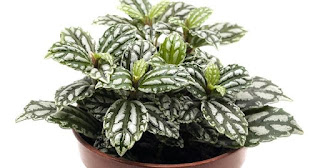
Pilea cadierei) – aka Watermelon Pilea. This alluring plant is originally from China and Vietnam, but it has found a place in homes worldwide due to its non-demanding nature. This smallish (6”-12”) evergreen will grow out umbrella-fashion and produce deep green pointed leaves patterned with silver markings that shine like tinfoil. This plant is very desirable for its beauty and easy care.
The ASPCA has endorsed this plant as a non-toxic choice for animal lovers. To learn more, go
here or watch
this video.
 PURPLE SHAMROCK
 (
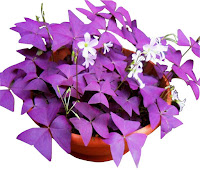
Oxalis triangularis) – aka False Shamrock and Love Plant. This gorgeous Brazilian is more than just a pretty face – it has moves! It will turn its leaves to and follow the light during the day and then close them up when night falls. It can also retreat. Let me explain: The
Oxalis triangularis grows from a group of bulbs and when conditions above the soil deteriorate enough, the plant will allow some die back and then wilt and pull back into its bulbs until conditions improve. Like the Butterfly Plant, many people think this purple stunner resembles a swarm of butterflies at rest. This plant is toxic, but it has a very bitter taste that works well as a deterrent for most nibbly pets.
Here’s more on this beauteous plant and
here’s a video.
HARDY TAPIOCA (
Manihot grahamii) – aka Graham’s Cassava, Graham’s Manihot, and Hardy Cassava. Pick this South American beauty if you have the space for a tall statement piece. It’s dramatic leaves and long, elegant shape will really pop in a sunny corner. It may come to you small, but it can easily grow several feet in a year and will eventually top out at around 10 feet. If you live in a warm climate you can turn it into an outside tree – the bees will appreciate it; they love the pale yellow flowers. The leaves and roots are poisonous, which will keep wild animals away if it’s outside but that may be a concern if you have pets. There’s more information
here and a video on a different variety
here.

As a reminder: We have great products to help keep your houseplants happy and healthy
here.
I hope I have inspired you to commit to one of these delightful plants. If you already have amazing examples, send us pictures. If you plant some after this, send us pictures. Spread the beauty.
Submitted by Pam


