Showing posts with label zombie makers. Show all posts

Thursday, October 11, 2018

Pt. 2 - These Zombies Don’t Eat Brains – But They Might Have Theirs Eaten.

In my last blog, I offered an overview of zombies in the insect world and showed you some of its stars. When writing that blog, I quickly realized that there is a whole Milky Way of zombie-making stars that should be shown. What follows are some of those stellar parasites that I did not get to before.

Dinocampus coccinellae: These parasitic wasps prey on cocinellid beetles, which include the ever-popular ladybug. The wasp attacks the bug and injects an egg into it.Included with the egg is a nice little dose of a virus that paralyzes the ladybug.
Lady blue sitting on a straw-like Dinocampus coccinella cocoon
Ladybug sitting on a Dinocampus coccinella cocoon.
About 3 weeks after the egg has been laid, the wasp larvae pushes out of the bug’s body and weaves a cocoon between its legs. Here’s the twist in this scenario: the ladybug is not completely paralyzed; it is left with the ability to twitch around (which works to keep predators away), but unable to leave the cocoon. In this way, it becomes a zombie babysitter. All’s well that ends well for the ladybug though; once the wasp offspring are ready to venture out on their own the ladybug is released from its bondage. The ladybugs continue on with no apparent damage from their alien abduction.To see how they come out of this check out this video.

Long tangled mass of worms protruding from the body of a cricket
Horsehair worms emerging from a cricket.
Horsehair worms
: These parasitic worms have a multi-stage life cycle that is complicated enough to need some zombies to complete it. Their larvae are laid in water, but they are unable to swim and
need to get to the surface before they can metamorphosize into their next phase. So, they wobble around on the bottom until the more advanced larvae of another insect (like the mosquito or midge) finally eats it. They stay with the larvae as it grows into a flying insect and now they are airborne. They will fly around with this host until it either dies and gets eaten by a cricket or gets eaten by a cricket and dies. And now they are in the cricket, where they will bore through the gut and get into the body cavity (how they do this is very puzzling as they have no mouths). Usually it is only one worm, but as many as 32 have been found in one cricket. It is when they are growing (to about 1 foot long) in the body of the cricket that the mind control begins. At a point known only to the worm, the cricket will be compelled to move toward light and the reflective surface of water. Crickets usually avoid the water and the dangers it carries, but these zombie crickets head right for it and jump in. Once they hit the water, the worms will erupt from the host (to see this in all its grossness, click here). They then immediately mate and begin the cycle anew. The crickets generally die in the water, but every now and then one will survive and take its ravished body back to shore.

Orange Phorid aka Hump-backed fly on a grey tree branch
Phorid or Hump-backed fly

Flies and bees: When it comes to bees, there are two predatory parasites that create “zombees”: In the case of honeybees, phorid flies (Apocephalus borealis), also known as hump-backed flies, use the living bee as an incubator for their eggs. As with other ill-fated hosts, the bee will be consumed from the inside. While this is happening, the honeybee will exhibit most un-bee-like conduct such as flying at night and seeking artificial light. No one except, perhaps the fly, knows why they do this. The bee eventually dies, but the weirdness does not end there. About 7 days later, flies will burst out of the neck of the bee, decapitating the corpse.
Black Conopid aka Thick-headed fly in the air
Conopid or Thick-headed fly

Bumblebees have their own nightmarish zombie maker – the conopid (Conopidae) or thick-headed fly. These flies pry open the body segments of a bee and lay their eggs inside. They are so good at this, that they can do it while both insects are flying. When the larvae inside has grown sufficiently, the mind control takes over. The bee will begin digging in the ground. This is not normally something a bee has any reason to do, but a nice burrow is an excellent place for developing fly babies. And a nice little grave for the helpful host/food supply.

Orange dragonfly sitting on a branch with white spikes protruding all over his body
Dragonfly with a Cordyceps problem
Cordyceps fungi: By now, many people have heard of these terrifying fungi; their effects are nothing short of lurid. In short, the spores enter the host body and force it to climb and move around (this helps further spread spores). Once the host’s nutrient value is gone, the fungus grows stalks that shoot out of the body and further spread their spores. If you haven't seen it, you should watch the morbidly beautiful video of this fungus on an ant from Planet Earth on BBC. This fungus only affects insects and arthropods, but it is so grisly and creepy that it has been imagined as a threat to humans in an apocalyptic video game called The Last of Us by Naughty Dog for PlayStation 3. Check it out here.

Drawing of a zombie woman with white specks protruding from her head. Image from the video game The Last of Us.
Image from The Last of Us
All of the above zombie situations are gruesome and a bit disturbing, but they are simply another part of inherently brutal Nature. It is interesting how we place some insect behavior in the negative category while others are seen as a positive. A number of our most important products here at ARBICO Organics™ are parasites: Fly Eliminators™, Aphidius colemani and Beneficial Nematodes, to name a few. ARBICO would not be here without these parasites, I'm just glad we aren’t in the horsehair worm business!                               

Submitted by Pam

Tuesday, October 9, 2018

Pt. 1 - These Zombies Don’t Eat Brains – But They Might Have Theirs Eaten.

Whether you like the grossness of them or not, zombies are all over pop culture these days. I know I have fallen victim to their creepy appeal. In fact, I did a little binging on The Walking Dead this past weekend. Zombie shows may be entertaining to watch, but the truly disgusting and cruel zombie stories are real. They occur all around us in nature and particularly in the insect world. Unlike the zombies that try to eat Rick Grimes and his merry band of Walker killers, zombie insects are much more like the traditional zombies in Haitian Voodoo. In Voodoo, zombies are created from people by other people in order to enslave them. They lose their autonomy over their minds and bodies and exist only to serve whatever needs their masters may have. This same dynamic is present in all zombie insects; they serve a purpose for their creator.

A zombie man in a white shirt and red tie lunging out from the page
No, not this guy - insect zombies!
In the insect world, zombies are created by many organisms, they can be other insects, nematodes, worms and viruses. With insects alone, the sheer number of insects that parasitize and take over other insects is staggering. For instance, there are over 600 species of parasitic Strepsiptera (twisted wing insects) and each one has its preferred host. Not to mention the 800 species of Conopidae flies (aka thick-headed or conopid flies) – all of which are parasitic.

The one thing that all these aggressive zombie-makers have in common is that they parasitize in the interest of reproduction. They are all trying to either feed their offspring or find a home to raise them in. They find a host and use one method or another to gain control of the body and/or mind of the insect. They then either keep it alive to feed on, cause it to commit suicide or force it to fulfill some other nefarious purpose of the parasite. How they gain the mind control is, in many instances, still not thoroughly understood. However, most researchers believe that the parasites produce neurotransmitters that somehow short out the neurotransmitters of the host. As gruesome as it seems, parasitization is extremely beneficial to the parasite (which is why there are so many of them) – it provides for their next generation and removes a resource competitor at the same time.

Now for the ghoulish details of the work of a few noteworthy zombie makers:
Close up of the head of iridescent green emerald cockroach wasp
The face of a zombie maker (Ampulex compresa)

Emerald cockroach wasp (Ampulex compressa):This lovely solitary wasp will sneak up on a cockroach and sting it in the head a couple of times. This leaves the roach alive but unable to move. After snacking a little on the roach’s antenna, it will lead the mindless roach to a burrow. Now that she has filled the cupboards with groceries, she lays a single egg case on the roach's body and seals the doomed insect up in the burrow. In due time, the wasp larvae will hatch and chew its way into the roach’s abdomen. As the wasp young continue to grow inside the roach, they feast on the living roach’s internal organs. Even while being eaten alive from the inside, the roach never struggles or moves. There is an incredible video on YouTube that shows the wasp creating its personal zombie. See it here.

Three images of a Roly Poly, or pill bug. One is all rolled up, one half rolled up and the other on its feet.r
This is why they're called Roly Polys.
Acanthocephala worms and pill bugs (aka Roly Polys): These parasitic worms enter the bodies of pill bugs and then use them as lures for birds. With the ultimate goal or reaching a bird's gut to reproduce in, Acanthocephala worms send pill bugs out to where they can be seen and eaten by birds. These normally light-hating insects not only go straight for the sun, they head to lighter colored surfaces to more easily be seen. That’s refined zombie-making!      

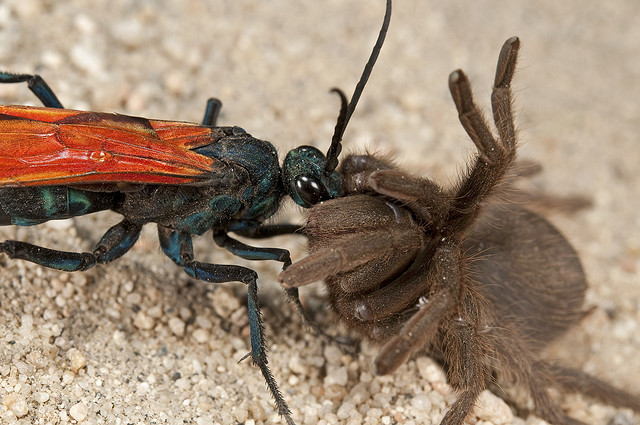
Tarantula Hawks (Pepsis formosa):  Technically, these large wasps don't create zombie insects. Instead, they have looked outside the insect world and developed their zombie making skills to exploit a host no one else wants to take on - the tarantula. The tarantula hawk will hunt for tarantulas and when they find one they confront it. The tarantula will rear up when challenged (which is a bad instinctive reaction in this case), allowing the tarantula hawk to run in and sting it on its abdomen. Here's
A close-up of a black moth with red wings face to face with a brown tarantula with its front legs up
A tarantula hawk subduing a tarantula
 a video of a tarantula hawk in action. In no time, the toxin will take effect and paralyze the spider. At this point, the tarantula must drag the much larger tarantula into its burrow (apparently they haven’t figured out mind control). Once there, like the emerald cockroach wasp, it will lay an egg on its host and seal it in a burrow. When the eggs hatch, the larvae will eat the non-essential organs first to keep the hapless spider alive as long as possible. Like something out of a 
B-grade horror movie, the larvae will eventually spin a cocoon around the poor spider.

An encounter between a tarantula hawk and a tarantula results is a ghastly and macabre end for the tarantula. On the other hand, an encounter between a human and a tarantula hawk is generally benign. However, should you be unfortunate enough to be stung by one, be prepared to experience an agonizing pain. The pain level that has been given second place (after the South American bullet ant) by Justin Schmidt on his Schmidt sting pain index (see below). Luckily, the pain will dissipate in about five minutes and you can go about your life with a better understanding of what the poor tarantulas suffer. I, personally, will take your word for it.

I have more fascinating and totally disgusting zombies to share with you. Check out Part Two now!

Submitted by Pam

The Schmidt Sting Pain Index - A pink chart with white lettering that shows 8 insects with level 1-4 painful stings


Featured Post

IT'S EARTH DAY 2026!

Happy Earth Day from ARBICO Organics! This year we'd like to introduce you to our newest local non-profit partner - Mission Garden. Loca...