Wednesday, December 2, 2020

Tree Gifts

2 gifts wrapped in brown paper with acorns and leaves on them by a fir tree.
Now that we are done digesting the turkey and are almost sick of turkey soup, it is time to get serious about Christmas shopping. This year shopping, like everything else in 2020, is colored by Covid. Instead of flocking to big box stores and the mall, many people are shopping in the safety and comfort of their homes. But endlessly searching the net can be deadly dull for some people, and rife with a-lot-of-the-same for everyone. So, if you are a tree lover and/or are shopping for one, I have done some of the scrolling for you and curated some cool choices. But, don’t think only of tree aficionados while looking through these choices, anyone who loves Nature in general will enjoy one of these. 

A mother and daughter planting trees with others in the  background. In Addis Ababa, Ethiopia by Eyoel Kahssay.
When you get right down to it, the best present for a tree lover is probably an actual tree and these days there are a variety of ways you can gift one:

• Trees that someone else plants: For someone who doesn’t have the place or desire to plant a tree, you can donate to a non-profit and they’ll plant one for you. The Nature Conservancy is not fooling around. This well-respected organization plans to plant a billion trees, much of it funded by small donations. Another option is the nonprofit Donate A Tree To The World. They are fighting climate change and helping disadvantaged communities in Mexico and Colombia through reforestation. They will send you a picture of your tree and follow its growth for you. One of their projects is working to build the numbers of pine nut trees, whose struggle I wrote about in my last blog. Pine nuts are not just important to people around the world, according to this article by the World Wildlife Fund, pine nuts are essential to tiger survival in the Russian Far East. 

Pine nute in a white ceramic bowl with pine cones and branches surrounding it.
• Trees to grow from saplings or seeds: It takes real optimism in your recipient’s commitment to give a tree seed as a present. But, should you choose to do so, Seeds of Life has the stuff for you. They sell seed packets, seedlings, and gift trees. Many other outlets, like FastGrowingTrees.com and Bower & Branch, sell a great variety of small trees ready to be gifted. 

The cover of the book The Hidden Life of Trees by Peter Wohllesen.
Still unsure about giving a living tree? This short article has some ideas about why you should, trees for different occasions, and additional nonprofits that plant trees.

If you think having a tree planted from afar seems less-than-personal for a Christmas gift, perhaps you’d prefer to buy a present that you can touch, and still plant a tree. There are more and more businesses that position themselves as eco-friendly and many are getting their hands in the dirt to prove it. Companies like Save Lands offer cute gear and entice you to buy with their tree-planting mission. For Save Lands, it’s twelve trees planted for every item sold. Here is a list of nine other companies that do something similar. This trend of driving e-commerce with feel-good consumerism is not universally accepted. Here is an article from Canada that explains some of the reasons why.

Some retail sites have outstanding selections for the tree lover on your list. Here are some standouts:

A glass sculpture of a green Tree of Life. Available from Wildlife Wonders.
• Soul Flower – Their things are very I-wish-it-was-the-60’s, Boho-Hipster Chic. But in a good way.

• Popular Science - I know – Popular Science? This is not really a retail site, but, Eleanor Cummings has put together a thoughtful collection for tree huggers. 

• Uncommon Goods – This site has an uncommonly good selection of tree-themed gifts.

A clock with a picture of misty mountains on it.
Misty Mountain Clock
• Wildlife Wonders - Their goods can be pricey, but they're clever and beautiful. Even if you don’t have deep pockets you should take a scroll through this site just to admire what they have. And there are some deals to be found.

Large retail sites like Etsy have seemingly endless items under their tree-themed sections. If you’ve ever been on Etsy, you know the stuff ranges from the sublime to the ridiculous. For not-expensive gifts, I particularly like the pinecone key chains, the misty mountain clock, and the handmade fir tree soap. The tree wall art is also very nice if you have the right person with the right space to give it to. Another potential Etsy gold mine of tree presents is the multitude of Tree of Life designs – jewelry, art pieces, textiles, you name it - I think I even saw a knitted cap in there.

As I’ve been looking at tree-centric gifts, I’ve noticed all the family trees that keep popping up. They are clearly wildly popular these days, and with good reason. As more and more people do their DNA, interest in ancestors has grown and family trees are a great way to showcase all that. But, the variety of styles and cost-points is nearly overwhelming. You can get a kit from Family Locket that can be done with the kids and makes a felt family tree. Or you can get a pretty black metal tree that you add engraved magnetic leaves to from Personalization Mall. Or you can get a wall hanging that shows your family fanning out in a beautiful tree from this Etsy vendor. Or you can go to Branches and get a fully custom family tree made, including framing. Or (my personal favorite) get your family tree put on an actual piece of wood from Foxbairn. If this is something you think you want to do, you should act fast as custom pieces take extra time to create.
A family tree on a slice of a log.

Finally, I’d like to recommend an ARBICO Organics gift certificate.  While it’s true that we don’t sell trees or tree-themed merch, we do cater to people who care for trees. So, if your tree lover walks the walk by growing trees, we have something they can use. And, of course, we have something for anybody who loves to grow anything. 

Christmas is meant to be a happy time of year, but this year is bound to be challenging for many. If at all possible, try to make the one thing you can control –your gift-giving – as simple and enjoyable as possible.

Take Care.

Submitted by Pam

A cartoon Christmas tree with a gift.


Tuesday, December 1, 2020

Local Organizations Gardeners & Plant Lovers Can Support On #Givingtuesday

Photo by Elaine Casap on Unsplash

In the spirit of giving and gratitude one fosters during Thanksgiving, we at ARBICO Organics wanted to share information about local organizations you can consider giving to and becoming involved with in honor of #givingtuesday!


Photo by Zoe Schaeffer on Unsplash 
Local urban gardens are a great way to get involved in growing, especially if you lack your own garden space! You can get some dirt under your nails and fulfill your gardening aspirations all while helping the community! You can locate urban gardens in your area by visiting the international database available at Urban Farming. 
 
Your local cooperative extension is also a terrific place for resources about growing in your specific area and may offer many ways to get involved in the local garden community scene! You can find your location by visiting the Pick Your organization’s website! 


Photo by Kelly Sikkema on Unsplash
Another fantastic way to support and give back to your community is to get involved with your local school system’s garden program. Working to teach children gardening skills and the importance of nutrition is a very valuable part of growing our community’s next generation! To find out more, visit your local school district’s website!
 

If you are more of a hands-off gardener, who prefers to find fresh produce from local farmers, consider joining a CSA. Not only is this a great way to diversify your fridge’s inventory, but it supports local growers and guarantees that you have the freshest and most in-season options! In many areas where farmer’s markets are closed due to COVID-19, this option will also help support farms that relay on these markets. To find a CSA in your area, visit Local Harvest. 
 
Local gardens and farms are just one place to start, don’t forget about local food banks and other organizations that help protect your local region’s biodiversity!
 
In Tucson, where our company is located, in addition to gardening and farming organizations,  we support the Community Food Bank of Southern Arizona, the Center for Biodiversity and the Sonoran Institute!
 
Let’s keep the spirit of giving going at this time and continue to support our communities! 

We are better together! 
 
Submitted by Aurora @ ARBICO Organics
 

Thursday, November 19, 2020

Trees & Thanksgiving


People gathered around a table under a tree. There is a big pine cone in the forefront.

As I continue my months-long devotion to trees, Thanksgiving looms large on the calendar. It’s a week away as I write this, and people are scrambling to get their plans together. I feel fortunate in that we had already been planning an immediate family-only meal ahead of the Covid call to shrink gatherings. Without the preoccupation over preparations, I have had time to consider how trees fit into Thanksgiving. My conclusion is that every season, and every holiday, gives us an opportunity to appreciate trees and Thanksgiving gives us some special opportunities.

A bright red Chinese Pistache tree in a green field.
Chinese Pistache 
The thought of Thanksgiving conjures up nostalgic images for most Americans. These include turkey, of course, but there are also seasonal delights like football and crisp, cold days. In 2020, some of these traditions are somewhat diluted because of Covid and, with Global Warming, the weather may be warmer than usual (it’ll be 74°F here in Tucson). But, what can – and should – remain unchanged is the being thankful part of Thanksgiving. We all can find a reason to be thankful for trees (here are 10 good ones). This lady was so inspired she wrote a lovely “Thanksgiving Mediation” on trees, with a special call-out to the glorious Chinese Pistache.

Branches in a clear vase with paper leaves attached that have messages written on them.
Rather than just being thankful for trees, you could create a Thanksgiving or Thankful tree. Apparently, these have become increasingly popular in the last few years, but I just became aware of them this year. The idea is to create a decorative piece that people can adorn with those things that they are grateful for. A tree whose leaves carry these messages seems to be the general practice here, but the variations are limited only by imagination. Here and here are some great examples. I heartily endorse this new trend, whether you go all in and create a tree or just use parts of this idea in your décor for the day. Unsure as to how to go about this? Here are some step by step directions for one version.

Another tree decoration that is gaining popularity is a Harvest tree. This is a more seasonally based decoration and is adorned with things that make you think of fall and harvests (think colored leaves, pumpkins, and old-fashioned scarecrows). Here are some pretty examples. 
A small tree decorated with fall-themed decor and a scarecrow doll standing next to it.
 You could put your own spin on these types of decorations, like using a football theme (team-specific encouraged). Or you could wrap up the year with a tree that reflects the whole of 2020 – it could have things that represent the pandemic, toilet paper shortage, politics, and natural disasters. On second thought, don’t do that – it could turn out to be the most depressing tree ever created. Okay, I know there are some of you out there for whom these trees are just a little too much like Christmas trees and feel that those sorts of decorations belong in December. But, the truth is, most of us need to feel better as we come to the end of a brutal year. So why not put up whatever decorations make you feel better or nostalgic for better times, whenever you're so inclined? This article makes an excellent case for this. Here is a simple tutorial on how to make a Harvest tree and, for those of you who are more visually inclined, here is a video.

Speaking of decorations and nostalgia, who remembers making turkeys out of leaves pasted to paper plates? Many generations have brought that treasure home from school to be displayed on the refrigerator. If you think about it, many of the classic Thanksgiving arts and crafts are derived from or represent trees and/or their parts. Between the colorful leaves, the atmospheric shape of newly-bare branches, the acorns, and the pinecones, there is a lot to work with. Here are some great children’s projects, both new and familiar, and here are some projects that adults may enjoy. For the adults, I recommend pairing the activity with hard apple cider (delicious, therapeutic, and provided by a tree). You’ll feel thankful in no time.
A bowl of apples on the bottom left and an apple pie with leaf decor crust on the upper right.

No matter how you slice it, Thanksgiving is about the food. Sure, there are the “required” staples, but everyone also has those particular dishes that the day just wouldn’t be the same without. Take a moment to think about what foods you will have in front of you, and chances are many come from trees. There is apple pie, of course– not just the fruit but the cinnamon that flavors it; pecan pies have a place of honor on many Southern tables; avocados and pine (piñon) nuts are Southwestern staples; some people have to have walnuts in their stuffing; chocolate, of course, and coffee or tea to top off the feast. It is especially important to appreciate the trees that give us our beloved foods; the fact is that many of them are being affected by climate change. I love the flavor of maple and would hate to see the world lose it, but sugar maples are really struggling. The same can be said for Piñon pines. Without an appreciation for and knowledge of what these trees bring us, people are less motivated to protect them. As a side note: If you are interested in directly feeding off of a tree or two, here is an interesting article (complete with recipes) on which ones make the best dining.

An outside Thanksgiving table set on a blonde wood table with blue and whit settings and a colorful leaf centerpiece.
This year, public health officials are encouraging people to take their Thanksgiving outside. I cannot think of a better way to acknowledge trees than to get out there where they grow. Turkey and trimmings under the shade of a tree sounds like a sublime dining experience to me. If you decide to go this route, there are a bunch of ways to decorate the space to get that holiday feel. Here are some really nice examples to get your creative juices flowing. 

If you choose to stay inside while eating, getting outside before or after dinner is another way to bring the natural world into your celebration. For some families, a little touch football with the family is the perfect warmup to food and pro-football. Others have a less structured or less active approach. Whatever makes you feel happy and grateful, go outside and do it if you’re able. Sit under a tree and laugh with friends, take a bike ride with the kids, or go on a short walk to see how the trees are doing with their color-changing and leaf-dropping. This is generally a time of good weather for most of us, so go outside and appreciate it – especially in this year of Covid when Nature is still doable but long periods in confined spaces not so much.

Nyle DiMarco using sign language to say Happy Thanksgiving

Happy Turkey Day, y’all, and remember to thank a tree.

Submitted by Pam


Wednesday, October 28, 2020

Is There A Ghost In My Tree?

The silhouette of a tree in front of a misty lake with the sun setting. Photo by Matt Bluejay on Unsplash
For many people, the idea that trees can be haunted is preposterous. But for millions of others, it seems as natural as the changing seasons. I’ve written previously about how entwined humans are with trees and this close connection extends into the spiritual realm for many. This is not a new or radical idea. Our ancestors were firm believers – everyone from the ancient Romans and Egyptians to the Celts and Native Americans, and millions in between, saw trees as spirit homes. 

Tree spirits are very much a part of cultures around the world (here is a partial list of just some of them). Nowhere is this truer than in India. This vast and complicated country has one commonality that covers all the geographical and cultural regions: The apparent infestation of ghosts in their trees and the acceptance of their presence by locals. Indian ghosts have a preference for particular trees – specifically the fig, banyan, neem, and tamarind. Here is a quick and fun read that illustrates how ghosts are assimilated into everyday life by a family in Kolkata in northern India and here is a cool story about ghosts in southern India.

A drawing of a large banyan tree with one person and many ghosts in its roots.

Silk Cotton trees (aka kapok trees) have a uniquely spooky presence to many people in the Caribbean. They say these trees are haunted because so many slaves (and some criminals) were hung from them. Others say the ghostly spirits were always there. This belief in kapok spirits can be traced back to the West African roots of the enslaved people brought to this region, where this tree is considered sacred (read more here). In an interesting cross-oceanic parallel, the ancient Mayan also saw this tree as sacred. In their tradition, the first human came from a kapok tree. 

What appears to be an angry, yelling face in the gray bark of a tree.
Almost anyone can be turned into a tree ghost believer if they look long and closely enough at a tree. It is easy to see things there. Whether we invent what we want to see or the spirits are showing themselves is up for discussion. Here is one explanation of why we see faces in trees.  A compelling example of this phenomenon is the following story: In the spring of 2017, a storm came through Rochester, NY, and left behind some unusual damage. It tore a large piece out of a tree in Durand-Eastman Park, exposing what looked to be the figure of a woman holding a baby (although not everyone sees the baby part). What makes this particularly unique is that for decades this area has been haunted by sightings of a woman in white, called the White Lady or the Lady of the Lake. She is said to be searching for her lost baby. Could her spirit have been trapped in this tree all this time? Check out the pictures here; they’re pretty impressive.

A large tree in a clearing by a pond in Epping Forest, England
Around the world, there are whole forests that are deemed haunted (see some here). Often it is easy to understand why this designation has evolved – they are places that have seen the whole of the human experience over eons, or they are the sights of bloody battles or fascinating events. But, sometimes they just seem creepy for no definable reason. 

Here are some examples of singularly spooky trees:

A large black tree in this distance in a snowy field - the Basking Rige Devil's Tree.
In New Jersey, there is an oak tree called the Basking Ridge Devil’s Tree. This particular tree has a wealth of stories swirling around it about ghostly goings-on, supposed-curses, demonic activity and more. People claim it’s where the Ku Klux Klan practiced rituals, it’s a portal to hell, a driverless truck will chase you down if you get near it, it’s haunted by a man who murdered his family, and even that if you touch it your hands will turn black if you eat at a restaurant. If you are still interested in visiting this now-protected (from the public or on behalf of the public) tree, here are directions. 

In Northern Ireland (another culture with a great affinity for supernatural beings) the village of Finnis, County Down, has a haunted sycamore tree that has been a resident there since the early years of the 20th century.  Before that time, there had been a nasty little spirit pestering people around their bridge over the river. A priest eventually trapped it in a bottle and put it in the tree. No one has messed with that tree since. Even powerlines were re-routed around it. See it and read more about it here. 

Apples that are red on the outside and the inside - Micah Rood apples.

Sometimes haunted trees produce more than just goosebumps. In the case of an apple tree in Franklin, Connecticut, its flowers and fruit tell a haunting tale. The story goes that in the mid-1750s, a farmer murdered a peddler and buried him under an apple tree. In some versions of the story, the farmer can’t handle the guilt and hangs himself from the same tree. No matter the version, when the trees bloomed in the spring the flowers were crimson-red instead of white, and when the apples appeared they had strange, blood-colored flesh. The actual tree in question most likely was downed by a hurricane in 1938, but these apples (known as Micah Rood apples) are still in existence. Some of this story is true, some is not and some may be. Go here to learn more.  

A row of Frangipani trees nest to a gazebo.
Not all haunted trees are old or scary-looking. In many parts of Southeast Asia, the frangipani tree is thought to house ghosts, and worse. While these beautiful and fragrant trees are appreciated for just those things, according to Malay (still widely believed) folklore, if you get a sudden whiff of their fragrance a Pontianak may be nearby. These are vengeful lady vampire spirits that seduce and kill. In Thailand and Vietnam, this tree is associated with death and the unhappy ghosts that live in them.

A live oak tree with very tall and spread-out branches - the Angel Oak.
In the US, live oaks are a favorite for ghosts. Wherever there is a spectacular old specimen, there seem to be ghost stories hovering around it. This is the case for a spectacularly beautiful, nearly 500-year-old live oak on St. John’s Island in South Carolina that has become as famous for its haunts as for its beauty. Known as the Angel Oak, this glorious tree rises up 65 feet with branches that spread out over 17,000 square feet. It needs all that room for the thriving population of ghostly beings that call it home. Well before colonizers appeared on this shore, the Native Americans were aware of the power of this tree. They buried their dead around it and those spirits are some that abide here. Once a part of a plantation, there are the understandably restive souls of slaves that had been hung from its branches. And that’s just some of the ghosts. Learn
more here or see a video here.

A cartoon of a girl holding a torch in a scary forest.
Whether you call them spirits or ghosts or something else entirely, it seems clear that trees have a presence that is unique to each individual. And, like all individuals in a larger whole, not all of them are nice.


Take Care.

Submitted by Pam


Wednesday, October 21, 2020

Yes, We Have Trees In Our Desert


Large shade trees over grass in Riverfront Park in Oro Valley, AZ
The biggest misconception non-desert dwellers have about our ecosystem is that we don't have trees. Or that our “trees” are saguaros. Both couldn’t be more untrue: We have a huge number of trees that grow happily here and, while we love our saguaros, they are the grandfathers of the desert cacti and not trees at all. The Sonoran Desert where I live is a harsh and arid place, but by no means the harshest or most arid of deserts (see here for those). The part of the Sonoran Desert I live in (Tucson) is not even the most extreme area in the region. Here we have some elevation, deep underground water resources, and, on occasion, are able to pull moisture from the Sea of Cortez and even the Gulf of Mexico. All of which means this ecosystem is able to maintain healthy trees and tree diversity.

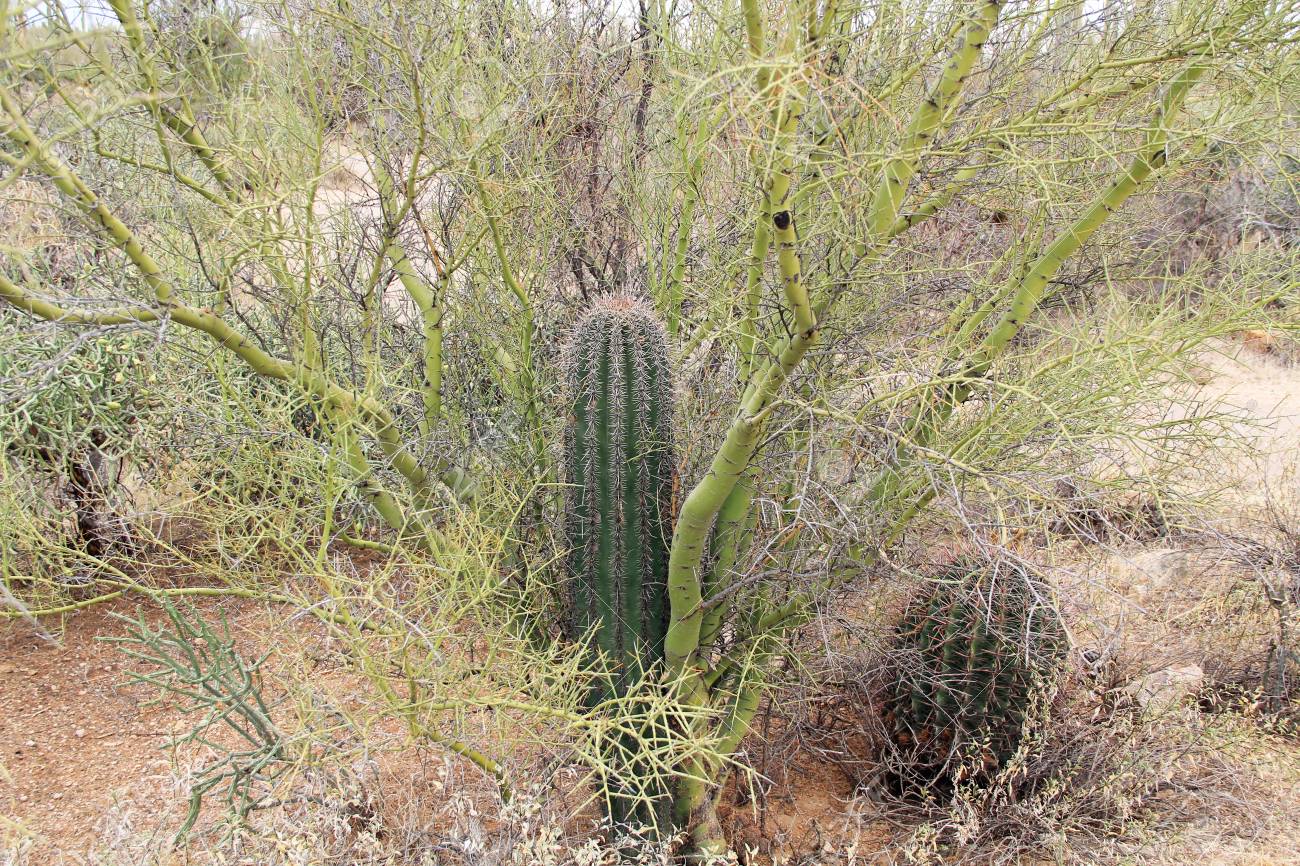
A Palo Verde serving as a nursery tree with a young Saguaro growing up amongst its branches.
Besides their aesthetic appeal and the alluring shade they offer to people, desert trees are entire ecosystems unto themselves. What goes on in their understory is a huge part of their story. Birds, small mammals, reptiles, arachnids, baby plants, and cacti all depend on the shade and protective cover of nursery trees. The shade of the branches of and the water-holding power of roots create a cool hide-away from the brutal sun. It is the perfect place for something small to grow in until it is strong enough to step out into the sun. The very-sharp spikes on many of these trees also adds a layer of protection from predators for small animals. Even the most determined of coyotes will hesitate before poking his nose into such a thorny situation. Without our native trees to nurture our wildlife, many species simply couldn’t survive. Here’s more on this.

A Mesquite tree with branches full of yellow polllen and pollen forming a carpet of yellow on the ground. Photo by Caroline Reilly.
Africa may have its Big 5 of animals, but here we have a big 5 of desert trees: Palo Verde, Mesquite, Catclaw Acacia, Desert Willow, and Desert Ironwood.  There are other natives, but these, in their various varieties, are the most prolific in our area. Palo Verdes are our state tree; they can grow up to 30 feet and live for hundreds of years. Their distinctive green bark provides their name; it means “green stick” in Spanish. Mesquites are the most common tree in the Tucson valley. They are fire-resistant and provide food from their seedpods for people, birds, and animals. They also have abundant golden pollen that can be mighty troublesome for allergy sufferers. Catclaw (aka Devil’s Claw) Acacia, (as the name implies), have imposing curved thorns that most creatures steer clear off. Birds and bees, however, love these trees and acacia honey is especially delicious. Desert Willows are not related to true willows but do have long,
A close-up of a Catclaw Acacia branch showing its curved thornes.
thin branches with graceful, drooping leaves like willows have. These trees have multiple trunks and fragrant, pink trumpet-shaped flowers that are a favorite of hummingbirds. Desert Ironwoods are the slowest-growing of our Big 5 group. They are also the tallest (up to 45 ft.) and longest-lived (as much as 1,500 years). They are essential to our native environment as nursery trees, but they also have deep cultural ties to our indigenous people. The dark, finely textured and dense wood of this tree has been used for artistic, utilitarian, and ceremonial purposes for untold hundreds of years. There is even an Ironwood Forest
An Ironwood tree with pinkish blooms surrounded by smaller mesquite trees.
 National Monument in our state, a good portion of which is on Tohono O’Odham tribal lands to the west/northwest of Tucson. 

Many of the trees you may see in Tucson are not originally from here but have proven popular because they do so well in our sunny climate. These include palms (which you see everywhere), olive trees, citrus of all kinds, fig-trees, Texas Mountain Laurels, Vitex/Chaste trees, Pistache trees, guava, and even Southern Live Oaks. One non-native that all Tucson kids seem to love is the Pomegranate tree. As soon as kids find out about the juicy goodness that is their fruit, no neighbor’s tree is safe. Most mothers I know (myself included) have had their offspring come home with smeary, red faces and hopelessly stained T-shirts. 

A very large tree called Phina's tree towering over a 6 story building.
Another outsider species of note is the Eucalyptus tree. These aromatic Australian natives are fast-growing and undemanding water-wise and can grow to be 80 ft. tall and more. In fact, the tallest tree in the city is a Red Gum Eucalyptus near downtown Tucson known as Phina’s tree. It is between 110 and 120 feet tall and has a charming backstory (read more here). Great trees they may be, but the Eucalyptus has several things working against it: They have relatively weak limbs, which can become projectiles on a windy day. This can be especially dangerous during our violent monsoon storms. And then there is their immense size - in a neighborhood of closely placed homes they can be problematic. And, due to their high oil content, they are quite flammable. Even though they have fallen out of favor for these reasons, they were once a popular choice and there is still a lot to be found in older neighborhoods. 
Olive trees lining the walkways at the University of Arizona. There is a man in red shorts running in the foreground.
One last group of Tucson trees I’d like to mention make their home on the University of Arizona campus. Known as the Heritage Trees, there are 8,000 of them from 400 species around the world. Some of these trees date back to around the time that the U of A was founded in 1885. There is even a “Moon Tree”, an American sycamore that was grown from seeds that went to the moon with the Apollo 14 astronauts in 1971. I have always loved the trees at the U of A and enjoyed them as an undergrad, graduate student, and employee.

A moving images of trees and cacti along a pathway.
Even though we have a lot of trees around here, we can always use more to combat climate change and habitat loss. To that end, Mayor Regina Romero has started a Tucson Million Trees campaign. The aim is to get a million trees in the ground by 2030.

I’m sure there are some notable, or note-worthy, trees that I have missed. If so, I think that makes my point that there really are a lot of trees here in our desert. And they add so much to our lives – here is an excellent article (with fabulous pictures) about all they do.


Take Care.

Submitted by Pam


Monday, October 12, 2020

The Magnificence of Autumn Trees

A view looking up into a magnificent yellow-leafed tree.

 “Autumn is a second spring when every leaf is a flower” – Albert Camus

As I write this, in the northern parts of our globe Nature is putting on one of its most spectacular displays – colorful fall foliage. As a child in Virginia, this was a magical time for me. The crisp air, the smell of burning leaf piles and fireplaces lighting up, the beauty of the trees, the excitement of all the Fall holidays – it was all just so exhilarating. Now that I live in the Sonoran Desert, I am hopelessly nostalgic at this time of year.

A line-up of similar trees with different colors.As the season heads toward winter, spurred on by shorter days, trees in cooler climates begin releasing hormones that cut off the chlorophyll to their leaves as they prepare to overwinter. The gorgeous colors in the leaves, which had been hidden by the chlorophyll up to this point, are made delightfully visible again. The chemicals that cause specific colors in leaves do the same thing for other plants. The carotene that makes carrots orange is also responsible for making certain tree leaves go orange. Anthocyanins turn leaves red, but cause fruits like blueberries and grapes to turn purple-blue. Evergreens keep their green on in winter due to their uniquely shaped needles, which are compact and watertight. If they do drop leaves it will be in the spring, when older leaves can turn yellow and fall off.

A view looking down on a road winding through a forest of multi-colored trees.
In the United States, the image of fall (a uniquely American way of saying autumn) foliage is dominated by images of New England. Undeniably awe-inspiring, the colors of fall are much more than a thing of beauty in New England – they are an economic boon to the area. After the lake-dwellers, beach-goers, boaters, and hikers have left, and before those states are hit hard by winter, there is a rush of tourism to see the trees. “Leaf-peeping” (as they call it up there) can bring in as much as three billion dollars a season. Not an insignificant amount.

A snow-covered mountain with a grove of Aspen trees in the foreground. Off Last Dollar Road in southern Colorado.
It’s the variety of deciduous trees here in North America that makes our viewing especially colorful. We have vast hardwood forests, which produce vivid and diverse displays of color. The colors of New England show all of them. But, the western US has some incredible displays as well, although there may not be as many varieties of tree species. The spectacularly photogenic aspen trees in their large groves, for instance, rival any New England vista for sheer magnificence. If you are interested in what colors are peaking where and when, this article can help. NASA also keeps track of fall colors.

A house by a green field on a fjord with colorful forests all around it. There is a boat moving on the water.
Spectacular autumn foliage is not only occurring in North America right now, of course. All across
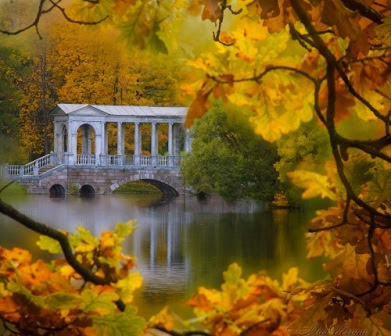
Europe, they are being treated to their own version of this Nature’s gift. In Scandinavian countries, you can even see the Northern Lights after a day of viewing autumn leaves –a Nature double-feature for sure. Russia, with its immense tracts of forests, has leaf-peeping for days – literally – a trip across the country (Moscow to Vladivostok) by train takes 7 days. If you are brave and hardy enough, it will take you a minimum of 11 days to drive. In St. Petersburg, they call it Golden Autumn (a term attributed to the beloved poet Pushkin) and it looks amazing – see more on St. Petersburg here and other Russian Fall destinations here.

A white marble building by a lake in St. Petersburg, Russia
In the northern Far East Asian countries, the arrival of fall colors is holiday-time. China has many traditional and wildly popular Red Leaves Festivals that last the month of October. In the Sichuan province, the Red Leaves Festival at Guangwu Mountain is considered by many to be the most beautiful spot in China to see fall color (see a video here). Beijing also hosts visitors in the city itself and the surrounding countryside. The number of people who travel to see trees across China is staggering – tens of millions of visitors will come to just one site. According to Beijing Holiday, in one year 90 million people visited the Xiangshan Red Leaves Festival on the outskirts of Beijing.

Mist and red foliage around the Great Wall of China.

In Japan, the sublime pleasure of tree-watching is more than a seasonal pastime, it is a deeply-held cultural rite. In the spring, they gather to appreciate the spectacular flowering of cherry trees in an event called hanami (roughly “viewing the flowers”). In Autumn, it is koyo (the phenomenon of changing Autumn colors) and, more specifically, the glorious maple tree. References to and metaphors about this tree are deeply entrenched in the Japanese world. For instance, there are expressions like “Maple leaves and a deer”, which defines a good match (for more on all this, go here). The Japanese have also created a seasonal delicacy that dates back more than 1300 years - tempura-battered maple leaves (momiji tempura). They only use the yellow leaves, apparently the red just doesn’t work. Leaves are first pickled and then battered and deep-fried. I can honestly say they sound divine and I would definitely try one.

Deep-fried maple leaves with a white napkin underneath them in a grey bowl with chopsticks.While all this is going on in the northern half of the world, in the southern half it is spring going into summer. Autumn in those places goes from March into May. If you think of deserts and beaches when you think of Australia, you’re right. They have a lot of that. But they also have some majestic mountain ranges. The Dandenong Ranges, not far from Melbourne in the southern part of the country, are not the largest mountains in Australia, but they are appreciated for their display of colors. Their peak color season is March. Here is an article on that beautiful place and here is one on other places for leaf-peeping Aussie style. On another continent in the southern hemisphere, the Patagonia region of Argentina and Chile, draws foliage tourists from near and far. Their peak time is April. 

Leaves in all colors by Phil Barnett.

So, if you had the time, resources, and inclination, you could travel around the world enjoying autumnal foliage. You could go Down Under in March-April, visit southern South America in April-May, and then spend the summer months in the middle of the globe where the daylight stays mostly the same year-round and trees don’t change. Come September, you could head north and begin the leaf-peeping process in New England. It sounds like a wonderful way to live to me.A cartoon with 2 faces, one with sunglasses and one with a white beard. It says "Greetings from Red Leaf Forest. The hottest nature around".


Take Care.

Submitted by Pam                 


Friday, October 2, 2020

Did You Know? The Tree Edition


Trees with moss covered roots in a forest with a carpet of orange leaves. The Otzaretta Forest, Spain

We’re going to play a game called “Did You Know?” in which I try to dazzle you with some surprising, and hopefully new-to-you, facts. In this edition of the game, trees are the subject. Here we go:

DID YOU KNOW that trees didn’t exist for the first 90% of Earth’s history?

According to treehugger.com, the timeline goes like this: Earth is 4.5 billion years old – 470 million years ago plants arrived on land, but they were mosses and algae – 420 million years ago vascular plants appeared, but they were small (under 3 feet) – after that, tens of millions of years passed before trees as we know them developed. Making them downright modern in the big picture of Earth.

A tree in Indonesia with carved out burial chambers for children.
DID YOU KNOW that there’s a place where they bury babies in trees?

In Tana Toraja, Indonesia, babies who die before they start teething are lovingly placed in hollowed-out holes of special trees. These trees can hold dozens of babies. The belief is that the tree will absorb the child’s spirit and gently send it on its way. For more, check out this article. 

DID YOU KNOW that there are six ginkgo trees that survived the atomic blast at Hiroshima?

 There is also a pear tree that lived through 9/11 at the World Trade Center and an elm that survived the Oklahoma City bombing. In Japan, the trees have become potent symbols of national resilience and are greatly honored and protected. The pear and elm here in the US have also been protected; but, unfortunately, they do not seem to hold a place in their nation’s heart as the ginkgoes do.

DID YOU KNOW that the fastest-growing hardwood tree is the Empress Splendor Tree?

A beautiful Empress Splendor tree in bloom by a lake.
The Guinness Book of World Records has recognized this beautiful tree (Paulownia tomentosa) as the fastest growing hardwood. It can mature in 7-10 years, is fire and insect resistant, and prefers being raised organically. And, according to treehugger.com, it produces 3-4 times the oxygen than other known tree species. It seems like this non-invasive species could be the perfect tree. Read more here.

DID YOU KNOW that there is a 1360-acre forest in India planted by one man? 

In 1979, when he was just 16 years old, Jaday Molai Payeng came across some snakes that had died on a riverbed. They had become stranded and succumbed to extreme heat because there was no shade for them to cool in. The sight of those unfortunate creatures compelled him to do something about de-forestation in his area. He began planting bamboo and moved up to trees and has been planting ever since. His forest (known as the Molai forest) now holds more than trees – deer, tiger and rhinoceros roam there. Truly a story of how one person can change the world. See him in his forest here.

A sign pointing the way to the Tree of Life in the distance.
DID YOU KNOW that there is a 400-year-old tree in Baharain that’s alone out in the desert?

Known as the Tree of Life, locals will tell you this mesquite tree stands where the Garden of Eden once was. It is on a 25-foot hilltop (the highest point in Bahrain), far away from any other trees or any sources of water. Scientists say it gets its water from an incredibly deep (over 100 ft.) taproot and other extremely far-reaching roots; but others say it comes from Enki, the god of water. 

A Old Tree In A Courtyard-The Chapel of Allouville-Bellefosse
DID YOU KNOW that there's a chapel in an oak tree in France?

Some say this is the oldest tree in France, and it certainly is quite old – perhaps 1,000 years. In the late 1600’s it was struck by lightning and, taking that as a sign from God, they built a church in it. For more on its story, read this.

DID YOU KNOW that the rarest tree in the world lives on a remote island in the South Pacific?

This starts out as a sad story but ends on a high note: On the very small and very remote Manawatāwhi island off the coast of New Zealand, sits a wild tree that is the last of its kind– a kaikōmako. At one time, there were plenty of kaikōmako trees on the island; but, in 1889 some thoughtful-but-unaware people decided to put a colony of goats on the islands to serve as a food source for shipwreck survivors (apparently shipwrecks were common enough for this to make sense). The goats ate all the trees but one. The last one only survived because it lived on an inaccessible cliff 700 feet over the ocean. In the decades since then, conservationists have had a series of setbacks trying to figure out how to save this species. But now, with the help of the Maori, they have saplings planted with great hopes. Learn more here.

Close-up of the trunk of a Sandbox Tree
DID YOU KNOW that there is a tree with potentially deadly explosive fruit? 

Also known as the “Dynamite Tree”, the sandbox tree (Hua crepitans) is a member of the spurge family that can be found in tropical parts of Central and South America (and in south Florida). It has nasty-looking spikes all over the trunk and poisonous sap and fruit. But the real clincher is the seed pods of this tree – they look like mini pumpkins and explode loudly when mature, sending pieces flying out at the speed of a bullet. You do not want to be nearby when that thing goes off. Learn more and watch one blow here.

DID YOU KNOW that there are more trees on Earth than there are stars in our galaxy?

Scientists estimate there could be as many as 200-400 billion stars in our galaxy. That is still way below the estimated one trillion trees on our planet. I first got this factoid from a blog on tentree.com. I encourage you to check them out – they are a Canadian company that plants ten trees for every product sold. That is truly a noble mission worth supporting.

DID YOU KNOW that there are trees that grow sideways? 

Trees bent over from the wind. Slope Point, New Zealand.
There is seemingly no end to stories about the resilience of trees. These trees in Slope Point, New Zealand are the epitome of such determination. With nothing standing between them and Antarctica, they have to deal with relentless, fierce wind from that frozen place. They also sit on cliffs above the water, which creates even more of a “whoosh” as the wind comes over the lip of the land. So, they’ve adapted and grow sideways now. I don't know how the sheep stay standing. See more here.

DID YOU KNOW that there is a tree that loves red underwear and pot?

There are trees that are considered sacred all over the planet, and often people leave offerings by such trees. However, there is only one that prefers gifts of red male underwear and cannabis – the Ghost Tree in Bagahi Kumhapur, India. Why does this pipal (Ficus religiosa) need such things? Who knows? It’s just a party animal, I guess. See it (and some other way cool trees) here.

A grey tree with a cartoon face dancing while holding a beer and a cigarette.
Party Animal Tree


                    Take care out there.


                                            Submitted by Pam.

Featured Post

5 Cool Things About Nematodes

It’s September, and here at ARBICO, it’s Beneficial Nematode season. Every year we put our Beneficial Nematodes on sale at this time to enc...