Monday, October 12, 2020

The Magnificence of Autumn Trees

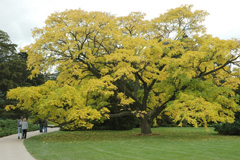
A view looking up into a magnificent yellow-leafed tree.

 “Autumn is a second spring when every leaf is a flower” – Albert Camus

As I write this, in the northern parts of our globe Nature is putting on one of its most spectacular displays – colorful fall foliage. As a child in Virginia, this was a magical time for me. The crisp air, the smell of burning leaf piles and fireplaces lighting up, the beauty of the trees, the excitement of all the Fall holidays – it was all just so exhilarating. Now that I live in the Sonoran Desert, I am hopelessly nostalgic at this time of year.

A line-up of similar trees with different colors.As the season heads toward winter, spurred on by shorter days, trees in cooler climates begin releasing hormones that cut off the chlorophyll to their leaves as they prepare to overwinter. The gorgeous colors in the leaves, which had been hidden by the chlorophyll up to this point, are made delightfully visible again. The chemicals that cause specific colors in leaves do the same thing for other plants. The carotene that makes carrots orange is also responsible for making certain tree leaves go orange. Anthocyanins turn leaves red, but cause fruits like blueberries and grapes to turn purple-blue. Evergreens keep their green on in winter due to their uniquely shaped needles, which are compact and watertight. If they do drop leaves it will be in the spring, when older leaves can turn yellow and fall off.

A view looking down on a road winding through a forest of multi-colored trees.
In the United States, the image of fall (a uniquely American way of saying autumn) foliage is dominated by images of New England. Undeniably awe-inspiring, the colors of fall are much more than a thing of beauty in New England – they are an economic boon to the area. After the lake-dwellers, beach-goers, boaters, and hikers have left, and before those states are hit hard by winter, there is a rush of tourism to see the trees. “Leaf-peeping” (as they call it up there) can bring in as much as three billion dollars a season. Not an insignificant amount.

A snow-covered mountain with a grove of Aspen trees in the foreground. Off Last Dollar Road in southern Colorado.
It’s the variety of deciduous trees here in North America that makes our viewing especially colorful. We have vast hardwood forests, which produce vivid and diverse displays of color. The colors of New England show all of them. But, the western US has some incredible displays as well, although there may not be as many varieties of tree species. The spectacularly photogenic aspen trees in their large groves, for instance, rival any New England vista for sheer magnificence. If you are interested in what colors are peaking where and when, this article can help. NASA also keeps track of fall colors.

A house by a green field on a fjord with colorful forests all around it. There is a boat moving on the water.
Spectacular autumn foliage is not only occurring in North America right now, of course. All across
Europe, they are being treated to their own version of this Nature’s gift. In Scandinavian countries, you can even see the Northern Lights after a day of viewing autumn leaves –a Nature double-feature for sure. Russia, with its immense tracts of forests, has leaf-peeping for days – literally – a trip across the country (Moscow to Vladivostok) by train takes 7 days. If you are brave and hardy enough, it will take you a minimum of 11 days to drive. In St. Petersburg, they call it Golden Autumn (a term attributed to the beloved poet Pushkin) and it looks amazing – see more on St. Petersburg here and other Russian Fall destinations here.

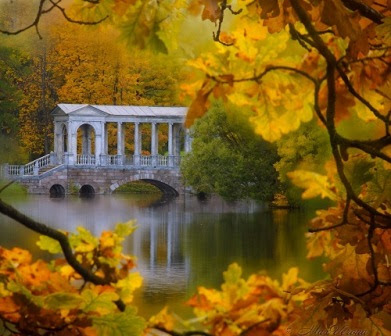
A white marble building by a lake in St. Petersburg, Russia
In the northern Far East Asian countries, the arrival of fall colors is holiday-time. China has many traditional and wildly popular Red Leaves Festivals that last the month of October. In the Sichuan province, the Red Leaves Festival at Guangwu Mountain is considered by many to be the most beautiful spot in China to see fall color (see a video here). Beijing also hosts visitors in the city itself and the surrounding countryside. The number of people who travel to see trees across China is staggering – tens of millions of visitors will come to just one site. According to Beijing Holiday, in one year 90 million people visited the Xiangshan Red Leaves Festival on the outskirts of Beijing.

Mist and red foliage around the Great Wall of China.

In Japan, the sublime pleasure of tree-watching is more than a seasonal pastime, it is a deeply-held cultural rite. In the spring, they gather to appreciate the spectacular flowering of cherry trees in an event called hanami (roughly “viewing the flowers”). In Autumn, it is koyo (the phenomenon of changing Autumn colors) and, more specifically, the glorious maple tree. References to and metaphors about this tree are deeply entrenched in the Japanese world. For instance, there are expressions like “Maple leaves and a deer”, which defines a good match (for more on all this, go here). The Japanese have also created a seasonal delicacy that dates back more than 1300 years - tempura-battered maple leaves (momiji tempura). They only use the yellow leaves, apparently the red just doesn’t work. Leaves are first pickled and then battered and deep-fried. I can honestly say this article makes them sound divine and I would definitely try one.

Deep-fried maple leaves with a white napkin underneath them in a grey bowl with chopsticks.While all this is going on in the northern half of the world, in the southern half it is spring going into summer. Autumn in those places goes from March into May. If you think of deserts and beaches when you think of Australia, you’re right. They have a lot of that. But they also have some majestic mountain ranges. The Dandenong Ranges, not far from Melbourne in the southern part of the country, are not the largest mountains in Australia, but they are appreciated for their display of colors. Their peak color season is March. Here is an article on that beautiful place and here is one on other places for leaf-peeping Aussie style. On another continent in the southern hemisphere, the Patagonia region of Argentina and Chile, draws foliage tourists from near and far. Their peak time is April. See some of that (including a video) here.

Leaves in all colors by Phil Barnett.

So, if you had the time, resources, and inclination, you could travel around the world enjoying autumnal foliage. You could go Down Under in March-April, visit southern South America in April-May, and then spend the summer months in the middle of the globe where the daylight stays mostly the same year-round and trees don’t change. Come September, you could head north and begin the leaf-peeping process in New England. It sounds like a wonderful way to live to me.A cartoon with 2 faces, one with sunglasses and one with a white beard. It says "Greetings from Red Leaf Forest. The hottest nature around".


Take Care.

Submitted by Pam                 


Friday, October 2, 2020

Did You Know? The Tree Edition


Trees with moss covered roots in a forest with a carpet of orange leaves. The Otzaretta Forest, Spain

We’re going to play a game called “Did You Know?” in which I try to dazzle you with some surprising, and hopefully new-to-you, facts. In this edition of the game, trees are the subject. Here we go:

DID YOU KNOW that trees didn’t exist for the first 90% of Earth’s history?

According to treehugger.com, the timeline goes like this: Earth is 4.5 billion years old – 470 million years ago plants arrived on land, but they were mosses and algae – 420 million years ago vascular plants appeared, but they were small (under 3 feet) – after that, tens of millions of years passed before trees as we know them developed. Making them downright modern in the big picture of Earth.

A tree in Indonesia with carved out burial chambers for children.
DID YOU KNOW that there’s a place where they bury babies in trees?

In Tana Toraja, Indonesia, babies who die before they start teething are lovingly placed in hollowed-out holes of special trees. These trees can hold dozens of babies. The belief is that the tree will absorb the child’s spirit and gently send it on its way. For more, check out this article

DID YOU KNOW that there are six ginkgo trees that survived the atomic blast at Hiroshima?

 There is also a pear tree that lived through 9/11 at the World Trade Center and an elm that survived the Oklahoma City bombing. In Japan, the trees have become potent symbols of national resilience and are greatly honored and protected. The pear and elm here in the US have also been protected; but, unfortunately, they do not seem to hold a place in their nation’s heart as the ginkgoes do.

DID YOU KNOW that the fastest-growing hardwood tree is the Empress Splendor Tree?

A beautiful Empress Splendor tree in bloom by a lake.
The Guinness Book of World Records has recognized this beautiful tree (Paulownia tomentosa) as the fastest growing hardwood. It can mature in 7-10 years, is fire and insect resistant, and prefers being raised organically. And, according to treehugger.com, it produces 3-4 times the oxygen than other known tree species. It seems like this non-invasive species could be the perfect tree. Read more here.

DID YOU KNOW that there is a 1360-acre forest in India planted by one man? 

In 1979, when he was just 16 years old, Jaday Molai Payeng came across some snakes that had died on a riverbed. They had become stranded and succumbed to extreme heat because there was no shade for them to cool in. The sight of those unfortunate creatures compelled him to do something about de-forestation in his area. He began planting bamboo and moved up to trees and has been planting ever since. His forest (known as the Molai forest) now holds more than trees – deer, tiger and rhinoceros roam there. Truly a story of how one person can change the world. See him in his forest here.

A sign pointing the way to the Tree of Life in the distance.
DID YOU KNOW that there is a 400-year-old tree in Baharain that’s alone out in the desert?

Known as the Tree of Life, locals will tell you this mesquite tree stands where the Garden of Eden once was. It is on a 25-foot hilltop (the highest point in Bahrain), far away from any other trees or any sources of water. Scientists say it gets its water from an incredibly deep (over 100 ft.) taproot and other extremely far-reaching roots; but others say it comes from Enki, the god of water. 

A Old Tree In A Courtyard-The Chapel of Allouville-Bellefosse
DID YOU KNOW that there's a chapel in an oak tree in France?

Some say this is the oldest tree in France, and it certainly is quite old – perhaps 1,000 years. In the late 1600’s it was struck by lightning and, taking that as a sign from God, they built a church in it. For more on its story, read this.

DID YOU KNOW that the rarest tree in the world lives on a remote island in the South Pacific?

This starts out as a sad story but ends on a high note: On the very small and very remote Manawatāwhi island off the coast of New Zealand, sits a wild tree that is the last of its kind– a kaikōmako. At one time, there were plenty of kaikōmako trees on the island; but, in 1889 some thoughtful-but-unaware people decided to put a colony of goats on the islands to serve as a food source for shipwreck survivors (apparently shipwrecks were common enough for this to make sense). The goats ate all the trees but one. The last one only survived because it lived on an inaccessible cliff 700 feet over the ocean. In the decades since then, conservationists have had a series of setbacks trying to figure out how to save this species. But now, with the help of the Maori, they have saplings planted with great hopes. Learn more here.

Close-up of the trunk of a Sandbox Tree
DID YOU KNOW that there is a tree with potentially deadly explosive fruit? 

Also known as the “Dynamite Tree”, the sandbox tree (Hua crepitans) is a member of the spurge family that can be found in tropical parts of Central and South America (and in south Florida). It has nasty-looking spikes all over the trunk and poisonous sap and fruit. But the real clincher is the seed pods of this tree – they look like mini pumpkins and explode loudly when mature, sending pieces flying out at the speed of a bullet. You do not want to be nearby when that thing goes off. Learn more and watch one blow here.

DID YOU KNOW that there are more trees on Earth than there are stars in our galaxy?

Scientists estimate there could be as many as 200-400 billion stars in our galaxy. That is still way below the estimated one trillion trees on our planet. I first got this factoid from a blog on tentree.com. I encourage you to check them out – they are a Canadian company that plants ten trees for every product sold. That is truly a noble mission worth supporting.

DID YOU KNOW that there are trees that grow sideways? 

Trees bent over from the wind. Slope Point, New Zealand.
There is seemingly no end to stories about the resilience of trees. These trees in Slope Point, New Zealand are the epitome of such determination. With nothing standing between them and Antarctica, they have to deal with relentless, fierce wind from that frozen place. They also sit on cliffs above the water, which creates even more of a “whoosh” as the wind comes over the lip of the land. So, they’ve adapted and grow sideways now. I don't know how the sheep stay standing. See more here.

DID YOU KNOW that there is a tree that loves red underwear and pot?

There are trees that are considered sacred all over the planet, and often people leave offerings by such trees. However, there is only one that prefers gifts of red male underwear and cannabis – the Ghost Tree in Bagahi Kumhapur, India. Why does this pipal (Ficus religiosa) need such things? Who knows? It’s just a party animal, I guess. See it (and some other way cool trees) here.

A grey tree with a cartoon face dancing while holding a beer and a cigarette.
Party Animal Tree


                    Take care out there.


                                            Submitted by Pam.

Wednesday, September 23, 2020

Trees - A Love Story

A heart-shaped silhouette in a tree at sunset.
We humans love our trees. Even those who would claim not to probably dreamed of a treehouse as a kid; or would enjoy swinging lazily in a hammock under a shade tree, or spending a cozy evening by the fire with the Christmas tree twinkling prettily in the corner. More than any other type of plant, trees are deeply intertwined with the human experience. Trees provide the air we breathe, of course, but they also provide goods, food, and shelter; they enable our dreams and creativity; they provide emotional and spiritual succor; they serve as entertainment and inspiration, and we arguably would not have thrived so spectacularly on this planet without them. Trees are really Man’s best friend (sorry dogs).

A magnificent Amur Cork tree next to a sidewalk with people on it.
The list of things that trees have done for humankind is probably endless (what we have done for them is decidedly shorter), but let’s just consider some products that we enjoy (aside from food; that’s a story for another day). The most basic, and the one used in most ways in most places, is wood. Wood for shelter, wood for transportation, wood for paper, wood for fencing – you get the idea. There are so many things that are tree-derived that we use regularly without appreciating their origin. They include: wine corks (so necessary in these trying times), dental floss, furniture and car wax, makeup, turpentine, latex (how could we fight COVID-19 without this?), charcoal, candy coatings, medicines, waterproof fabrics, tires, chocolate and more chocolate, deodorant, and maple syrup (the real, über delicious kind). One could write a book (and many have) of all the products we get from trees. I encourage you to look around and take notice of all they provide us.

A Native American Trail tree growing at an unusual angle.
 Humans have turned to trees to solve problems that nature has thrown at them since our prehistoric ancestors sheltered in trees. In modern times, indigenous people in the Meghalaya plateau of eastern India, create bridges from trees. In a mountainous region with deep ravines prone to extreme monsoonal flooding, reliable bridges are essential and these, made from the aerial roots of the Indian rubber tree, are strong and get even stronger as the trees grow over time. To see how they do this, check out this article. On this continent, some Native Americans used trees as markers to show the way to trails, burials, resources, or tribal lands. Young saplings were bent so that they would grow in a particular way that delivered a clear message to those that knew how to read them. To outsiders who did not know this language of trees, they seemed like any other tree, albeit a little quirky. Here is a man who has spent decades documenting these trees.

Viking Longships

Trees have also been the means by which people have been able to expand their resources and seek out better-living conditions. Take boats, for example: 10,000 years ago, someone used an ax to hack a canoe out of a Scotch pine tree. Known as the Pesse canoe, it is the oldest known boat and was found in the Netherlands. What were they after? Or what were they fleeing from? It’s an intriguing artifact. In the millennium since then, people have been taking to the water with help from trees. Ancient mariners traveled to Australia and throughout the Pacific islands. The Chinese built vessels during the Han dynasty (220 BC- 200 AD) and Romans built craft that enabled them to manage an expansive empire. The British were able to create an even larger empire, in part because they had plentiful forests to build their ships. And those ships ate up huge numbers of trees. Henry the VIII’s prized warship, the Mary Rose, required 600 oak trees to build in 1511. When you compare that to the 14 trees it took to build a Viking longship (also skilled sailors and colonizers), it is easy to see how the consumption of forest resources amped up over the centuries. As "new" lands and forests were populated (hello, America), the destruction of trees has continued unabated.

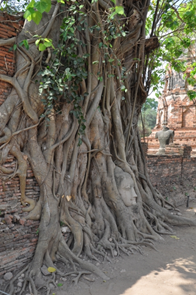
A sculpture of Buddha's head amongst the roots of a Bodhi tree.
Humans are experts at exploiting forest resources; things could be vastly different if we recognized the spiritual side of trees as eagerly as we do the economic advantage of them. It’s hard to understand why this is as trees play a role in every major (and most minor) religion. In the Old Testament of the Bible, there are 328 references to trees and, in Genesis, God created trees before Man. In the Quran, Muslims are instructed to plant trees, to treat them with respect, and to recognize their spiritual essence. In Buddhist tradition, the Buddha gained enlightenment under a Bodhi tree. In Christianity, think of how Jesus’ crucifixion and everything that sprang from that would not have happened without that wooden cross. Animist beliefs, the essence of most indigenous religions, directly assigns spirituality to trees. This can be seen in Madagascar, where the awe-inspiring Baobab tree is believed to hold the spirits of ancestors. Across all these beliefs there are special trees, ones that are said to be miracle-makers, hold supernatural powers or cosmic secrets. In a time of great human divisiveness, we are bonded together in a spiritual connection to trees, whether we acknowledge it or not.
Children playing at the feet of massive Baobab trees in Madagascar.
As I write this, trees are imperiled by bookend tragedies in the United States. Wildfires are decimating hundreds of thousands of acres in the Pacific Northwest and West and back-to-back hurricanes have sent untold thousands tumbling in southern states. Forest fires in Siberia have burned 42 million acres this year and the Amazon is burning. Given our close bond with trees, this devastation must be causing subliminal harm to the human psyche. Perhaps this (Covid-19 aside) is part of what is causing such angst in people. I fervently hope that people will become unhappy and uncomfortable enough to address the causes of such mass forest destruction and act to protect this glorious plant, in all its variations, that has meant so much to us.

A cartoon showing two arms coming out and hugging a tree.Stay tuned: my next few blogs will be about trees as well - there's just so much cool stuff to share!
Take care.
Submitted by Pam


Stay tuned: My next few blogs will be about trees as well - there's just so much cool stuff to share!


Take care.
Submitted by Pam

Wednesday, September 2, 2020

A Perfect Paring: Cannabis and IPM

A bud of cannabis at the bottom of a wine glassCurrent cannabis growing norms are ideal for practicing Integrated Pest Management (IPM). Whether they are motivated by the desire to grow healthy, clean plants, or purely by regulatory constraints, the end result is the need to minimize impacts on people and the environment. IPM begins with getting your soil or soil medium right and moves on to pest prediction, trapping and monitoring; using cultural, biological and (carefully vetted) chemical controls and, throughout it all, conscientious observation and record-keeping to plan for the future (for more on all this see our IPM page here). All of which works perfectly for a well-run grow.

A close-up of a cannabis bud - Photo by Avery Meeker on UnsplashA good portion of IPM practices are pretty straight forward and easy to initiate, even for beginners to the field. The biological controls part, however, can be daunting (if not downright confusing) even for seasoned growers. Here at ARBICO Organics, our mission is to guide growers towards these best practices and help them maintain smooth and efficient biological control using the proper beneficials for the job.

Any IPM program no matter the crop or growing style, works best when it’s started before you even touch a plant. Soil/soil mediums should be pathogen-free, yet full of microbial life, before any plants go into it. The introduction of beneficial nematodes and/or Stratiolaelaps scimitus (Hypoasis miles), for instance, can offer early, pro-active protection from a long list of insect pests. Hypoasis miles specifically preys on the dreaded fungus gnats. A little bit of pre-emptive treatment early on can save you financial and emotional hardship later.

The life stage of a cannabis plant - seed, seedling, vegetative, flowering and harvest.Another necessary step to be taken from the start is close monitoring of the grow environment. Not only to ensure that plants are in optimal growing conditions, but also to spot pests and pathogens as soon as they appear. Biological controls work best over time, so it is important to apply them at the first sign of trouble. This is often the stage where growers who are new to biological control falter. We have been conditioned to reach for a killing spray as soon as we see a bug, so there is sometimes a learning curve and a change in expectations that needs to happen. Instead of squishing the bug instantly, observe and identify it, discover where it came from, and determine if there is a population living in your plants. Armed with the specific knowledge of what you’re up against, you can move on to your
next step – choosing the beneficial to use - with confidence.

An indoor grow - Photo by Ryan Lange on UnsplashKnowing the pest you need to control is important, but when choosing the right beneficial agent for your specific needs your growing environment needs to play a role in your choice as well. Certain beneficial insects have specific temperatures and relative humidity requirements to perform their best, while for other insects the amount of light can affect their biological functions. Outdoor growers are restricted in their choices by their environment, whereas indoor growers have more options, including modifying their conditions to ensure that the beneficials thrive. There are some biologicals that can work indoors and out for most situations, but for optimal control, you’ll want the best beneficial for the specifics of your grow. This does not mean that the “all-purpose” biologicals are no good, only that they are but one part of a multi-tool IPM approach.

A man with a cap on examining cannabis plants- Photo by Terre Di Cannabis on UnsplashThere is a wealth of beneficial/predatory insects and organisms that work extremely well to control pests in cannabis cultivation. Some of these include predatory insects and mites, parasitic wasps, microorganisms, and the afore-mentioned beneficial nematodes. Amongst the predatory insects, there are generalists (non-selective) predators and specialist (targeted) predators. The generalists aren’t picky eaters and go after lots of different insects in various life stages. They include Assassin Bugs (Zelus renardii), Green Lacewings (Chrysoperla rufilabris), Minute Pirate Bugs (Orius insidious), and even Ladybugs (Hippodamia convergens). The specialist predators have specific dietary proclivities and either consume or parasitize particular prey. They include Mite Predators (Phytoseiulus persimilis), Aphid Wasps (Aphidius colemani), and the Fungus Gnat Predator Hypoasis miles that I mentioned earlier. Unless you have used beneficial insects before or you are a professional in the good-bug field, it is perfectly normal to not know what to choose. That’s what we are here for. Likewise, if you can't identify the insect plaguing your plants, take a picture of it and give us a call (our specialist will tell you where to send it). Armed with the picture and your input, it is usually very easy for our pros to figure out your problem.

Spider mites on a cannabis plant
Once you have determined which beneficial to use, it is essential that you treat with the right amounts at the right time and keep it up. Continuity and scheduling should be your mantra at this point. Most pest insects reproduce at an energetic pace; you will need to outpace that reproduction with scheduled applications of sufficient amounts of predatory insects. Additionally, some specialist insects require a lead time in order to receive them, so you will need to plan to cover that time frame. Using beneficial/predatory insects is very much like taking antibiotics – do not stop your treatment just because the condition seems better; it is essential to complete the prescribed course.

A German Shepherd dog with his tongue hanging out in a field of glittering cannabis.If you have questions (and why wouldn’t you?), I encourage you to dig into our website. A good place to start would be our Hemp/Cannabis page. We also have a Cannabis Catalog with products that have been hand-picked for the industry. We have worked hard to provide comprehensive content to inform and guide any visitors, and I feel confident that you can begin your road to IPM through our pages. But, for those of you who prefer a person-to-person exchange, our Bio-Control Specialists are also available for free consultations Monday-Friday from 8:00-4:30 pm. (we are on Mountain Time). Let them help you figure out what will work for you. For more on cannabis and IPM, you may also be interested in reading “5 Questions with Arianna Weisbly Taylor” in the July 2020 issue of Cannabis Business Times.

Take Care.
Submitted by Pam

Friday, August 21, 2020

The Black and White of Indoor Plants

Black and white translucent flower heads. Photo by Matthew Schwartz on Unsplash.
Some of us are very color-conscious and need to have the colors in our home match, or at least reside harmoniously together. So, why not incorporate your plants into your color scheme? The fun will be in the challenge to find and nurture the beauties that will be the perfect enhancement to your space. If you are a green-lover, congratulations – you have all the choices in the world. Reds, purples and other colors are also well represented. But for those that want something less run-of-the-mill, I’d like to offer some ideas and suggestions on the most basic of neutrals - black and white.

BLACK: Plants in this hue are highly in demand for trendy Goth Gardens. These outdoor gardens amp up the spooky factor with black plants or plants with ominous names or histories. They often contain decorative pieces that continue the dark theme (here is one celebrity’s cool Goth Garden). You may not want to go all Goth, but decorating with black plants can be an elegant way to add a time-honored neutral to your décor. When choosing a black plant, you should be aware that not all of them start or stay black and that many need specific conditions to maintain their color. Just do your research and pick carefully and you will be rewarded with beguiling black beauties.

A Zamioculcas Zamifolia Raven plant in an orange pot with a ceramic rabbit sitting next to it.
ZAMIOCULCAS ZAMIIFOLIA “RAVEN” - aka Raven ZZ. This plant is so easy to grow that some people claim it’s virtually impossible to kill. Be that as it may, this African native is definitely undemanding. It can survive quite well in very low light, really thrives when placed near direct sunlight, and is okay with irregular watering. Lighting does not affect the colors of this plant, the darkness of its glossy leaves increases over time from bright green to deep violet-black. Learn more here and watch a video here.
SINOCRASSULA YUNNANENIS aka Chinese Jade in a beige pot.
SINOCRASSULA YUNNANENIS – aka Chinese Jade.  This perennial rosette succulent originated in the Yunnan province of China. It grows up to 4” in diameter and has densely packed, very dark green (close to black) leaves. If possible, put this beauty in full sun - it likes the warmth and the light helps it keep its darkest shade. For more on how to get the most from your Chinese Jade, read this and watch this short video.

A close up of the dark leaves of a BLACK PATENT LEATHER COLEUS – aka Shiny Shoes BLACK PATENT LEATHER COLEUS – aka Shiny Shoes – Most people are familiar with the coleus as a houseplant, but this variety has a special look. A native of Southeast Asia, this upright plant grows to about 18” x 18” and does little to no flowering –it’s all about the leaves. They have a shiny, bubbly texture and ruffled edges and are all-together delightful. Unlike some black plants, this one holds its color in the shade. There are several varieties of black coleus, some of which are hard to come by; so, if the one you want is not available, give another one a try. They are all beautiful. Here is a helpful article on growing coleus indoors.
A OPHIOPOGON PLANISCAPUS “NIGRESCENS” – aka Black Mondo Grass plant in a beige pot. There are berries on it.

 OPHIOPOGON PLANISCAPUS “NIGRESCENS” – aka Black Mondo Grass, Black Lilyturf, Black Dragon, Ebony Night, and more. If you’d like a change from run-of-the-mill houseplants, this flashy perennial from Japan really brings the drama. Black Mondo Grass sports dense, slender and long (8”-12”) leaves that arch gracefully out in all directions. This plant has traditionally been used as a groundcover in landscaping, but there’s no reason it can’t move indoors (here’s more on that). You can enjoy its foliage year-round, its small pale-pink flowers in the summer, and its glossy berries in the fall.

A COLOCASIA ESCULENTA “BLACK MAGIC” – aka Black Elephant Ear in a black pot on a green surface.
COLOCASIA ESCULENTA “BLACK MAGIC” – aka Black Elephant Ear, Taro, Taro Black Magic, Elephant Ears Black Magic. This beast of a plant can grow 3-6’ tall and produce leaves as long as 2’. Plants in both the Alocasia and Colocasia families are known as Elephant Ears; one difference is that the leaves of the Alocasia point up and the leaves of the Colocasia hang down. Elephant Ears are popular houseplants for their dramatic look and this variety will not disappoint - it will produce abundant, gorgeous deep purple/black leaves. Keep in mind that this plant grows from a bulb and may go dormant in winter. For more on growing this plant indoors, check out this article and for some more quick info, watch this video.

WHITE: 
Attempting an all-white houseplant theme may be surprisingly challenging. The reason is pretty simple - most plants have green stems and/or foliage (at least at some stage). So, when searching for white plants, you will soon find yourself looking mostly at plants with white flowers. Of course, there are some exceptions (with Nature there always is); check out the White-stemmed Bramble (which looks more grey to me) and the Ghost Plant. With such a paucity of truly white plants, I’ve expanded my white selections below to include a couple of silver (again, some may call them grey) choices. As far as white-flowered plants go, I’ll leave it to you to sort through the many thousands to find the ones that suit you, should you go that route.

A close-up of the furry leaves of the SRACHYS BYZANTINA – aka Lamb’s Ear plant.
SRACHYS BYZANTINA – aka Lamb’s Ear – This pretty perennial has silvery leaves that are as soft and fuzzy as a lamb’s ear, and somewhat the same shape. These captivating leaves are what most people like about this plant, but in the summertime, it produces a tall flower spike with little purple blossoms that is equally interesting. Lamb’s Ear is usually used as a ground cover because it likes to spread, but it can be grown indoors if it’s given the proper conditions. Read more about how to grow this here.

A WHITE CALADIUM plant in a stand next to a blue chair.CALADIUMS– aka White Queen Caladium, Moonlight Caladium, Caladium Florida Moonlight, Angel Wings Caladium, and many more. These tropical perennials, with their elaborately mottled and almost translucent leaves, are real show-stoppers and with their nearly-endless varieties, there is something for every taste. Despite their huge popularity, these plants are not easy to keep healthy and are seasonal, so you will only get the foliage from spring to autumn. They grow from a tuber, however, so when winter approaches you can store the tubers and begin again the following spring. Here’s an article on how to grow them indoors and here's a video you may find interesting.
A HELICHRYSUM PETIOLARE – aka Licorice Plant in a black pot.
HELICHRYSUM PETIOLARE – aka Licorice Plant, Trailing Dusty Miller, Silver Bush. This is a small (9”-12”) perennial that prefers to grow out rather than up. The small, roundish leaves are plentiful and covered with soft grey hairs that shine with an iridescent glow. This plant is not the edible type of licorice, but it has a delicious fragrance nonetheless. There are several varieties of licorice with varying degrees of silver-shine; take your time and pick the one that is right for you. Here’s more on how to grow this in containers.


WHITE PAMPAS GRASS in a black pot with 2 ceramic owls sitting next to it.MONEY PLANT aka Lunaria Silver Dollar dried seed pods in a white vase.A fun option to add white to any room without bringing in a plant itself is to bring in some dried accent pieces. You could go with White Pampas Grass - it is absolutely stunning. However, it can grow very tall (10’-13’), so it's not practical for most indoor settings. But, if you have a place to grow it on the patio or in the yard, you could harvest and dry the plumes for indoor decorations. According to this article, White Pampas Grass is the newest Instagram craze. (Here is more on how to grow them in containers.) Another fabulous option is the Money Plant (aka Lunaria Silver Dollar), these biennials have beautiful magenta flowers, but they are coveted for their silvery, translucent, coin-shaped dried seed pods. You can enjoy all stages of this outside plant and then bring the pods indoors to add glamour to your fall and winter décor.

Morticia Adams from the Addams Family show cutting off white rose heads.I hope this gets you thinking about some of the endless possibilities of using plants as a basis for interior design and that you will find your way to your own uniquely beautiful decor.

Submitted by Pam

Thursday, August 13, 2020

10 Super Succulents and Cool Cacti

A figurine of the Marvel Comics character Groot standing next to cacti and succulents in brown pots.As part of the Plant Parenting craze that has surfaced in the last few years, succulents have seen a rise in popularity that is more of a tsunami than a surge. As a person who lives in and loves the Sonoran Desert, it pleases me to know that cacti and succulents are getting the appreciation and respect they deserve. On the other hand, as with many things that suddenly become popular, their very popularity can be devastating to them. Desert habitats may seem tough and durable (and in many ways they are), but they are also finely balanced and the flora that thrives in them can be quite delicate. They can be damaged irreparably by the smallest amount of foot traffic, not to mention rampant and/or random harvesting. Here are two excellent articles on the effects of the succulent/cactus trade: This one explains how all cacti are endangered and this one lists the succulents that are almost gone already. There are several plants on the following list that are endangered and/or rare. If you are interested in them or are actively collecting any cacti or succulents, always order from a reputable dealer and never purchase from unknown sources online or attempt to collect them yourself.

As an aside: If you are unsure as to the difference between cacti and succulents, this article explains it simply.
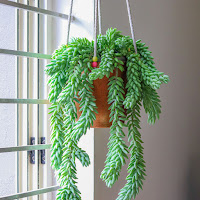
SEDUM MORGANIANUM hanging in front of a white-paned window.SEDUM MORGANIANUM – aka Burro’s Tail, Burrito, Donkey’s Tail, Lamb’s Tail, Horse’s Tail, Sedum Burrito. Originally from southern Mexico, this is a dramatic yet easy-to-grow succulent, with long, thick, trailing stems of overlapping grey-green leaves that look almost braided. This plant can get quite long (up to 4’) and heavy; it looks fantastic as a hanging plant, but make sure you have a strong enough pot and hanger. Here's more on their care and here's a video as well.

Close-up of the leaves and flowers of a CRASSULA UMBELLA CRASSULA UMBELLA – aka Crassula Wine Cups, Wine Cup Succulent. This unique succulent is native to South Africa. It has erect, smooth stems that end in leaves that are roundish and curved under around the edges to form an upside-down umbrella-like shape. Flowers will appear around an erect, inflorescence that pops out of the middle of the leaf. This lovely succulent is easy to grow but hard to find commercially, making it a desirable addition for any collection. Learn more here.

ESCOBARIA ABDITAESCOBARIA ABDITA – This cool-looking cactus was named after the Mexican naturalist Romulo Numa Escobar. It comes from a very dry basin in the Mexican state of Coahuila. In times of extreme drought, this plant can retract its stems and live partially (or even completely) underground. The unique spines that thickly crisscross the surface are white and look like spindles or flowers. The actual flowers are large and daisy-like and pop out from between the spines. This cactus is not easy to keep alive and thriving – it’s hard to duplicate the harshness of the environment it is accustomed to without actually killing it. But that does not mean it is impossible; here's more.

CONOPHYTUM BURGERI
CONOPHYTUM BURGERI – aka Burger’s Onion, Little Light Bulbs. This endangered South African plant is a simple, single-bodied succulent that can be green, white, strawberry-colored, vaguely purple, or some mix of each. It has a roundish, almost onion-like shape and a big ole purple and white flower that perches on top like a lady’s sun hat. It is reported that the flower smells like honey. The native habitat of this little gem is protected by the current owner – a mining company, no less. Read more about his cute little plant here and here’s a video on the always-important watering of this family of succulents.
A hanging PSEUDORHIPSALIS RAMULOSA
PSEUDORHIPSALIS RAMULOSA – aka Red Rhipsalis, Red Mistletoe Cactus. This stunning epiphytic cactus is native to rainforests in large parts of the Caribbean, Central America, and northern South America. The Red Mistletoe Cactus has long (up to 2’) stems full of flat, ribbon-like leaves. It starts out green, but bright sunlight will cause it to color up in shades from peach or light violet to a deep burgundy-red. Along the leaf edges, it will produce small white flowers that look like a trim of seed pearls. To learn more, read this and watch this short video.
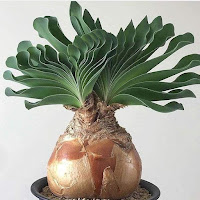

BOOPHONE HAEMANTHOIDES BOOPHONE HAEMANTHOIDES – aka Namaqua Century Plant, Cape Century Plant. This southern African native is unusual among succulents in that it does its active growing during winter months (because that’s when the rains come in its native land). The wavy, bluish-green leaves can get 15”-18” long and protrude from a massive (8+ inches) bulb. This bulb grows in layers like an onion and displays most of its bulk out of the ground. This plant will bloom, and the flowers are indeed beautiful and fragrant, but it is extremely slow to flower. This is because Boophone Haemanthoides is a long-living plant, with some bulbs living as long as 100 years in the wild, so it can easily take as much as 8-10 years for them to reach their blooming stage. Luckily, the foliage of this neat plant is so entertaining you may not care if it ever flowers. More on the intriguing plant here and watch a woman talk about her first bloom from one here.
XEROSICYOS DANGUYI in a white pot

XEROSICYOS DANGUYI – aka Silver Dollar Vine, Silver Dollar Plant, Dollar Vine, Penny Plant, String of Coins. This fast-growing vine from Madagascar is actually a member of the Cucurbitaceae family, which makes it a relative of the cucumber. This succulent is nearly all tendrils, which have thick, coin-shaped leaves at intervals along their length. In mid-to-late spring, you can expect tiny, four-petaled pale yellowy-green flowers. The arms of this succulent can get quite long (20” or so) and will spread nicely along a windowsill or tabletop - or allow it to make a statement as a hanging plant. Watch this video and/or read this for more information.


EUPHORBIA TIRUCALLI EUPHORBIA TIRUCALLI – aka Pencil Cactus, Sticks on Fire, Milk Bush, Firesticks, Firestick Plant, Indian Tree Purge, Naked Lady. Think you have the chops for a “dangerous” plant? And the space for a large indoor tree? If so, this succulent may be for you. Euphorbia Tirucalli hails from the warmest climes of Africa and India, where it can grow up to 30 feet. Grown indoors, it can achieve six feet and, at certain times of the year, it glows in shades of orange, yellow, and pink. Its danger lies in its milky-white sap. The sap carries toxins that, for most people, are not a huge concern. But for some people, it can cause severe, even anaphylactic, reactions. And everyone should take precautions to keep it away from their eyes. If you take proper safety measures when handling and don’t have children or pets to worry about, this gorgeous plant could be a stunning addition to your collection. For more on the inherent risks in keeping this succulent, read this article. For general information on this plant, check out this article and video.

CRESTED SENECIO VITALIS - it looks like a mermaid's tail coming out of a white pot filled with blue stones.CRESTED SENECIO VITALIS – aka Mermaid Tails, Whale’s Tail, Blue Chalk Fingers, Blue Chalksticks, Narrow-Leaf Chalk Sticks. Here is another terrific South African succulent and this one gives off some serious under-the-sea vibes. The particular shaping of these specimens is caused when they crest, meaning they stop producing stems and branches and, instead, flatten out and grow out wild shapes on top. This process is natural and may only last a few years, at which time they can begin to take one another more “normal” shape, These look really cool in a pot, but keep in mind that they can grow 3-5’ wide 2’ tall. You can grow them outside in some areas, but they’ll need to be watched as they can turn invasive in certain environments. Watch this video to see how to trim one and read this article for more information overall.

A close-up of anAEONIUM ARBOREUM ZWARTKOPT
AEONIUM ARBOREUM ZWARTKOPT – aka Black Rose, Black Rose Aeonium, Black Tree Aeonium, Black Beauty. Are you ready to add some unusual color to your collection? This exotic succulent has its roots in the Canary Islands and its delightful deep-burgundy, almost-black-looking leaves are a real treat. There is a caveat, however: these beauties need plenty of direct light – about 6 hours a day. This preference for sunbathing (they’re from the Canary Islands, after all) allows them to maintain their gorgeous coloring. Without it, they will fade to an ordinary green. They also can get pretty big (4’ high and 2’ wide), which is something else to take into consideration for an indoor plant. As a patio plant, they would do well. Once you get their space and light requirements down, they require little attention. See more here and read more here.

A cartoon of a cat popping out of a pot surrounded by cacti and other plants.An essential component to growing any of these plants successfully is to have the right soil. We offer a really terrific one from a company right here in Tucson, where we know our cacti and succulents. Check it out here. And for all you cactus lovers, here is a way to safely adorn yourself with our iconic Saguaro Cactus.

Stay cool out there.
Submitted by Pam

Featured Post

5 Simple Ways To Celebrate The Summer Solstice

The summer solstice will make its yearly appearance on Sunday, June 21, 2026. It is the longest day of the year and considered by many to be...